UNVEILING THE FOLK DANCE IDENTITY OF CARL NIELSEN'S CLARINET CONCERTO OPUS 57: A FYNSKE MODERNIST STORYTELLING
(2022)
author(s): Ettore Cauvin
published in: Codarts
Carl Nielsen's Clarinet Concerto Opus 57 is a work of a problematic nature for both performers and audiences, who always find it difficult to understand its rich yet intricate content. Despite copious written material, many interpretations are unfortunately significantly misleading because of the extreme technical difficulty of the music and the lack of information about the composer’s identity, especially concerning his production for clarinet and the distinct role of the instrument in Nielsen's life.
My research shows that the composer's roots, the development of his production and the uniqueness of Danish folklore and related dances uncover narrative levels which are fundamental to a correct reading, not only of this work but of Nielsen's music in general.
This study aims to create a multidisciplinary performance that combines the original score with dance and storytelling to enhance its peculiar characteristics, such as the bipolarity of characters and the intrinsic reminiscence of elements of Danish folklore within specific sections. Based on an extensive critical literature review and a fruitful expert consultation, I made analyses, charts and transcriptions, attaching explanatory video recordings as the basis of my work.
Thanks to my field research trip to Denmark, I started designing a new performance combining the folk-related investigation and the extra-musical elements linked to Nielsen’s identity, to both the musical interpretation and imaginative dance performance to show the bipolarity of characters as well as portray the inner storytelling.
The goal of my research here is not to demonstrate Carl Nielsen’s compositional willingness but to establish relations which can help the performer and the audience to connect the music to its vital folk heritage, extraordinary customised spirit and distinctiveness in both dance and storytelling.
The artistic result is, in fact, a new hybrid performance of the work which portrays the complex music more consciously and innovatively, combining an informed musical approach with an imaginative choreography and active interplay between the contrasting manic episodes and the homeward feeling of the heartening sections, letting the audience partake in the musical narration.
Despite the complex construction and demanding realisation of this kind of creative approach, I firmly believe that the result of this research makes an essential contribution to the understanding and interpretation not only of this work but of the music and identity of Carl Nielsen and the Danish musical tradition for the world of classical music and beyond.
Further research is needed to shed light on the relations between classical and folk music, within performing arts in general, to strengthen their essential role in today's society to make what is usually considered a niche more accessible to the public by exploiting its unique characteristics for a more sustainable artistic and social usefulness.
Seeding Actions
(2022)
author(s): Polina Golovátina-Mora, Sunniva Skjøstad Hovde, Tone Pernille Østern
connected to: Norwegian University of Science and Technology
published in: RUUKKU - Studies in Artistic Research
The exposition shares the collaborative multispecies journey and addresses the issue of art, art-based research and of art-based research publishing. The three processes are seeing as intra-activity between multiple species, materials, media. It does not have a goal as destination but is driven by curiosity and care for and with each other. This ever-expanding becoming creates ever new world and possibilities and so the new knowing-being. The exposition is a map that combines different tracing and it is up to the reader to follow any direction they prefer at the moment.
Biopoéticas: convergencias artísticas interespecie
(2022)
author(s): ANA LAURA CANTERA
published in: Journal for Artistic Research
Español
En la propuesta se reflexiona sobre las implicancias de concebir obras artísticas en conjunto con seres vivientes no-humanxs y las problemáticas y particularidades que esto conlleva. Asimismo, se propone la terminología de biopoética como alternativa nominal al concepto antropocéntrico y problemático del bioarte desde una concepción más locativa y contextual. Se pretende visualizar las metodologías y los accionares de la materia viva desde el arte contemporáneo latinoamericano y repensar tanto las prácticas como los modos de exhibición.
English
The proposal reflects on the implications of conceiving artistic works in conjunction with non-human living beings, as well as the problems and particularities that this entails. It proposes the biopoetics terminology as a nominal alternative to the anthropocentric and problematic concept of bioart from a more locative and contextual conception. It is intended to visualize methodologies and actions of living matter from contemporary Latin American art rethinking both practices and modes of exhibition.

Performing the ecstasis: An interpretation of Katharine Norman’s Making Place for instrument/s and electronics
(2022)
author(s): Jean Penny
published in: Journal for Artistic Research
Katharine Normans’ work Making Place for instrument/s with live electronics (2013/16) combines recorded sounds, images, text, live interactive processing and instrumental music performance to create a unique experience of place. As the performer, I can choose a location, collect photographic images and recorded sounds, and interpret and re-create the score. The score is semi-improvisatory, consisting of many composed and freely pitched musical gestures which trigger text, visual animations and sound processing. This exposition traces the re-conceptualization, adaptation and performance of Making Place for alto flute. A multi-layered experimental methodology evolved that encompassed practice, discussion, description and reflection, with the performance itself forming the pivotal event, the epoché. To begin I share pre-performance thoughts – ideas of re-conceptualization and the construction of method. I follow with an account of pre-performance activities – the walk, collecting materials, transposing the music for alto flute, inserting new artefacts into the software, and rehearsals. Next come descriptions of the performance, and finally, I offer a reflective conclusion to the project. This project illuminated the quotidian through sound, image and text, transforming the everydayness of a walk along a disused railway track, turned walking/cycling track, in Victoria, Australia, into an extraordinary musical work, creating a shift from a knowing about to a knowing from within, from playing and doing to reflective awareness.
The application of creative practice as a means of disrupting or re-defining the dynamics of power in, with or for different communities.
(2022)
author(s): Sabrin Hasbun, Gareth Osborne, Rachel Carney, Julika Gittner, Catherine Cartwright, agnes villette, Harry Matthews
published in: Journal for Artistic Research
In this exposition, seven research practitioners investigate how creative practice can be applied as a form of knowledge production in order to disrupt or re-define the dynamics of power in a range of different contexts. These applications of creative practice take varied and complex forms, often transferring creativity from the practitioner-researcher to their participants, increasing participant agency or re-defining existing hierarchies, as they form, empower, and enlighten real and conceptual communities. This collaborative exposition has been developed through presentations and discussions over the course of two years. Although each researcher applies different methodologies to their individual projects, our work as a group followed a pattern of creative practice, reflection, and reformulation, as we responded to each other’s research, creating a research community of our own. We want to emphasize that creative practice can not only disrupt or re-define the dynamics of power in a range of different contexts, but that it can do this in an infinite number of ways. In this variety and adaptability lies the potential of creative research.
Little Do They Know
(2022)
author(s): Olivia Rowland
published in: Journal for Artistic Research
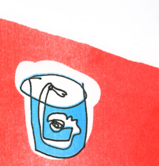
This exposition functions as both a visual and poetic essay, and a manifesto for my methodology of ‘line’. My definition of ‘line’, defined here as:
‘The gestural and abstracting tandem force of drawing-and-writing as a narrative means to express selfhood.’
The exposition posits the methodology of ‘line’ as one alternate artistic means to artistically communicate feminine selfhood. The methodology of line works to resist the internalised assignment of feminine voice to a corporeal body.
Instead, ‘line’ communicates selfhood through poetic means and a sense of fragmented corporeality. Visually, the stark and abstracting nature of the drawn line, and the allegorical, metaphorical nature of writing present an abstracted self that playfully evades full understanding.
The titling phrase ‘Little Do They Know’ intones a kind of secret power on behalf of the speaker, and the presence of secret and intricate worlds to which the gaze of the spectator has limited access. It is on this premise which the exposition operates, articulating the presence (in all its anxiety, instability, rage, joy and frustration) of a playful and evasive selfhood that reclaims agency from the spectator’s gaze.