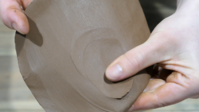
Subtle Ground: Feeling our ways towards a supportive method in ceramic practice
(2022)
author(s): Priska Falin, Helen Felcey
connected to: Aalto University
published in: Journal for Artistic Research
This exposition focuses on the exploration and development of Subtle Ground, a method that directs attention during and through making with clay, in the context of creative practices in ceramics. The method takes a non-conventional approach to making; it focuses on being with the material instead of pursuing a conclusion in the creative process. The method directs the practitioner to follow aesthetic qualities in making understood from a pragmatist view on having an experience. In this exposition, the focus is on the author's collaborative work that has shaped the Subtle Ground method, particularly the workshop ‘Sensorial Ground’. In Subtle Ground, the idea of dwelling is emphasized offering the specific approach to making. The method consists of a series of exercises that direct attention towards subtle sense perception within the body. Through working with the Subtle Ground method, we suggest that it is possible to begin to understand the embodied dimension and how it influences creative practice. The Subtle Ground method has been built on the clay’s supportive qualities, bringing together sense perception and physicality, thus understanding the practice’s aesthetic qualities and connections to meditation.
Experiments in Aural Attention: Listening Away & Lingering Longer
(2022)
author(s): Rebecca Collins
published in: Journal for Artistic Research
This exposition puts forward ‘lingering longer’ and ‘listening away’ as potential means to remain with non-semantic possibilities, resisting the tendency to know immediately or to classify — to get lost, albeit momentarily in a more messy moment of being. At stake in this investigation is the recognition that our experience of the world, characterized through a depth of engagement, is not limited to how relations operate on the surface. The direction or orientation of our attention, the intensity with which it is applied, and how it weighs on and shapes our experience implies choice and agency.
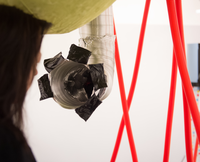
Experiment I: Aural + Orientation = Aurientation emulates the experience of a fictional gallery-goer who encounters the sound installation, This is for You (Don’t Treat it like a Telephone) (2012). This piece was developed at the advanced centre for performance and scenography studies (a.pass) in Brussels and aims to consider how sound and the voice shape our orientation, when mediated through objects. Experiment in Aural Attention II: Vibrant Practice details the process undergone for creating Listening to Water (2013), a site-specific investigation into ancient well sites located in Powys and Ceredigion, two counties in Mid West Wales. The work, made in collaboration with Jane Lloyd-Francis and Naomi Heath, considers how a turn towards site, via a process of tuning in to the Welsh landscape, can bring attention to overlooked aspects of our environment.
Pandemic performance: A Haunting of Haunts
(2022)
author(s): Garrett Lynch IRL
published in: Journal for Artistic Research
During the COVID-19 pandemic that started in 2020, galleries, theatres, and performance venues closed in accordance with social distancing, lockdown, and confinement policies. Art practice, and in particular performance art, faced an existential crisis: adapt its form or cease to exist for audiences. To adapt, performance art adopted video on the internet as a means through which to perform posing immense challenges to its understanding of performance, liveness, and what is considered physical or ‘real’. As a response, I started to create a body of work employing the methodology of practice as research (PaR) during periods of confinement of the pandemic.
Titled A Haunting of Haunts (2020–ongoing), the practice is designed to be situated within networks and is therefore classified as networked performance. The practice aims to enable artists to create performance under conditions of social distancing, lockdown, and confinement, to explore the idea of transposing performance from ‘real’ spaces to ‘virtual’ spaces, and to critique video as the dominant and largely accepted visual form employed in networked performance. This exposition proposes that while A Haunting of Haunts facilitates practice and assists in the development of a visual language specific to networks that consists of what are termed as networked images, thereby contributing to networked performance as a field of practice, it also highlights the hauntological condition of such a practice.
The communication intent in 'matéria disponível’ (‘available matter')
(2022)
author(s): rosinda casais
connected to: i2ADS - Research Institute in Art, Design and Society
published in: RUUKKU - Studies in Artistic Research
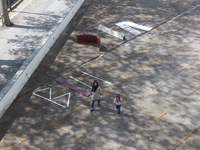
This article is based on the personal work 'matéria disponível’ (2020) by Rosinda Casais and proposes to analyse the importance of communication-driven art in its different stages. This work emerged from the objective to explore the outdoor space as a space to communicate, during the period of the first lock-down (social distancing) due to CoVID-19, from march to june 2020. Crossing this period, she and her 5 years old daughter used the debris that remained in the courtyard of the building, where both live, and started communicating through objects with the neighbours.
From the intention to interact with the other, this artwork fulfils itself, broadens and questions the communicative nature of the objects and the artistic practice as well.
Concepts, along with the capacity of the objects to change the atmosphere of a place and the common/individual memories, were developed during this work towards a sense of communication from/to it and is discussed here.
Strategian sisäistäminen
(2022)
author(s): Mia Seppälä
published in: RUUKKU - Studies in Artistic Research
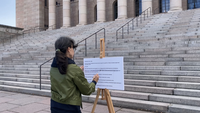
Tämä ekspositio asetettaa yksittäisen taiteellisen teon laajempaan julkiseen keskusteluun yliopistopolitiikan rakenteellisen kehittämisen synnyttämien ajatuksien liepeiltä. Eksposition keskeinen elementti on videoperformanssi ”Internalizing The Strategy”, joka tapahtuu kaikille avoimessa julkisessa paikassa - Eduskuntatalon edessä.
Strategia tulee vastaan mitä moninaisimmissa yhteyksissä. Tuntuu siltä, että kaikilla pitää olla oma strategiansa. Kunnat, yritykset, urheiluseurat, päiväkodit, korkeakoulut esittävät kilvan omia strategioitaan, mutta miten on strategian sisäistämisen laita? Yliopistojen strategioissa painotetaan maailman muutoksen mukanaan tuomiin vaatimuksiin reagoimista, johon yliopistoilla on korkeatasoista osaamista tuottavina instituutioina mahdollisuus ja suoranainen velvollisuus. Muutoksesta tuotetaan mielikuvia, jotka esitetään sekä pelottavina uhkakuvina, että mahdollisuuksia tarjoavina positiivisina kehityskulkuina. Asiantuntijakielen tarkoituksena on saada tietyt valinnat tuntumaan tarpeellisilta ja hyödyllisiltä. Tähän kieleen on upotettu tietty edistymisen vaatimus ja lupaus, jota on vaikea vastustaa.
Ekspositio pyrkii havainnollistamaan ja koettelemaan strategian sisäistämista taiteellisin keinoin, joka on suhteessa vaatimusten absurdiin luonteeseen.
Menetelmänä käytetään tekijän itse kehittelemää "poismaalaamisen" tekniikkaa, jonka lähtökohtana on digitaalisen valokuvan tai tekstin siirtäminen painomenetelmillä maalauspohjalle. Valittu kuva tai teksti liittyy olemassa oleviin rakenteisiin, formaatteihin ja vakiintuneisiin ajattelu- ja menettelytapoihin. Poismaalaamisessa tehdään näkyväksi merkityksen häilyvyys - teksti/kuva on ihmisen mielikuvien rakentama. Se on purettavissa ja uudelleen tulkittavissa. Kuvan rakentaminen tapahtuu strategiatekstin poistamisen kautta. Poistamisen on määrä virittää useita rinnakkaisia tulkintamahdollisuuksia, jotka liittyvät esimerkiksi tekstin/kuvan pysyvyyteen, kirjoittamisen, poispyyhkimisen ja päällekirjoittamisen suhteeseen sekä Taideyliopiston strategian osalta säädösten valta-asemaan.
GRAPHIC NOVEL CLANDESTINE JOURNAL
(2022)
author(s): ANARTIST
published in: RUUKKU - Studies in Artistic Research
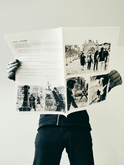
The article describes, with a self-ethnographic position, the limit and potentiality of an "art of subjectivity" carried out by an a-modal "stranger" thrown into a foreigner country with abstract rationalist features that obstacle the immanent becoming(s) and repress the excess of a practice of interventions that is necessary to shape an uncoded "ethico-aesthetic territory". In this context of extinction the writer of the article, who is also the protagonist of the described art practice, presents the necessity of a new clandestine media for his art research publishing. After a brief outline of a Deleuzian theory of the media, he reveals and presents his project that consists of a "graphic novel clandestine journal". This "graphic novel style form" suits well to his practice of disruptive interventions in public space and the character-avatar "Anartist", which is the mask performed by the writer in its critical urban interventions. The "author" writes that our hyper-capitalist reality is already a form of dystopian graphic novel. For this reason the portrait of his action as a "graphic novel" is a form of realism and an aesthetic strategy to deal with it.