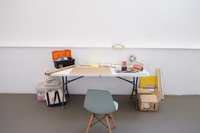
Configuring the artist residency as a thinking, making, showing space
(2022)
author(s): Alira Callaghan
published in: RUUKKU - Studies in Artistic Research
This exposition presents the format of an artist residency as a temporary, intense period of development that can exist between a studio and a gallery with the potential to be a semi-private/semi-public alternative to making creative research public. In this sense, the residency becomes a space for thinking, making, and showing art. In my practice-led doctoral research I identified the importance of this alternative site of engagement for focussing on the process (more so than outcomes) of artistic research.
Lyssna till ASIA/ÄRENDE och UniZona & PolyZona
(2022)
author(s): Vanja Hamidi Isacson
published in: Stockholm University of the Arts (SKH)
Welcome to the exhibition "Listening to ASIA/ÄRENDE: Kaarle Vihtori Turunen and UniZona & PolyZona".
This exposition is linked to the thesis "The potential of multilingualism in dramatic works", which is available both as a printed copy and digitally as a PDF. The thesis consists of eight chapters and a prologue and epilogue. Chapters three to seven contain audio files that are available to listen to in this exposition.
The exposition consists of audio files and text excerpts from the two multilingual works ASIA/ÄRENDE and UniZona & PolyZona by Vanja Hamidi Isacson.
The audio files and excerpts from the works relate to specific chapters of the thesis, where these examples are discussed and analysed.
The thesis in its digital form can be read and downloaded in the exposition "The potential of multilingualism in dramatic works"
For those who visit the exposition without reading the thesis, it is recommended to go through the pages via the chronological order of the table of contents.
White/acoustic infrastructure: a crucial tool for the transition to an environmentally sustainable future in urban areas: The case of Paris La Defense, a modern district in dissonance
(2022)
author(s): Sara El Samman
published in: Research Catalogue
The national lockdown due to COVID-19 abruptly cut down on human activity in cities, and enabled urban dwellers to notice nature’s comeback through birdsong: It has shown that today’s urban environment is in acoustic imbalance.
My research aims to provide an overview on how soundscapes fit into the landscape design process, and to explore the notion of white/sonic infrastructure in order to give a tangible tool for landscape architects to read landscapes with their ears and design acoustically sensible places for all living beings. Sound informs the design process not simply by reducing unwanted noise but by encouraging a sound-considered city design approach. This adopted strategy would entail the extraction and reinterpretation of sonic cues as blueprints for the reshaping of the space and the transformation of the soundscape experience for users and nature alike.
The paper applies all of its findings on Paris La Defense, the biggest business district in Europe, who’s current morphology, within the ring of noise that is the “Boulevard circulaire”, dissociates it from its territory creating acoustic and physical discontinuities.
A study of the flows that animate the site along with its morphology helped me extract the multiple sonotopes (sonic biotopes) that shape the acoustic space of the district. Sound maps were created and a white infrastructure strategy was furthermore developed.
The article develops an elaborate method that could help translate a soundscape vision into concrete landscape design actions and proposes an approach to sonic continuities on large and local scales.
White infrastructure affords the additional dimension necessary to conceive the landscape and to create space for the non-human, for the human, and for the dialogue between them. The notion of eco-acoustic design contributes to shaping a non-anthropocentric city that is considerate of all living things and therefore is crucial to designing ecological urban ecosystems.

Case-Specific Electroacoustic Systems
(2022)
author(s): Alejandro Montes de Oca
published in: University of the Arts Helsinki
This composition-based project of artistic research introduces the term Case-Specific Electroacoustic Systems to describe a set of electric, digital, and acoustic devices that are interconnected in a particular way to embody a specific sound work. The artistic research states that when the sound composition process occurs in tandem with the electroacoustic system configuration and design process, a particular creative practice is engendered. The main research questions are how the development of such a system becomes another parameter of sound creation, and how this influences the artistic ideas and process elaborated around a specific sound work. In the course of the doctoral trajectory five new sound works were created and presented, thus forming the artistic portfolio of this doctoral project. Each work included the composition, design, and creation of a case-specific electroacoustic system. An introduction to the concept of Case-Specific Electroacoustic Systems, its contextualisation, and an analysis of the artistic practice and the outcomes of each of the five artworks are presented in this written thesis. The complete scope of this doctoral project, including the media material of the artistic portfolio and this artistic doctoral thesis, is contained within the exposition Case-Specific Electroacoustic Systems, published and archived in the Research Catalogue online database.
Hair, Materiality and immanence
(2022)
author(s): Gunilla Pettersson Thafvelin
published in: Stockholm University of the Arts (SKH)
A research on materiality and human hair as material. Can a material on itself create narratives and if so, because of its immanent qualities? What constitutes that presumed immanence?

Prototyping Situations: Interdisciplinary Free Improvisation in Technology Development and Latour’s Mode of the Technical
(2022)
author(s): Dominik Schlienger
published in: Research Catalogue
Interdisciplinary improvisation provides an innovative tool for technology development, based on the principle of prototyping the situation of a problem and letting the solution develop from within that situation. This stands in a contrast to the conventional paradigm by which technological prototypes are presented as solutions which then are tested as to their suitability, in hindsight. A participatory design practice which resulted in the development of spatial interactive technology for sonic arts provides a case study for this method. In focusing on the situation, rather than a (proposed) solution, technology is contingent on practice. This resounds with the description of the technical mode of existence the French philosopher Bruno Latour gives in An Enquiry into the Modes of Existence: According to Latour, the technical does not show itself directly as an object and is not directly experienceable. On that premise, the implications for technology development are intriguing: The fact that the technical is mostly only noticed when it is not working, needs to be considered in development methodology – evaluation has to become the main phase of development.