We Would Strike!: Beyond Representation in a Post-Industrial Town.
(2022)
author(s): Arturo Delgado Pereira
published in: VIS - Nordic Journal for Artistic Research
On 30 July 1984, 11 mercury miners locked down in the mines of Almadén (Ciudad Real, southern Spain) to protest against their precarious economic and social conditions. 650 metres deep inside the oldest and most productive mercury mines in world history, the miners endured the dark and contaminated galleries for 11 days and nights until their claims were addressed. As an emigrated local filmmaker, I come back to post-industrial Almadén in 2019 to make a documentary film about the mining strike. The premise is to find young locals willing to live inside the now-closed mines for 11 whole days in homage to the older miners and to recreate the experience of 1984, 35 years later. Apart from engaging our collective mining past, performing the form and duration of a previous workers strike, Encierro proposes the underground as a living and symbolic space to foster a series of conversations, encounters, and social and political propositions to reimagine Almadén, which rose from a mine shaft more than 2000 years ago, as ‘something else besides’ a mining town.
This exposition explores the potential of documentary film fieldwork to take on a different relationship to normal life that the same or similar events would have as ‘untransformed reality’ – a strike versus the reenactment of a strike – and its potential for activism and social transformation. I will also explore the use of the conditional tense in documentary; a speculative and hypothetical approach to reality sensitive to the ‘potentially’ real, the ‘possible’, and the ‘what if’ as modes of documentation. What happens when the forms of ‘documentary’ and ‘reenactment’ are exceeded, and act upon the world rather than only represent it?
The Sonified Textiles within the Text(il)ura Performance: Cross-cultural Tangible Interfaces as Phenomenological Artifacts
(2022)
author(s): Paola Torres Núñez del Prado
published in: VIS - Nordic Journal for Artistic Research
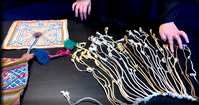
This research is working with Sonified Textile Controllers. They can be described as textile sensor-based tangible interfaces. Some of them are part of a disruptive sound performance – an experimental sound art concert that has been presented in various cities in Europe and the Americas called "Text(il)ura"[1]. The three fiber-based controllers presented as part of this performance, The Shipibo Conibo-Style Textile, The Hanap Pacha Quipu, and the Unkuña of Noise, all reference the cultures of Paola Torres Nunez del Prado’s country of origin, Perú. These textile artifacts are works of art as well as devices that fall within the scope of smart textiles and that of human-computer interaction, as they allow the user to experiment with alternative ways of approaching the execution of sound art or electronic music. Referring to both aesthetically and symbolically distinct forms of expression from diverse human communities, these cross-cultural devices are characteristically hybrid and ever-changing: history, myth, craft and technology, gender, transhumanism, sound, visuals and tactility – everything is intertwined in an amalgamation of human knowledges and experiences aiming for a type of universality that does not impose one thought system over the other. The design of the interfaces proposes a different approach to tactile manipulation of electronic sound instruments, where it is common to find controllers made of metal or plastic, and where the aural and tactile sensitivity with which they are first made, transforms the performance itself. The Sonified Textiles aim to redefine musical interfaces, both conceptually and design-wise within the e-textile realm. The research uses a phenomenological framework to go beyond the mind-body dualism and to reconnect with the natural world.
Composing Together and Not Together - Intimacy as a Condition for Collaboration
(2022)
author(s): Josh Spear
published in: Norwegian Academy of Music
Collaborative creative processes within the realm of Western Art Music are usually hidden and/or not actually collaborative at all. Vera John-Steiner (2000) defines ‘integrative collaboration’ as a working situation in which roles merge and a shared ideology and vision emerge through dialogue.
This artistic research project investigates to what extent intimacy is a condition for collaboration and what it means within music-making. Intimacy is newly defined as the play of affective, physical and emotional borders between people where our own sense of ourselves can be shaped.
By considering collaborative working as a compositional tool, intimacy becomes something that can be encouraged, indeed collaborative skills can be practiced. Through a variety of music-making projects in which I am project lead, composer and/or performer or composer-performer, I devise strategies for handing over power to my colleagues and harnessing their creativity such that they become co-creators rather than just interpreters. I investigate different approaches to intimacy within the domains of music and theatre. I also reflect on my own development as a collaborator and attempt to create a set of principles for successful collaborative working.
A set of advantages to adopting a devised process have emerged and a new focus on the long-term potential of a group or partnership changes the context for collaboration. Understanding that a creative partnership is a tree and artistic products are the fruits of that tree has caused me to understand collaboration as multimodal, beyond the score, and made clear the options for the choices of values within collaboration.
Fluxos entre dança, poesia, perfume e composição musical.
(2022)
author(s): Patrícia Garcia Leal, Ezequias Oliveira Lira
published in: Research Catalogue
O presente diálogo expositivo propõe uma apreciação reflexiva imagética-poética-performática-sonora focalizando duas composições musicais específicas: “Eixo” e “Quando em ar”, enfatizando as transversalidades de linguagem entre música, dança, poesia e perfume. A exposição foi sendo construída aos poucos, mês a mês, pelas necessidades evocadas pelo diálogo. A proposta expositiva propõe uma linguagem sintética em camadas, aproximando-se do comportamento dos acordes em perfumes. Aos poucos, as notas vão se revelando, mas trazem de saída, muitas informações, em pouco tempo, que vão abrindo em combinações mais profundas e sutis. A vivência da exposição deve permitir, assim, ao leitor, a experiência sensível, ora do diálogo entre compositora/cantora e violonista, ora da apreciação das imagens, ora do fluxo dos poemas, ora da escuta das canções, da absorção pelo vídeo. O processo performático da leitura é proposto como conteúdo expositivo. Desde que foram criadas, as canções em foco, vem encontrando mobilidades, tessituras, versões... A exposição enfatiza o processo e a interação sensível entre texto, imagens, sons e perfumes.

Playing in the Manner of Ricardo Viñes
(2022)
author(s): Håkon Magnar Skogstad
connected to: Norwegian University of Science and Technology
published in: Research Catalogue
Playing in the Manner of Ricardo Viñes is an artistic research project undertaken at the Norwegian University of Science and Technology (NTNU) for the degree of Philosophiae Doctor (PhD) in Artistic Research. The project’s reflection work takes the form of an exposition, which includes texts, videos, annotated scores and the artistic results.
In this artistic research project, Håkon Magnar Skogstad uses an extreme form of imitation to embody and recreate the historical recordings of Catalan-Spanish pianist Ricardo Viñes (1875-1943) with the aim of evoking a romantic performance tradition in classical music. Ricardo Viñes was one of the leading pianists in Paris around 1900 and premiered several compositions, including a substantial part of the piano works of Claude Debussy and Maurice Ravel. In his recordings, we hear a tradition of romantic performance practice, which Skogstad claims is not heard in modern-day performances. Furthermore, Ricardo Viñes’s close relationship to the works of Debussy and his recorded performances have the potential to challenge performance practice norms in impressionistic music.
By analyzing, studying and recreating the historical recordings of Ricardo Viñes, Skogstad sets out to research, experience and through this to gain an understanding of of Viñes's playing style on a fundamental level as a performing artist. The method of recreating recordings is carried out by imitating and playing alongside the originals to the point where the recreated performances can be superimposed onto the original historical recordings – achieving a sort of artistic “synchronization”. Skogstad believes that by committing to such extreme imitation, it is possible to extract unique artistic knowledge from these old recordings. In order to examine the performance practice in context, the playing style of Ricardo Viñes is compared to selected and equally thoroughly recreated recordings by contemporaneous pianists Sergei Rachmaninov, Ignacy Friedman and Jesús María Sanromá. Finally, four recordings of pieces by Claude Debussy played by Ricardo Viñes are recreated with the purpose of examining the influence of Viñes’s playing style in the music of Debussy.
In the film Playing in the Manner of Ricardo Viñes, which is one of the artistic results of the research, Skogstad records five of Ricardo Viñes’s original recordings in a “historical recording environment”, approaching that which Viñes encountered in 1930. The aim of this is for Skogstad to expose himself to a similar recording environment to what Viñes experienced – including recording one-off takes without any possibility of editing. The performances are rough, imperfect and on-the-fly - played in a “high-risk” manner just like Viñes's – in contrast to the perfectionism of music production standards today.
Håkon Magnar Skogstad (b.1989) is a prize-awarded diverse pianist and composer holding degrees in classical performance from Trondheim (NTNU, Department of Music), Oslo (Norwegian Academy of Music) and New York (Manhattan School of Music). He has performed in ensembles and as a soloist throughout Norway and played concerts in the U.S., Argentina, Germany, Austria and Sweden. Skogstad released three recordings with critically acclaimed ensembles in Norway, as well as his debut solo album Two Hands to Tango and Visions of Tango, featuring his original Concerto for Piano and String Orchestra with Atle Sponberg and the Trondheim Soloists. Both albums have received numerous outstanding reviews and the latter was nominated in the Norwegian Grammy Awards for best classical album.
Flower Clock
(2022)
author(s): Christina Stadlbauer
published in: Research Catalogue
The art work is inspired by the concept of the flower clock by Carl Linnaeus, renowned 18th century botanist from Sweden.
The installation “Who will pollinate the Flower Clock” that was exhibited in 2021 features a selection of endemic plants arranged in an outdoor installation. The piece is an invitation to decelerate, and tune into plant-time.
How do plants know time? How do they attune to rhythms of day and night? How slow do they open and close their petals? How long do they blossom so that insects can visit them?