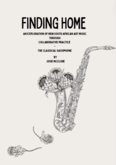
Finding Home: An Exploration of South African Art Music through the Classical Saxophone and Collaborative Practice
(2024)
author(s): Josie Mc Clure
published in: KC Research Portal
This research project explores South African Art Music through collaborative practice and the classical saxophone. It begins by investigating the discourse surrounding South African Art Music through testimony collected from various conversations with South African composers, musicians and academics such as Dr Kevin Volans, Dr Antoni Schonken, Professor Hendrik Hofmeyr, Dr Cara Stacey and Arthur Feder. I began collecting the scores of South African saxophone compositions which led to the development of an online catalogue system to document these works -The South African Saxophone Catalogue. This catalogue forms the base - as well as the network - for how this research was developed.
To further investigate the South African repertoire, I embarked on creative journeys with four South African composers through performer-composer collaboration. I decided to use this means of investigation as the relationship formed between myself and these composers shows a different level of engagement with this music, first-hand experience in the creation of this music as well as creating an open space for discourse. These collaborations were documented through reflections, audio and video recordings and are investigated in the form of case studies. The final artistic product was a concert featuring these new compositions in Cape Town, South Africa.
The data collected was organised through an amalgamation of critical reflection and thematic analysis.
Through this collective music-making, I discovered the variety in thought surrounding South African Art Music and paradoxically those who vigorously deny this term. I discovered the complexity both politically and socially that the term South African Art Music implies. In conjunction with my personal reflections, this exposition explores the ideas, opinions and art of individuals in various fields in the South African classical music scene who represent a variety of South African cultural backgrounds and generations.

Spring at Geassemahjohka
(2024)
author(s): Maarit Mäkelä, Priska Falin
published in: Research Catalogue
The video is part of artistic research that explores a dialogue between human, non-human, and forces of the land in Utsjoki, Finland. In this artistic research, walking is used as a method to connect with the environment. During the walks, small amounts of soil – sand, stones, and clay – is gathered and processed further in a studio. Some soil is transformed to slips and used when painting hand-built vases made from the gathered clay. The fired vases are placed temporarily in local rivers. The result is a series of three vase experiments done in a dialogue between human, soil, water, and the forces of the land.
The video presents the third vase experiment, where the vase is built from the local clay. The motifs of the painting are the nationally endangered animals: arctic fox, fell owl and glacial salmon. In the River Teno catchment, small juvenile salmon often spend some of their first years of life in tiny tributaries, which they enter from their birth place, the spawning areas in the main stem of the river. One of these nursery streams being Geassemahjohka. The vase is positioned in Geassemahjohka, which is running to the main stem of the River Teno some 70 km upstream from the estuary. Via the experiment we speculate: can act of crafting vase be conceived as act of caring, the vase being thus a symbolic shelter for the salmon?
Engaging the Audience: a Matter beyond Music?
(2024)
author(s): Gustavo Abela Cruz
published in: KC Research Portal
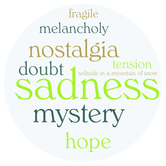
Despite knowing that music and emotions have a lot to do with each other, sometimes it is hard to articulate which relationship they have. Since the emotional impact seems to be one of the biggest appeals for an audience, do we, the musicians (specifically the performers), pay and draw enough attention to it? After reviewing the relevant literature about the processing of emotions, I came across the philosophical approaches of emotions in and through music by Peter Kivy, Jerrold Levinson, and Stephen Davies, proposals that could serve as inspirations for an audience and for performers.
Then, I decided to carry out a series of experimental sessions to test the impact of these three approaches, as well as the performer's role, and components that could also affect a performance, such as set-ups, musical manipulations, or what I have called 'extramusical' items or elements. In addition to my research question “How can a performer affect or manipulate the emotional engagement of an audience?”, I sought to explore another inquiry. Is engaging more with the public nowadays strictly a musical matter?

The Relevance of Point of Audition in Television Sound: Rethinking a Problematic Term
(2024)
author(s): Svein Høier
connected to: Norwegian University of Science and Technology
published in: Journal of Sonic Studies
There are good reasons to consider point of audition (POA) as a problematic term when writing about sound. This essay addresses the different challenges one meets when using the term and discusses different alternatives for future use of this terminology within the field of television sound. The motivation for rethinking the term is the analytical and descriptive problems raised when writing about recent trends in television sound in drama, sports, news, documentaries and other television genres. The argumentation refers to the flexible and creative uses of television sound today and discusses how various production examples can be better accounted for by refining the term point of audition. All in all, four categories of point of audition are suggested for analysis: observational, active, individual and personal POAs.
Cloak of Longing - Dr Mikey Georgeson
(2024)
author(s): Konfessor Kimey Peckpo
published in: Research Catalogue
The Cloak of Longing has been involved in conference keynote, public and university pastoral occasions. At the heart of my research practice is a desire to liberate capacities of expressivity via a processual use intuitive material vitality. This contingent radical empiricism regards the communication model's need for pre-given therefore-ness as potentially occluding of capacities to work with matter flow – a characteristic of a cosmos of nonhuman agency inside which a performative intra-relational understanding emerges.
Silenced Womb
(2024)
author(s): Petra Kroon
published in: Royal Academy of Art, The Hague
Thesis of the Royal Academy of Art, The Hague, 2022
Master Photography & Society
In Silenced Womb Petra Kroon ( @fotosvanpetrakroon) examines the age-old taboo on menopause. What does it mean to be systematically silenced for centuries? What effect does it have on how you are represented? How you are treated? And how do you behave? She explores these questions from three perspectives: the medical world, society and photography. She investigates what this in/visibility looks like and analyses what it does to her and to her allies. Since she wants to lift this taboo on menopause, she also makes some suggestions for a different representation.