Rules for the Rigorous
(2023)
author(s): Anna Nygren
published in: Research Catalogue
This project is part of the bigger project "Autistiskt skrivande. Ett modersmål / Autistic Writing. A Mother Tongue", funded by Vetenskapsrådet. The bigger project aims to investigate neuroqueer, and specifically autistic ways of using language. Melanie Yergeau use the term "neuroqueer" to point to the "sidling, desiring, idealizing" aspects of being of a neurofunction set apart from the neurotypical norm. This article is a collaborative piece of writing, created as a poetic research method in how rhetorics are used to inform and create oppressive as well as empowering games of language. Julia Miele Rodas calls it an Autistic Poetics, a way of living with words that exceeds the communicative aspect and leaks into the a(u/r)tistic mind. This text was written as a letter correspondence, a love act, and a curious performance. It is based in a neuromixed research environment and investigates the poetic mode of writing as a platform for further understanding.
About the autors:
Hanna Bertilsdotter Rosqvist is an Associate Professor in Sociology and currently a Senior Lecturer in Social work at Södertörn University. Their research is primary oriented towards disability, but also on gender, sexuality and space
Elisabeth Hjorth is an author, essayist and Senior Lecturer in Literary Composition at Gothenburg University. Their latest publication was Mutant (Glänta, 2021)
Anna Nygren is an author, dramaturgue and Lecturer in Literary Composition at Gothenburg University. Their latest publication was Fuck Your Marsvin And Dö (Poesiwerken, 2021)
[text]uring: writing through fashion for a new literacies dissertation
(2023)
author(s): Rachel Kaminski Sanders
published in: Journal for Artistic Research
The term 'literacy' encompasses reading and writing practices, each with distinct meanings and histories. Scholars define individuals as 'literate' or 'illiterate' based on these practices, a point not to be taken lightly. New literacies studies have expanded literacy from print to encompass all forms of meaning-making, leading to an expansion of associated terminology. In American higher education, despite the expanded meanings of terms like 'writing' and 'text,' the term 'research' remains dominated by written language, even within dedicated disciplines (Coiro et al. 2008; New London Group 1996; Wilber 2008).
Through a cultural studies perspective, I traced the historical evolution of American literacy to the present day. The study revealed darker consequences of literacy's past, providing insights for scholars to understand silenced voices and advocate for their inclusion in the future. Given the ever-expanding practices of literacy, the need for increased attention to writing instruction, and the problematic otherness of arts-based disciplines such as fashion, my goal is to broaden the range of accepted scholarly compositions in higher education. I believe this pursuit is key to the advancement of academic research publications.
To address this paradox, I actively embraced new literacy practices by creating a dissertation supported by Barone & Eisner’s (2012) concept of arts based research. Drawing on my experiences in the industry, I sought to challenge views of fashion as frivolous by writing my dissertation in the language of dress, offering a new perspective on the interwovenness of literacy and fashion. My dissertation argues that fashion is a form of writing by exploring nonverbal communication in scholarly work. This move reconciled the perceived frivolity with the substantive nature of fashion and ignited my commitment to the acceptance of research in diverse language forms.
TroublingGAN: generated visual ambiguity as a speculative alternative to photojournalism
(2023)
author(s): Lenka Hamosova, Pavol Rusnák
published in: Journal for Artistic Research
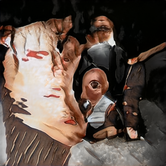
This exposition documents artistic research that engages with generative neural networks and artificial intelligence-driven visual synthesis, the goal being to challenge the limits of the research and question the value of the generated visual outcomes. We present here our experiment with a customised StyleGAN model. In contrast to its utilisation by computer scientists, it has been trained on a heterogeneous dataset, voluntarily exposing the generative neural network to failure while focusing on the unexpected moments of surprise that arise from such a process. Led by the critical thoughts of The Nooscope Manifested (Pasquinelli and Joler 2020), this experiment questions what kind of knowledge generative neural networks produce, whether they could change one’s perspective on studied objects (the dataset) and whether they could function as a viable tool for artistic research. The observed object in this project is the concept of ‘troubling times’ (inspired by ‘Designing in Troubling Times’, the theme of the 2021 Uroboros Festival) — rapid socio-ecological changes caused by shifts in global economic, political and technological power and the subsequent series of troubling events, including the COVID-19 pandemic, violent conflicts and environmental catastrophes. StyleGAN is used as a pattern-recognition and knowledge-production tool to create an intuitive understanding of what this ambiguous term ‘troubling times’ actually means today. During the experimentation process, multiple unforeseen moments and twists happened, offering valuable insights into the nature of synthetic media, generating ethical questions concerning the use of generative neural networks and spawning new propositions for further research.
The Making of 'Commotion'
(2023)
author(s): Sara Pinheiro
connected to: Academy of Performing Arts in Prague
published in: Journal for Artistic Research
“Commotion” is a fixed media multichannel composition that revolved around the principles of minimalist music. This exposition aims at understanding these principles while it tries to place the process of composing the piece within the common premises of artistic research. Due to the nature of its context, this approach includes also theories of reception - mostly by exploring themes such as intentionality, interpretation and representation. With this exposition, the author shares technical terminology of sound practices, in order to promote it in contexts predominantly visual-oriented.
Running Freight on the River. A Clean Cargo Prefiguration
(2023)
author(s): Tim Boykett, Tina Auer
published in: Journal for Artistic Research
We are interested in exploring the types of futures that are preferable for us all. Discussions of preferable futures can be made difficult by a lack of understanding of the lived experience of that possible future. We like to think that some wise person once said: “I hear futures and I forget. I see futures and I remember. I do futures and I understand.” In order to explore scenarios of possible futures, we thus look into experiential modalities.
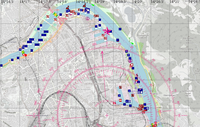
This exposition examines our Danube Clean Cargo project. The prefigurative process imagined what small scale localised transport could be like and attempted to run a pilot scheme. Reporting on that, merging the quantitative, qualitative and experiential aspects of the project, we present some resulting insights and imaginations. The project leaves us with speculations and visions drawn out by the process of prefiguration. It also leaves us with questions around heterotopic instantiations, queered economics and the everyday to be pondered as artistic research. This helps us reflect on the process of imagination and speculation, on dreams of various freedoms and the harsh realities of logistics chains.
The exposition develops ideas in both internal and external reflective modes. The exposition is oriented along a chart of the Danube river for the region of interest. Along the south bank of the Danube the project and its internal reflections are arrayed as episodic text fragments, leading up to a short vision that echoes older stories of sailing cargo barges. Along the north bank a more external reflection is positioned, bringing the project and its understandings into context with a collection of previous developments and external references. The entire exposition is arranged as a single page paper nautical chart, which in contrast to a digital chart plotter, always displays all of the information and does not hide features.
This exposition is part of Curiouser and Curiouser, cried Alice: Rebuilding Janus from Cassandra and Pollyanna (CCA), an art-based research project from Design Investigations (ID2) at the University of Applied Arts Vienna and Time's Up. It is supported by the Programme for Arts-based Research (PEEK) from the Austrian Science Fund (FWF): AR561.
Performing with Sonic Tools. An approach to designing and analysing new instruments
(2023)
author(s): Gaute Barlindhaug
published in: Journal for Artistic Research
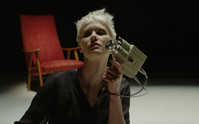
In recent decades, digital technology has accelerated the development of new musical instruments, not only establishing new techniques for creating sound but also enabling new performance practices. From the perspective of the performer, this has significantly broadened their possibility to express themselves, but through earlier experimentations it has become clear to me that audiences have problem comprehend such use of new musical instruments. In a traditional setting, when an artist performs with an instrument the audience can build on their cumulative experience and knowledge to evaluate the skill of an artist. With new experimental instruments such a strategy to understand a performance is not possible. This text describes my work with the dance performance Sound of Silence, and the creation of a device called the Looping Camera. Base on previous experience from using sensor technology in musical performances combined with theories and about the listeners position, we tried find a new approach to the creation of new sound producing devises that could overcome earlier problems with audience comprehension. With our work we tried to create a device that, even if it was largely unfamiliar for the audience, could establish a sense of meaning for the audience by including references to non-musical media technology. This performance also resulted in the developing of an analytical concept, that of “sonic tools”, that is meant to draw attention to the aesthetics of new an unfamiliar instrument through liberating such tools from the dichotomy of musical vs- nonmusical sounds.