The Phantom Carriage
(2023)
author(s): Dan Lageryd
published in: Stockholm University of the Arts (SKH)
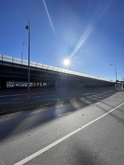
The Phantom Carriage is a practice-based research project in which an 8-channel sound recording from Essingeleden / E4an is played with 8 speakers deployed along national road 52 in Katrineholm.
About displacement. The sound of movement, the movement of sound, the emotional movement the experience of art can imply. About noise and its impact on us and the surroundings. About future nostalgia, how will the future sound, what will the roaring diesel truck sound like in the future?
The title The Phantom Carriage (Körkarlen in Swedish) is borrowed from the film by Victor Sjöström. The choice of title also opens up other aspects of the work / project.
Making it my own
(2023)
author(s): Mikael Charlie Bäckman
published in: Research Catalogue
Abstract
In the audio paper which forms the center piece of this exposition I have examined the idiolect of country harmonica player Charlie McCoy. In order to gain a multifarious understanding of McCoy’s idiolect I have made transcriptions of his recordings and interviewed McCoy himself and two other prominent harmonica players. With the aim of obtaining a more refined engagement with the performance, I have sought to embody McCoy’s playing by learning to play my transcriptions. The paper shows the prominent features of McCoy’s idiolect and how he created his idiolect while negotiating the affordances of the diatonic harmonica. The paper also shows how I am using transcriptions of his recordings with the intent of transforming my own artistic voice.
Keywords: Harmonica, Charlie McCoy, Idiolect, Voice, Affordances, Country music
Designing Agency
(2023)
author(s): Johanna Drucker
published in: HUB - Journal of Research in Art, Design and Society
As AI systems proliferate, questions about their emergent capacities focus on intelligence, sentience, and control. But the issue of agency, the capacity for action with consequences, brings other design issues into play. Agency takes many forms including mechanical, incidental, probabilistic, and intentional, but is largely assessed on the basis of behaviors. The challenge of designing agency can be met by considering what must be programmed into a system to provide it with the capacity for action, but the distinction between the appearance of agency (simulacral) and actual agency (intentional) is difficult to test. This paper discusses some of the connections between agency and debates in physics about determinism and probability as they relate to the question of human capacities for intentional action and concludes with a discussion of the difficulties of conceptualizing agency without falling into Romantic models of disruptive behavior. No easy answers arise in regard to the problem of designing intentional agency in a way that can be either tested or constrained.
Explorations with an Ash Tree
(2023)
author(s): Annette Arlander
published in: HUB - Journal of Research in Art, Design and Society
In this essay I describe one example of working with a tree (an ash tree on the former post quay on Eckerö Island) and suggest that such artistic methods, like performing with a tree repeatedly or addressing a tree in writing as a performance for camera, serve as useful tools to generate material to reflect upon later. The heightened perceptual awareness and the intensity of the moment of performance helps in articulating observations and ideas that might not have come to the fore in other circumstances.
The sea as a site of curation: Reflections on aesthetics education
(2023)
author(s): John Baldacchino
published in: HUB - Journal of Research in Art, Design and Society
With the sea as a “site” of curation, a thalassic approach (as that which belongs to the sea), facilitates a showing of those things that converge upon the contingency of daily living. The case for aesthetics is pedagogical, inasmuch as it provides us with a strategy for exiting into the wider world as we move outside the walls of a building (and that of Bildung). Exiting also implies rejecting all those institutionalized constraints that education’s edificial approach brings to learning. Here, in its aporetic nature, art is one of those few human actions which allow us to articulate and enact a sense of being both strangers and homecomers in our own world. In other words, this is a form of curation that is claimed through the autonomy that it portends.
Porous Worlds – the Liminal Spaces of Relief
(2023)
author(s): Pauliina Pöllänen
published in: Faculty of Fine Art, Music and Design, University of Bergen
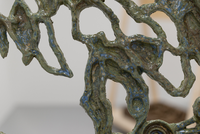
Porous Worlds – the Liminal Spaces of Relief was carried out as an artistic research PhD project in affiliation with The Art Academy, Faculty of Fine Art, Music and Design at the University of Bergen. The project examines the relief, its connections to art, craft, architecture, and ornament, as well as its various dimensions as an artistic medium.
It has been the relief´s in-between status and the lack of contemporary art discourse around it that has informed the questions like: what is at stake working with relief form today? What kind of artistic potential and possibilities does ceramic relief have to offer?