EXPERIÊNCIA SENSORIAL DIRECIONADA: Sons do Buriti, Escutar, Sentir e Criar
(2025)
author(s): Eunice Maria de Oliveira
published in: Research Catalogue
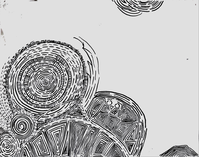
Esta pesquisa propõe uma instalação com foco em aprofundar uma experiência sensorial, para despertar a sensibilidade das pessoas, em São Bernardo/MA, no Balneário Rio Buriti. São abordados elementos da escuta sensível e consciente, como forma de valorização dos sons naturais e culturais do local. Para a execução da prática, realizamos algumas etapas, como: determinar local, dia e o horário da atividade; elaboração de um mapa mental contendo todas as ideias; retomada da leitura do mapa mental com novas impressões individuais, pessoais, subjetivas, objetivas; decidir sobre a ação em si. Nos desdobramentos desta ação, que envolve escutar, sentir e criar, observamos que a paisagem sonora, termo criado por Schafer (2009), possui todos os componentes para a criação e sensibilização das pessoas em relação aos seus próprios territórios. O autor demonstra sua preocupação com a qualidade da escuta, que está cada vez mais ameaçada pelo problema da poluição sonora, por isso a necessidade de que a população tenha consciência dos sons que nos rodeiam.
From Dust to Dusts
(2025)
author(s): Hudec Adam
published in: Academy of Fine Arts Vienna
From Dust to Dusts is a richly illustrated exploration of air’s hidden materiality and the plural worlds of dust. Drawing from the interdisciplinary practice of the Vienna based Dusts Institute, the book reveals dusts as more than residue: they are carriers of histories, markers of transformation, and agents of connection across geographies, species, and time.
Blending artistic research, environmental science, architecture, and public engagement, the publication traces projects such as the Dusts Catcher Kit, Dusts-Free Chamber, Biopatina Workshop, and the large-scale Airsight Deck installation. These interventions make the invisible visible while capturing airborne particles, revealing microbial ecologies on building façades, and transforming air into a perceptible, participatory medium.
Essays and visual documentation unpack the Institute’s concept of “dustsing”: a methodology of sensing, collecting, and activating dusts to challenge assumptions about cleanliness, permanence, and environmental stewardship. Moving from microscopic particulate matter to planetary airflows, the book examines dusts as both pollutants and ecological contributors, revealing their role in climate systems, biodiversity, and urban atmospheres.
A call for attunement and care, From Dust to Dusts invites readers to rethink air not as empty space but as a shared, contested, and dynamic commons, one that is continuously inscribed by the smallest particles we live among.
Grain: Mediator Between East and West
(2025)
author(s): Kateryna Tykhonenko
published in: Research Catalogue
"Grain: Mediator Between East and West" is an image-led, cross-temporal exploration of bread wheat as both a commodity and a metaphor. Drawing on its historical and practical ubiquity as a staple grain in agrarian (Eastern) Europe, wheat emerges as the focal medium through which cultural and geopolitical narratives are revealed. What narratives does bread wheat carry, and what is entangled within localised perspectives? To what extent does the cultural history of grain intersect with modern grain infrastructures, whereby wheat transforms from an elemental medium into a mediator between East and West? Through thinking with and about grain, this work interrogates the gaps, overlaps and resonances between East and West, the post-war Soviet 1940s and the present day, repositioning wheat as a cultural mediator.
This Master's project was conducted within the European Media Studies program at the University of Potsdam and University of Applied Sciences Potsdam, August 2025.
It’s Natural (and Other Frictions)
(2025)
author(s): Cecilia Carvalhal Braga de Andrade
published in: Research Catalogue
This exposition explores how performance-based artistic research can expose the constructedness of gender identity by placing the body in tension with resistant materials and wearable prosthetics. Working with spray foam insulation as both sculptural surface and choreographic partner, I investigated how its artificiality, rigidity, and eventual fracture could function as metaphors for the instability of normative embodiment. What began as a struggle to inhabit a rigid foam body evolved into experiments with prosthetic extensions, where the material was reimagined as a collaborator that displaced gestures, layered images, and generated hybrid presences. Drawing on Judith Butler’s theory of performativity, drag performance practices, Hélio Oiticica’s parangolés, and Rebecca Horn’s prosthetic sculptures, the research stages a dialogue between body, material, and viewer. Documentation through video and photography further expanded the work, creating layered choreographies where prosthetics multiplied into digital traces. In this process, the foam bodies became what Lauren Elkin calls “art monsters”: excessive, disruptive forms that refuse coherence, insisting instead on incompleteness, transformation, and the possibility of imagining bodies otherwise.
Splickshh
(2025)
author(s): Luca Carlevarino
published in: Research Catalogue
Splickshh è un innaffiatoio per tastiere. Una provocazione tangibile, un prodotto speculativo che mette in discussione il ruolo stesso della tecnologia.
Ci invita a ripensare la tastiera non più come interfaccia di scrittura ma come spazio botanico, in ottica di un'economia più circolare.
Welke digitale middelen kunnen ingezet worden om aan te zetten tot actieve muziekbeleving?
(2025)
author(s): Raf Brouns
published in: Research Catalogue
Met de komst van teamteach op verschillende scholen en de vernieuwde eindtermen, is kunsteducatie in de 1ste graad van het secundair onderwijs geweldig achteruit gegaan. Dit is een aanname die
meerdere van mijn vakcollega's delen. Dit weet ik vanuit informele gesprekken. De vakspecialist kan
zijn vak niet meer geven met de passie en beleving zoals men dat gewend is. Deze verdwijnt zelfs op
een aantal scholen en wordt dan vervangen door leerkrachten zonder kunstachtergrond. Dit is
bijvoorbeeld bij ons op school gebeurt.
Om dit gebrek aan kennis op te vangen, vraag ik me af of we dit gat niet kunnen verkleinen door gebruik te maken van digitale middelen en zo de muziekleerkrachten toch hun stem kunnen laten behouden in de klas. Ook al zou deze virtueel zijn.
Let op: ik wil zeker niet de vakleerkracht vervangen door digitale middelen. Ik blijf van mening dat we
vakspecialisten voor de klas nodig hebben!