The Research Catalogue (RC) is a non-commercial, collaboration and publishing platform for artistic research provided by the
Society for Artistic Research. The RC is free to use for artists and
researchers. It
serves also as a backbone for teaching purposes, student assessment, peer review workflows and research funding administration. It strives to be
an open space for experimentation and exchange.
recent activities <>
Glass Cities : Venice Revisited
(2026)
Zoe Panagiota (aka Betty) Nigianni

The exposition includes reworked video excerpt from the 'Glass Cities' two hour-long video art installation, with film footage and photography from three different cities, London, Athens and Venice. The original work was created for Elica's live music performance, shown at the Small Music Theatre, Athens, Greece, in 2007.
The aim of the process of making the video art was to remain and explore the surface of things when addressing historical changes. I used banal and seemingly unconnected photographic and digital film footage for this purpose and effect. The 'lure' is the film still: neither photograph, nor film, a notion that has been inadequately theorised in visual art history and theory.
Following a historical materialist approach, I employ the artistic theme of dead cities. Venice is a dead city in the visual arts modernist tradition. A dead city is a city that fails to change. Venice is actually slowly sinking, because it can't manage the rising water levels. In this context, I briefly trace Venice's economic history of the flourishing academic arts in the Baroque period, its Murano glass industry evocative of the ancient arts and crafts, and its inevitable re-invigoration by virtue of the Venice Biennale, the well-known international art and architectural exhibition.
I named the original video art after John Smith's experimental documentary about London 'Slow Glass' (1988-91). In the film, one of the narrators describes the liquid composition of glass - "even when it's hard, it's still a liquid" - which is a metaphor for the process of change.
Since I made the video installation, but also this exposition, I found out that my ancestor, a great grandfather, who was originally from Italy, might have been an Italian Jew and that this might have been the reason he left Italy in the nineteenth century to travel to and settle in my native Greece. Because the exposition is about collective history and collective consciousness, the research video could be taken as a reminder of the factual, global rise of antisemitism in the twenty-first century; in Italy represented by the extreme right-wing, neofascist political group Forza Nuova. The country that has seen the most prominent rise in antisemitic ideology is the United States of America.
Can Philosophy Exist?
(2026)
Zoe Panagiota (aka Betty) Nigianni
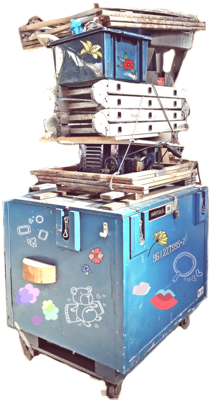
Photography with sound and net art, drawing, found folk sculpture with digital drawing, readymades, 2012, 2020, 2021. Accompanied by archival material.
The exposition exposes the question of what is artistic research. Usurping the mini-essayist format, which is traditionally associated with research in say the area of philosophy, the exposition formally operates on different levels. I selectively included visual art research material from my own artistic archive, as well as anonymous material that's readily available from the internet and in film archives. In this way, I wanted to emphasise the role of archiving and using archives in the artistic process, as an element of artistic research and artistic production that might involve remediation. Taking that we live in a largely theoretic culture, which means that we use external information systems for storage and retrieval of written, visual and other material, the implication is that art is part of this theoretical system.
Moreover, I specifically problematise the notion of value in relation to the visual arts by using the popular media figures of the counterfeit and the impostor, with reference to the so-called "impostor syndrome", correlated with being a minority of some sort in one's field: "A different thought is that two people may be answerable to the very same standard of success or competence, yet be subject to different epistemic standards for reasonable belief in their respective success or competence. This would be an example of pragmatic encroachment." (Katherine Hawley, "What is Impostor Syndrome?", Proceedings of the Aristotelian Society Supplementary Volume 93, 2019). I use visual art and figurative examples as illustrations, adapting from methods, such as the example, used in analytic philosophy.
I suggest that some artworks operate as philosophical provocations of the archive: "The artwork just exists", as Frank Stella argued. Artworks and archival artistic material are offered for aesthetic contemplation; they don't possess any "magical" qualities, they don't cause any phenomena or events in the world. In this view, I ordered this exposition as a design proposal for two independent, yet interconnected exhibitions: one for the final artistic exhibition show; and one as a general overview for the artist's studio, set up as a stand alone, if parallel, exhibition.
The conception of two parallel expositions as mocks of two parallel exhibitions is inspired by Jean Baudrillard's concept of "hyperreality", which refers to the blurring between reality and simulated representations, when sometimes, influenced by media, film, television, advertising, people tend to accept images or perceptions not corresponding to actual reality. The exposition hints at artists and others, who use different modes of communication, as skillfully exploiting the Baudrillardian concept of "hyperreality", with its accompanied "simulacra" and "simulations", for making indirect references on a sociological level; as well as for putting forward a critical commentary on the artistic and conceptual level.
Astrattismo
(2026)
Giusirames
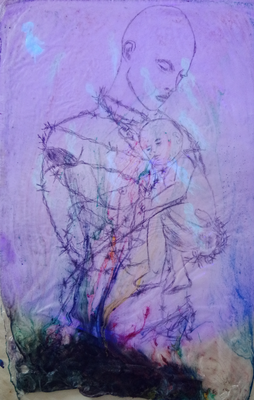
This thesis stems from the need to investigate an original painting technique developed by the author, which combines figurative painting and solidified atmospheric phenomena.
The heart of the research is a simple and radical question:
How can an ephemeral phenomenon be made permanent?
The answer takes shape through the creation of sheets of solidified rain, transparent membranes that preserve the logic of the drop, the flow, the surface tension. These membranes are superimposed on figurative paintings, generating a multidimensional visual language.
Transparency is not an aesthetic effect, but a temporal device: it freezes the work, suspends it, holds it in an eternal instant.
recent publications <>
Demolish Monsters on the Rocks: Prompting Through an Ensemble
(2026)
bruce gilchrist
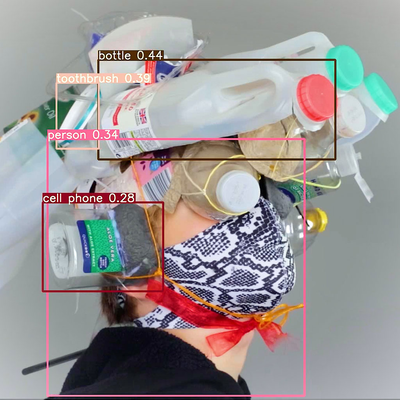
As interaction with corporate artificial intelligence increasingly becomes a precondition for contemporary life, artists need to see beyond Generative AI (GenAI) technology as a discrete tool that makes generic products. Instead, they can imagine combinatorial approaches and conceptual frameworks for AI-enabled artworks. Through my practice-based research, the act of prompting multimodal GenAI models has been informed by comprehending an assemblage as a “framework of instruction” held together through poetic alliances, within which the output from one component feeds the process of another. Practical experiments explored an interrelation of body, text, and predictive technology, where an algorithmic prediction of human action conjured “biometric poetry” that was used to stimulate a language model. Working with archival film footage and digital puppets animated with motion-capture files gave rise to the idea of a camera’s field of view – with its bounded contents acting like a key – eliciting value from a language model in a novel form of story making. Potential erroneous inferences were perceived as a new form of chance operation and a characteristic of algorithmic remix as defined by Steve F. Anderson. This method has been further developed in a project that combines performance, waste material, object recognition, and a language model to explore how the manipulation of garbage can be rationalised by a machine to produce poetic texts as a commentary to action portrayed on a screen.
In Sync With A Machine
(2026)
Ilja Mirsky, Leonid Berov, Gunter Loesel
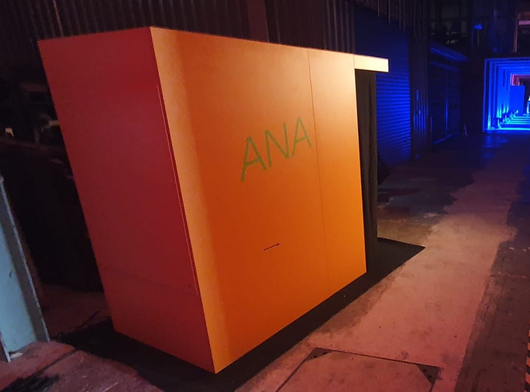
This paper delves into the dynamics and dramaturgical specifications of ANA, a theatrical installation engineered for co-creating narratives in a dialogic process with individual users. ANA embodies a collaborative storytelling environment that is used to communicate narrative and emotional information through multiple modalities, thereby bringing into focus an unexpectedly human essence in a human-machine interaction. Integrating GPT-4, emotion-recognition algorithms and a simulation of its own affective state, ANA engages users in a 10-minute interaction, fostering an immersive narrative exchange where the affective dimension of collaborative storytelling takes precedence. This paper explores the specific challenges of prompt design in this setting, focusing on the concept of emotional attuning, the feeling of being “in sync” with a machine throughout the interaction. Through an analytical lens encompassing cognitive science, philosophy of mind, and prompting techniques, the authors describe and reflect practices of employing multimodal sensorial data such as emotion recognition, and dramatic considerations, into the process of designing prompts. They also describe and reflect on their attempts to establish a form of meta-communication with the machine about the emotional aspects of the experience. By focusing on dramaturgical and improvisational strategies, this paper underscores the pivotal significance of emotional attunement and multimodal communication in fostering intimate technological engagement.
AI gave me an assignment, and I did it. Now what?
(2026)
Brett Ascarelli
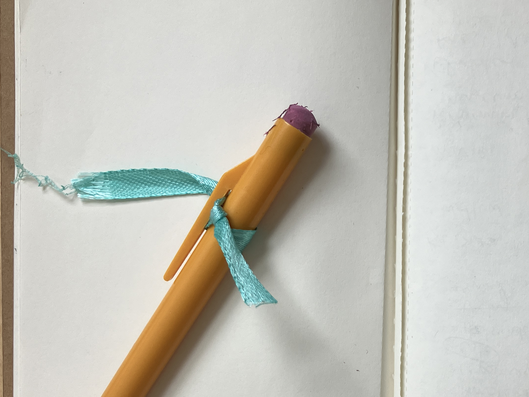
How useful can AI be at this present moment to generate assignments or instructions to teach and train people to live more playful, creative and ethical lives? In this artistic research, I try to put aside fears of a dystopian future in which runaway AI assumes control over humanity, and suspend them long enough to play with the idea of reversing the usual dynamic: what if AI were to instruct us, instead of us instructing AI? What kind of positive outcomes could emerge? I borrow from traditions of instruction art and avant-garde art, and I employ discursive practices that alternate between techno-enthusiastic and techno-skeptical. The AI tool ChatGPT and I hold conversations in which we explore the research question together, and in which I prompt ChatGPT to issue me instructions, then I describe the process and result of executing the instructions.
sar announcements <
Subscribe to SARA
[open call] — enuntiatio.praefatio.formulae — residency program for artistic research in music [2025/2026]
(2025)
Research Catalogue
Research Catalogue