Disembodied prosthetics
(2025)
author(s): Thorolf Thuestad
published in: HUB - Journal of Research in Art, Design and Society
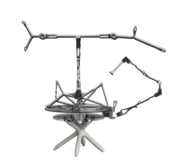
Exploring how artistic experience can be influenced by mimetic recognition of human motion patterns in non-representative kinetic figures.
This project investigates imbuing non-representational kinetic figures with human-like movement patterns and examines how these characteristics can modulate the expe rience of such figure(s). The investigation explores whether these motion patterns may facilitate mimetic recognition of human movement patterns and whether such recognition can intensify onlooker engagement with the figure(s) by eliciting affective and emotional responses. Of particular interest is evoking experiences of kinship and relation between humans and non-humans and proposing that the figures’ actions be experienced as an expression of intent on the part of the figures.
These topics are approached as artistic motivation and guiding principles for artistic creation and experimentation.

Glimpsing Speculative Utopias: Envisioning Futures
(2025)
author(s): Amna Qureshi
published in: HUB - Journal of Research in Art, Design and Society
This exposition explores the concept of speculative utopias within artistic research, offering glimpses into potential futures at the intersection of artistic imagination and futures thinking. Developed as textual concepts, these speculative utopias serve as vehicles for envisioning inclusive and sustainable futures, addressing complex socio-economic, cultural, and environmental challenges. The study employs a multidisciplinary approach by integrating aerial photography of Iceland’s landscapes with futures thinking methodologies and artistic research practices. These photographs function not merely as documentation but as speculative utopias that prompt critical reflection on climate adaptation, socio-political transformation, and public engagement. A unique aspect of the research is the use of artificial intelligence (ChatGPT), which supported iterative narrative development and reflexive inquiry. Through this exploration, the research offers alternative visions for resilient futures catalysing transformative dialogue and deepening reflection on the politics of the present while imagining possibilities for the world to come.
Language in AI Art: Encoding, Folding and Transforming
(2025)
author(s): Garrett Lynch IRL
published in: HUB - Journal of Research in Art, Design and Society
This article discusses four artworks that employ artificial intelligence (AI) as practice as research (PaR) by artist Garrett Lynch IRL. These are: I’m not Garrett Lynch IRL – DoppelGANger Portraits (2021), a series of Generative Adversarial Network (GAN) portraits; TheLastStraw (2021–23), a performative generative artwork for social media; Flag for States of Damage (2018), a performative mixed-reality artwork for the web and The Traveller (2024), a four-channel video installation with artefacts.
The objective of the works is two-fold. Firstly, each artwork’s use of AI is distinct yet is intended to form part of a broad ongoing exploration of how networks can be transformative to art practice. The works maintain that AI is a form of network that enables emergence. Not the emergence of intelligence as defined in the field of AI, but instead in the context of art theory a manner in which artworks are expanded, extended or activated beyond their artist/author defined forms. AI as a network is therefore defined as both the generative adversarial network, the input, employed in the formation of the work and the resulting network of artist, artwork and audience that emerges when a work is expanded, extended or activated. Secondly, instrumental in facilitating AI as a network is the use of language as a combined form of encoding and performative utterance (Austin, 2018). Building on a fundamental basis of computing that all digital media is reducible to language, code, and numbers as well as a basis of communication theory that language is a social construct, the works explore language as both form of representation and communication between human and machine. Language enables a process of folding (O’Sullivan, 2005) or flipping (Sloan, 2012) of concepts, media and artefacts between ‘virtual’ and ‘real’ spaces, between digital and materialised forms.

Assembling Hanoi: Metamorphosis of Photographic Images
(2025)
author(s): Lorena Bañares
published in: HUB - Journal of Research in Art, Design and Society
Interested in how photographs are constituted, this exposition situates itself in between materialities of photography to discover how photographs are actualized. Using photography as artistic research practice, it uncovers how matters, sounds, bodies, and machines intra-act within the practice of photography. The inquiry challenges the bifurcation between the outside/inside of the frame, rather it emphasizes its fluid nature. It delves into the cosmogenesis of a photograph exploring the multiple folds and transformations in actualizing a photograph revealing the intricate and dynamic assemblages of humans and non-humans from the outside folding with the inside. Thinking with Gilles Deleuze's concept of the Folds, the exposition was able to surface layers upon layers of bodily and material folds that trouble the traditional notion of photographs as images separated from the outside. In the middle of its messiness, the exposition was able to develop an Applique technique as a method of knowing that emerges from this artistic research practice. What came out are layers of images that describe photography as performative movement of matters and bodies, a metamorphosis of infinite images while navigating the rich culture of Vietnam’s Hanoi capital.
AS HOLA
(2025)
author(s): Aðalheiður Sigursveinsdóttir
published in: Research Catalogue, Iceland University of the Arts
AS this is an informal tale, restating my master’s studies.
AS I was in the midst of a Uturn, entering formal art education, my hopes and expectations were unclear but deeply felt.
AS ever, I feel compelled to question, review, examine some more. AS every question gives an indication to the inner world of the questioner. AS if I want to know if there is a pattern or a path?
AS a collector I have documented, framed and reflected with words and stored. As curators act I showcase my creative learning journey.
creative (mis)understandings - methodologies of inspiration (for RUUKKU call: Parallel indigeneities, art worlds and frictions)
(2025)
author(s): Johannes Kretz, Wei-Ya Lin
published in: RUUKKU - Studies in Artistic Research
The artistic research project Creative (Mis)Understandings: Methodologies of Inspiration is a collaboration between sound makers / compoers / performers from an indigenous community in Taiwan (Tao on Lanyu/Orchid island) and from Europe.
There is a high urgency to transform traditional songs into new artisttic forms, creating new ways of forwarding important traditional knowledge to the next generations.
This collaboration also sheds a different light on the question, what it means to create something "new" in the eurpopean context.