NIME - New instruments for Music Exploration
(2024)
author(s): Kjell Tore Innervik, Jonas Howden Sjøvaag
published in: Norwegian Academy of Music
An artistic Postdoc project intended to create an environment for musical innovation, to explore the design of new physical and electronic instruments and to host the international NIME conference 2011.
This interdisciplinary artistic research project was a collaboration between the composer Ivar Froundberg, Music Technologist Aleksander Refsum Jensenius and percussionist Kjell Tore Innervik. A project to enhance the possibilities of music performance for the many and for the few located at the Norwegian Academy of Music.
COMPOSING NON-LINEARITY IN MIXED MEDIA PERFORMANCES
(2024)
author(s): Sophia Bardoutsou
published in: Codarts
This paper aims to explore the potential of merging acoustic music with digital media and other art forms to create non-linear compositional forms. Often, it’s difficult to get away from traditional composition processes, make a piece adaptive in form and not strictly bound to time. Through case studies on works by Walter Giers, Michel van der Aa, Yannis Kyriakides and more, I focused on the elements of integration, interaction and nonlinear composition of different media. Looking at their work and through self- experimentation, I noticed that the different media can get dramaturgical meaning and interact live with every element of the performance. Digital media can specifically function as tools for interaction between the performers and the audience. By incorporating playful ideas in the compositions, derived from the world of games and indeterminacy, we can end up in nonlinear processes of performing notated music and allow for interpretation by other artforms. As a result, I composed the pieces In Medias Res for musicians, circus artists and interactive media, Dots for Pierrot ensemble and visuals, the 15’ opera Aer and the interactive music game A poppy blooms. Through this process, I tried to free myself, as a composer, from specific writing habits and approaches. A new field of possibilities opened up on how to develop music material, notate it and perform it.
The Aura of Electromagnetic Twilight
(2024)
author(s): Mikkel Wettre
published in: Research Catalogue
In this lecture I reflect on recent artistic work relating to perception, technology and bodily awareness. The lecture was part of the Digital Narratives Network Conference held at UiB in 2019.
The Digital Narrative Network Conference and Exhibition was a cross-faculty initiative at UiB/KMD with a keynote by N. Katherine Hayles on literature and AI, a series of presentations by scholars, artists and authors, and an exhibition of digital narratives, including a sample of my "Twilight Apparatus" sculpture-series.
In my sculpture-work I have taken eyesight and optical phenomena as a starting point for mechanical installations that engage the senses and serve as metaphorical depictions of the relationship between human and technical cognition. My presentation will track the development of recent projects and the role of imaginative awareness.
Finding Home: An Exploration of South African Art Music through the Classical Saxophone and Collaborative Practice
(2024)
author(s): Josie Mc Clure
published in: KC Research Portal
This research project explores South African Art Music through collaborative practice and the classical saxophone. It begins by investigating the discourse surrounding South African Art Music through testimony collected from various conversations with South African composers, musicians and academics such as Dr Kevin Volans, Dr Antoni Schonken, Professor Hendrik Hofmeyr, Dr Cara Stacey and Arthur Feder. I began collecting the scores of South African saxophone compositions which led to the development of an online catalogue system to document these works -The South African Saxophone Catalogue. This catalogue forms the base - as well as the network - for how this research was developed.
To further investigate the South African repertoire, I embarked on creative journeys with four South African composers through performer-composer collaboration. I decided to use this means of investigation as the relationship formed between myself and these composers shows a different level of engagement with this music, first-hand experience in the creation of this music as well as creating an open space for discourse. These collaborations were documented through reflections, audio and video recordings and are investigated in the form of case studies. The final artistic product was a concert featuring these new compositions in Cape Town, South Africa.
The data collected was organised through an amalgamation of critical reflection and thematic analysis.
Through this collective music-making, I discovered the variety in thought surrounding South African Art Music and paradoxically those who vigorously deny this term. I discovered the complexity both politically and socially that the term South African Art Music implies. In conjunction with my personal reflections, this exposition explores the ideas, opinions and art of individuals in various fields in the South African classical music scene who represent a variety of South African cultural backgrounds and generations.
Spring at Geassemahjohka
(2024)
author(s): Maarit Mäkelä, Priska Falin
published in: Research Catalogue
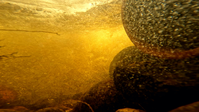
The video is part of artistic research that explores a dialogue between human, non-human, and forces of the land in Utsjoki, Finland. In this artistic research, walking is used as a method to connect with the environment. During the walks, small amounts of soil – sand, stones, and clay – is gathered and processed further in a studio. Some soil is transformed to slips and used when painting hand-built vases made from the gathered clay. The fired vases are placed temporarily in local rivers. The result is a series of three vase experiments done in a dialogue between human, soil, water, and the forces of the land.
The video presents the third vase experiment, where the vase is built from the local clay. The motifs of the painting are the nationally endangered animals: arctic fox, fell owl and glacial salmon. In the River Teno catchment, small juvenile salmon often spend some of their first years of life in tiny tributaries, which they enter from their birth place, the spawning areas in the main stem of the river. One of these nursery streams being Geassemahjohka. The vase is positioned in Geassemahjohka, which is running to the main stem of the River Teno some 70 km upstream from the estuary. Via the experiment we speculate: can act of crafting vase be conceived as act of caring, the vase being thus a symbolic shelter for the salmon?

Engaging the Audience: a Matter beyond Music?
(2024)
author(s): Gustavo Abela Cruz
published in: KC Research Portal
Despite knowing that music and emotions have a lot to do with each other, sometimes it is hard to articulate which relationship they have. Since the emotional impact seems to be one of the biggest appeals for an audience, do we, the musicians (specifically the performers), pay and draw enough attention to it? After reviewing the relevant literature about the processing of emotions, I came across the philosophical approaches of emotions in and through music by Peter Kivy, Jerrold Levinson, and Stephen Davies, proposals that could serve as inspirations for an audience and for performers.
Then, I decided to carry out a series of experimental sessions to test the impact of these three approaches, as well as the performer's role, and components that could also affect a performance, such as set-ups, musical manipulations, or what I have called 'extramusical' items or elements. In addition to my research question “How can a performer affect or manipulate the emotional engagement of an audience?”, I sought to explore another inquiry. Is engaging more with the public nowadays strictly a musical matter?