"Inseparable": Music and Dance in a Cross-Disciplinary Practice
(2024)
author(s): Kalina Vladovska
published in: KC Research Portal
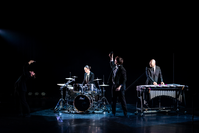
The following research observes the artistic creative process of a cross-disciplinary theatrical dance and percussion performance, called “Inseparable”. It discusses and analyses the process and methods behind the creation of the piece; the pros and cons of dance-percussion collaboration, and of working as a team of performer-creators; the involvement of a director; the creation of the final performance with a technical crew (light & sound); and the emergence of a mutual artistic language.
The cast includes Zaneta Kesik and Matija Franjes - two dancers (doubling as choreographers), and Joao Brito and Kalina Vladovska - two percussionists (doubling as composers), creating the narrative, dramaturgy, choreography and (some of the) music on their own. The director, Renee Spierings, was invited to be an external coach. Teus van der Stelt and Maurits Thiel - light and sound artists - took care of the final presentation. The four performances took place during and thanks to Muziekzomer Gelderland 2023 and were produced by Jarick Bruinsma.
Furthermore, in the research I discuss the social impact of the project's themes – technology addiction and human communication - and I examine a number of reactions and feedback from audience members.
The chosen form of presentation is a research exposition.
Assembling a Praxis: Choreographic Thinking and Curatorial Agency - Clew: A Rich and Rewarding DIsorientation
(2024)
author(s): Lauren O'Neal
published in: University of the Arts Helsinki
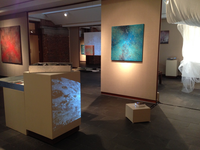
This exposition examines the curatorial project "Clew: A Rich and Rewarding Disorientation," held at the Lamont Gallery at Phillips Exeter Academy in 2017. The project is part of my doctoral research on “Assembling a Praxis: Choreographic Thinking and Curatorial Agency.” “Clew” proposes a framework for curatorial dramaturgy and asks: What is the potential of a dramaturgical approach within an open-ended exhibition structure? Who, or what, is the curatorial dramaturg? How do materials and time contribute to unfolding exhibition narratives?
[This exposition corresponds to Section Six: Extending Lines in All Directions: Curatorial Dramaturgy in the printed dissertation.]

Playing Schumann Again for the First Time
(2024)
author(s): Bobby Mitchell
published in: Research Catalogue
How can one learn to improvise convincingly within the context of the nineteenth-century piano repertoire? And why is it important to improvise on this repertoire in the twenty-first century? Taking the music of Robert Schumann (1810−56) as a departure point, Playing Schumann Again for the First Time proposes an answer to these questions through methods towards a pianistic practice that is driven by experimentation and strives to continually find more layers where improvisation can take place, both in sounding musical practice and in notation. These practice-based methods are contextualized by a discussion of the presence of improvisation in Western classical musical practice in the nineteenth century. They are then substantiated by an argument to use improvisation as a tool for rethinking the current performance practice of nineteenth-century music. Improvisation itself and the concepts driving this term will also be addressed: improvisation in musical performance will be described as a process guided by a feedback loop between mimesis and morphosis with which the practitioner engages using his or her individual cognitive and embodied approach to listening, forgetting, and conceptualizing; the results of which bear his or her own sonic signature. The knowledge gained in this project lies within the realm of what will be described as improvisation as practice, a category of improvisational behavior that circumvents the need to be presented as art and is rather intended for the development of one’s own music-making.

Queer and Gender-Fluid Artists in the Music Performance Universe of the 17th, 18th, and 19th Centuries
(2024)
author(s): Brian Lyons
published in: KC Research Portal
In classical music there has been an effort in recent years to bring to light those whose artistic output contributed to their genre or era but were not as well-memorialized as their caucasian heteronormative male counterparts. So, what about artist-musicians, and those adjacent to them, who lived outside the gender constructs of their contemporary hegemony? What contributions did they purposefully or inadvertently make? What is their reception history and how were these histories documented?
Queer Studies in- and outside of musicology has made strides to recognize the existence of historic queer and gender nonconforming individuals. Generally speaking, the aim has been to legitimize the gender spectrum and to make the lives of these noteworthy individuals known. Still it’s impossible for us to know how these gender non-conformists would have categorized their own gender in the Early Modern and Modern Periods were they to have the same terminology as we have today.
In this thesis I will cite figures from plays and broadsheet ballads of the 17th century, the developing opera genre in France in the early 18th century, the “low style” in London society and theater in the early 19th century, through to the Reconstructionist United States. By illuminating queer and gender nonconforming individuals and the performative acts that defined their personal lives, I show that these communities have always existed in some iteration and in many facets of the musical universe. What emerges is a centuries-old artistic lineage between gender non-conforming people that has yet to be fully explored.

More than Meets the Eye - Christoph Oeschger
(2024)
author(s): Christoph Oeschger
published in: University of the Arts Helsinki
More Than Meets the Eye: Capturing Invisible Flows and Processes:
For my doctorate, I created four films and one photo-text installation that engage with invisibility in various ways. My research for the film "2°", which seeks the impact of human interaction with changing geographies, took me to an altitude of 3,500 meters above sea level. In my investigations, I traveled as far north as the 51st parallel to produce the film "In the Ice, Everything Leaves a Trace", and the photo series "The Other Side of Ice", examining the economic exploitation of the Arctic. My research also led me to a place where the wind is harnessed for filming, inspiring the creation of the film "Memories of a Past Future", and to a location where filming is no longer possible, yielding images used in the production of "Unlearning Flow".
The decisive events of our time are often not visible. My research revolves around making this invisibility negotiable.
These occurrences possess a fascinating duality, simultaneously feeling both familiar and foreign. While we are intimately connected to them, they represent global processes that escape complete comprehension. They are complex chains of causality that have become inscrutable to individual perception.
Invisible events cannot be addressed through individual images or shots. Instead, it's the montage techniques of demontage, soft montage, and the productive gap that I employ. It is these working methods that allow me to approach the invisible, partially capture it, and make it negotiable.
These forms of montage are also mirrored in the written part of my dissertation. The written section of the doctorate brings together various text elements that influence each other and create cross-references within the individual works. The the written part contains conversations with other artist researchers contextualize my work within my field but also to build a forum to negotioate my work.

Understanding the Wagner Tuba: a practical guide for horn players
(2024)
author(s): Gaizka Ciarrusta Insagurbe
published in: KC Research Portal
Horn players have the duty to play the Wagner tuba when the repertoire demands it, but do they really know how to do it and how to adapt to the change of instrument? Mastering the Wagner tuba and feeling confident on stage can be a difficult task. Not having one's own instrument, nor subjects or teachers dedicated to the teaching of this instrument complicates its knowledge and preparation.
Therefore, this research aims to facilitate and educate in this process, providing the most relevant information both intellectually and practically and offering a complete overview of it. Following an inductive methodology based on written sources, an exhaustive technical analysis and the experience of professional horn players, it tries to answer questions such as why Richard Wagner created this instrument, what role it plays in the orchestra and what demands its performance requires.
For all this, if you are a horn player and have to play the Wagner tuba or have already played it but have had no previous education, the results of this research will guide you in the process and will make you obtain a higher level of interpretation and knowledge.