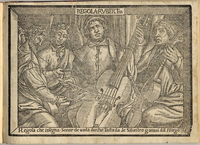
Diminutions, Divisions, and Doubles in Viol Literature
(2021)
author(s): Alex Baker
published in: KC Research Portal
Diminutions, divisions, and doubles are essentially different words for the same practice in viol literature - ornamenting music by dividing notes into smaller notes. The practice varies in name based on its context: in Italian and Spanish music it is called diminution, in English music it is called division, and in dance movements from French suites it is called a double. The question then remains: why do these theoretically identical practices remain distinct in name? Are there other ways in which they differ?
This exposition argues that there are indeed other ways in which these different families of diminution-style ornaments differ, and for this purpose it examines texts and scores from each group. For diminutions, the focus was Silvestro Ganassi’s “Opera intitulata Fontegara” (1535) and Diego Ortiz’ “Trattado de Glossas” (1553); for divisions, Christopher Simpson’s “The Division Viol” (1659); and for doubles, Marin Marais books of “Pièces de viole” (1686-1725).
The first chapter is an explanation of the chronological history of these different practices, beginning with diminution during the Italian Renaissance, moving to England in the mid-17th century, and ending with Marais’ suites from the late-17th to early-18th centuries. The second chapter explains the contextual differences of each style (in which genre/musical setting it was applied). The third chapter explores stylistic elements that are unique to each style, and the fourth chapter discusses the implications this information has for the modern player of the viola da gamba.

Acoustic Territories of the Body: Headphone Listening, Embodied Space, and the Phenomenology of Sonic Homeliness
(2021)
author(s): Jacob Kingsbury Downs
published in: Journal of Sonic Studies
Can we describe certain sonic experiences as “homely,” even when they take place outside of a traditional home-space? While phenomenological accounts of home abound, with writers detailing a rich spectrum of the felt characteristics of the homely including safety, familiarity, and affective “warmth,” there is a scarcity of research into sonic experience that engages with such literatures. With specific interest in the experience of embodied space, I account here for what might be termed feelings of “sonic homeliness” as they emerge during headphone listening. After forming a conceptual model of homeliness that draws from phenomenological philosophy, I investigate its applicability to experiences of headphone listening. Through analysis of primary interview data, I consider how headphones may be said to territorialize space for listeners, analyzing how sonic “boundaries” are experienced in relation to the body, as well as how some listeners describe their experiences as interiorized, comforting, and “wombic.”
Jazz in Worship and Worship in Jazz
(2021)
author(s): Uwe Steinmetz
published in: Research Catalogue
Jazz in Worship and Worship in Jazz
The musical language of Liturgical, Sacred, and Spiritual Jazz in a postsecular Age.
Abstract
The aim of this dissertation is to identify musical elements that contribute to the generation of religious meaning in jazz performance and to explore how religious experience can inspire jazz composition.
In this study, the history of jazz, specifically tailored to the aspects of my inquiry is imbricated with relevant theories and musical interventions from my own artistic practice in composition and performance. In addition to artistic research through my own practice as a performer and composer, the transdisciplinary fields of musicology, music theory, neurology, history of religion, and theology provides further critical tiles in the knowledge-mosaic constructed by this study.
Using my own artistic practice as my primary research method, my thesis investigates distinct intrinsic and extra-musical elements that help to create a typology of religiously inspired jazz, grounded in historical reference works. Twenty-five of my own compositions following this typology are submitted with this thesis and are analyzed in the three main chapters.
The final chapter (Imagine) summarizes conclusions of the main chapters and includes a brief evaluation of the research process. Conclusions from the thesis include (i) defining six distinct ways of expressing religious belief in jazz, (ii) demonstrating that the extrinsic meaning of religiously inspired jazz changes when placed within a liturgical dramaturgy, and (iii) generating new postsecular perspectives on jazz. Another concrete result of this thesis involves revisiting George Russell´s Lydian Chromatic Concept as a basis for my own compositions. The practice-based adaption and exploration of Russell´s theory opens new ways of understanding how his musical philosophy builds a bridge between Western classical sacred music and jazz. Finally, this thesis also raises new areas for further research such as microtonal and twelve-tone tonality in jazz, temporal concepts in jazz composition and improvisation, and the embodiment of Christian faith through music as an extension of the institutional church in society.
Keywords: jazz and religion, jazz liturgies, George Russell, Spiritual Jazz, Sacred Jazz, Liturgical Jazz, postsecularity in the arts, twelve-tone tonality in jazz
Accessibility of Music Production Software for the Visually Impaired: A study of developing an eyes-free audio application for a surface haptic interface
(2021)
author(s): Jakub Pesek
published in: KC Research Portal
In the past three decades, the process of music-making moved away from operating analogue devices to using the software running inside of computers. While these advancements provide significant advantages, visually impaired people cannot fully benefit from this progress because some of the software tools are not accessible to them. The aim of this thesis is to explore the accessibility of music production tools for the visually impaired and propose an accessible eyes-free audio equalizer application controlled by a surface haptics interface.
To determine the level of accessibility of music production software, this thesis reviews industry practices and research concerning assistive technology in music production by analysing the most popular digital audio workstations' accessibility features. Further, online interviews with visually impaired music producers are conducted to find out about the way they work and their experience with using the software.
Finally, an equalizer with a visual display of the EQ curve for a surface haptic interface is designed and developed to explore a new human-computer interaction method that makes it possible to operate audio plugins eyes-free. Due to haptics feedback, the user can control the application in a non-visual way. To validate the application design and potential for improving the accessibility of music production tools, two tests with participants are conducted. The results show that it is possible to control audio equalizer only with haptic feedback. However, more development is needed to improve the user workflow.
Down to business
(2021)
author(s): Heleen Bongenaar
published in: KC Research Portal
This research serves as a guide for musicians to develop their own business models using the Canvas model taking into account legal, economical and competitive context.
ANTIVIRUS !Make some domestic noise! on ∏ Node Part II
(2021)
author(s): Sarah Brown and Valentina Vuksic, Valentina Vuksic
published in: Journal of Sonic Studies
!Make Some Domestic Noise! was a series of collective online performances that took place during the first COVID-19 lockdown. They featured what might be described as an online domestic noise big band. As everyone was isolated at home, the ∏ Node collective launched the Antivirus program to train people on how to join and contribute their own stream and sounds.
Being alone at home can be stressful, but it can also reveal the beauty of everyday noises.
On a weekly basis, people were invited by email to participate by playing with the noises of their domestic appliances and live stream the results. These separate audio streams were then mixed in real time and sent to the main output stream. This was enabled by the ∏ Node site structure, which provides a volume control for every active stream. The website also has an Internet Relay Chat through which participants can, and did, directly interact.