Peripheral frequencies
(2021)
author(s): Mika Kiviniemi
published in: Research Catalogue
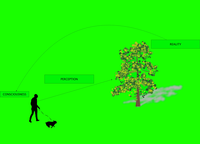
This exposition explores the backround noise as aesthetic periphery. My attempt is to define my subjective experience about what I consider as peripheral frequencies and how do they affect the formation of aesthetic experiences.
BRIEF HISTORY OF PERCEPTION
(2021)
author(s): Udo Maria Fon
published in: Research Catalogue
Even if this brief historical outline of perception is structured chronologically as far as possible, it is difficult to describe the variety of parallel events. This overview, therefore, makes no claim to completeness. It demonstrates that after the establishment of technical aids for the expansion of human perception, phases of an intensive exchange of information begin. This allows existing structures to be viewed and reflected on in a new way. But this does not mean the end of the world in any way. Only the end of an outdated worldview. And that means a new beginning.
Fading Quetly
(2021)
author(s): Nanna Hauge Kristensen
published in: Journal of Sonic Studies
This translated audio piece is a sonic exploration of the everyday life of an elderly woman called Alice. Alice lives in a suburb of Copenhagen. Based on the ways in which she inhabits her home a sonic cartography is unfolding, revealing a close connection between the acoustic environment and her bodily decline.
Moving through Choreography – Curating Choreography as an Artistic Practice
(2021)
author(s): Marie Fahlin
published in: Stockholm University of the Arts (SKH)
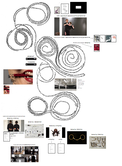
The purpose of the artistic research, Moving through Choreography – Curating Choreography as an Artistic Practice, has been to consider choreography and curating in their similarities and differences. Thus, at different phases of the working process, choreography and curating were treated as one and the same artistic practice; while, in other moments, as practices that are distinct from each other.
Curating has been implemented as a ‘taking care’ principle and a relational activity impacting the production, presentation and documentation of choreography. Choreography has undergone a process of self-reincarnations, or rather, of trans-carnations, whereby the entire body of work has been scrutinized and altered. Key figure/body/agent of these trans-carnations has been the horse, or rather, the assemblage of human and horse, women and horses, here called ‘Centauring.’
Curating and choreography have been integrated to a scrutiny of the art of riding, specifically, the choreography of dressage. In dressage, the research has identified the rigor needed by the research to both steer and unleash the working process.
The research has been pursued by purely artistic means, within a circumscribed field. Different perspectives and the making use of ramifications and loose ends, has proliferated into a plethora of intra-related works, objects and choreographies within which research result and artistic result coincide. The research har proceeded in consecutive phases. Each phase has developed its own specific artistic methodologies.
The overarching methodology has provided for a clear navigation of undetermined directions and dramaturgies. The concept of ‘One’ has produced and collected both core outcomes and residual manifestations. The exhibitions and the exhibitor have carried, pursued and embodied the works and otherwise choreographies, throughout the research process.
Tree Encounters – Berlin Series #takecare
(2021)
author(s): Carmen Raffaela Küster
published in: Research Catalogue
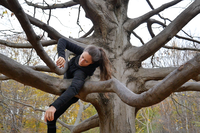
Tree Encounters – artistic dialogues of human and non-human bodies / #Berlin Series –
is the title of an Artistic Research project around the development of special movement forms of the body in suspension. The focus lies on the mutual interdependencies with nature/ the trees (in the urban sourrounding of this specific Berlin Series). In contrast to traditional movement concepts, especially in the classical aerial acrobatics, where an objectified body has cognitively been forced in 'preplanned' forms – in this work the Physical-Intuitive, the body-immanent knowledge is assigned more agency and a leading role. The practical artistic research is documented in this exposition mainly by video.
CHOREOGRAPHIC NATURE. A DISTANCED LOOK TOWARDS MOVEMENT (DANCE MOVIE 'NON-BREAKING SPACE' (2021) | ESSAY)
(2021)
author(s): Greta Pundzaite
published in: Research Catalogue
NON-BREAKING SPACE is a dance movie revealing the vulnerability of creation process to its context when questioning the nature of movement and looking at choreography through a zoomed-out lens. Thirteen minutes lasting continuous floating in sound, colour, shape and time starts with an impulse of a meandering line through drawing and of a floating thought through text imposing the interconnectedness and shared choreographic characteristics. The movie continues with moving mass, however, maintaining a distanced look towards movement.