FERRY EXPERIMENT: READING LINE AND SOUND | PHYSICAL MOVEMENT LAB
(2021)
author(s): Greta Pundzaite
published in: Research Catalogue
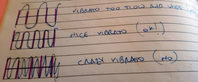
Ferry Experiment: Reading Line and Sound aims to grasp movement in different artistic elements and trace their interconnection. A sound of a ferry trip Lisbon-Berreiro is recorded as if from two differing ears of a passenger. One traces the movement of detailed noise inside while the other lowers itself to the machinery and gives an impulse of the repetitive swing of moving water. A drawing is created as a result, dismounted to its detail and used together with the sounds as a continuation searching itself in the movement of a body.
Isolated Attractors- TTT2020- Conference
(2021)
author(s): Sergio Patricio
published in: Research Catalogue
Attractors cause attraction, collision, repulsion and distraction between different poles of charged energies. Latour makes a metaphor about these attractors in society and politics by defining many layers of interaction between the poles, decades after quantum physics observed strange attractors in chaotic systems of particles. Initial conditions could make a difference in terms of observation of strange attractors in art practices, where artists have the access to continue their own art practice, and who have also faced the art market and non patronage within a competitive society of succession. The proposal observes an isolated artist, connected virtually to the environment, but losing social skills, because of social distancing. Isolation in artists is present here and now in today's societies, with society’s own practices infected by worldwide news, porn, violence, loneliness and a vacuum in daily life routines. What kind of attractors proceed in an artist’s own art practice while in isolation, at home in a shared “WG”(shared flat) , without the resources to develop their own art and without the possibility of success and social empowerment? Which kind of strange attractor could possibly define the steps and procedures of this new generation of artists who don’t feel supported and who feel isolated in their “home” artwork? This paper attempts to observe this idea based on a few cases by comparing interviews with artists isolated by Convid-19 in 2020 in different countries.
The horn of Leutgeb and Mozart : investigation and experimentation
(2021)
author(s): Nicolas Roudier
published in: KC Research Portal
A lot of researches have been conducted on Mozart's work and how to play it, including by myself. Eventhough those works helped our comprehension of this music, we still don't know what particular horn did Leutgeb (the composer's hornist friend) play at the time ; and never have I ever encountered a practical experimentation on such an instrument yet. XVIIIth century horns are rare and never played : every recorded performance of Mozart’s music on hand-horn is played on a copy or a XIXth century horn, which is historically inaccurate. We know a lot of theory ; but no one has gone any further yet. My goal is to step in the unknown : first, to get as close as possible to the horn Leutgeb and Mozart knew ; then, find and play a historical horn from Mozart’s time, and see what impact it has on the playing and the music.
HALFLIFE
(2021)
author(s): shasti
published in: Research Catalogue
This exposition posits art as a form of contagious divination, a glimpse into the multiplicity of possible futures, and an examination of artists' ability to detect momentum towards unavoidable outcomes.
In 2014, I was selected by curator Heather Pesanti to participate in the City of Toronto’s annual Nuit Blanche festival, an overnight public art event spanning twelve hours in multiple neighborhoods that draws over a million people from the surrounding regions.
Spurred by my concerns about the inescapable gravity of mobile electronic media and "viral culture," my work was to be a performance premised on contagion, pointing to the monumental role that electronic media had assumed in mediating our direct experience, and the civic and societal fallout I believed would ensue. Little did I suspect how bizarrely prescient the work would turn out to be.
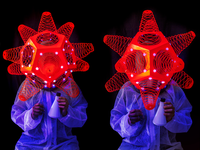
On October 6th, 2014, one hundred glowing “carriers,” dressed in fluorescent hazmat suits, wearing fluorescent LED-wired helmets in the dodecahedral geometric shape of an adenovirus, dispersed throughout the City of Toronto, each "testing" and “infecting” at least one hundred festivalgoers by marking their faces and hands with “spots” “lesions” and “rashes” using surgical swabs dipped into a beaker of invisible UV-reactive ink. Each "test subject" was then gifted a small UV pen lamp with built-in reactive ink marker and instructed to "infect" and "test" ten others.
It is estimated that HALFLIFE attained an "R-naught" value of ten, and through this performance, affected approximately one hundred thousand people.
Images of the performance went viral on Instagram for seventy-two hours, during which Toronto General Hospital admitted their first and only suspected Ebola case.
Effects of visual instructions in one-on-one violin lessons
(2021)
author(s): Mauro Smorto
published in: KC Research Portal
Starting from my personal teaching experience, I have been studying the effect of visual instructions on my violin pupils.
With a detailed analysis of the interactions between students and teacher and the help of 36 observation sheets, I could finally see the effects of enhancing visuals on student’s musical learning.
All conclusions were drawn after taking into account specific studies mentioned in the theoretical framework and with respect to the observations made by three external experts.
This research found further evidence of the link between visualization and critical thinking as well.