No Show
(2024)
author(s): Steinunn Knúts Önnudóttir
published in: Research Catalogue
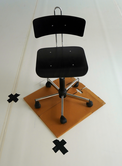
This exposition contains six letters about the work No-Show that was performed in Reykjavík in 2020. The performance is a part of the artistic PhD research "How Little is Enough?" Sustainable Methods of Performance for Transformative Encounters in Malmö Theatre Academy at Lund University. The letters address different aspects of my artistic practice and research such as motivation, method, affect, ethics and the findings.
No Show is a series of five immersive participatory performances, solitary experiences performed in five private homes in different neighbourhoods of Reykjavík in June – August 2020.
Crafting desire : Queering the artefact
(2024)
author(s): Rising Lai
published in: Royal Academy of Art, The Hague
Thesis of the Royal Academy of Art, The Hague, 2022
Master Interior Architecture (INSIDE)

Biases, glitches and oppressive values or a happy domesticity: starting from my grandmother’s house
(2024)
author(s): Georgia (Georgina) Pantazopoulou
published in: Royal Academy of Art, The Hague
Thesis of the Royal Academy of Art, The Hague, 2022
Master Interior Architecture (INSIDE)
Intimacy is found where the individual feels comfortable expressing, creating and existing. Our home, the domestic environment, teaches us every day, from the moment we are born, how to exist in a place that often functions as a miniature of the social and cultural system that we will later live in. This relationship continues throughout most of our lives if one considers that we spend more than half of our lives within the domestic realm. This of course does not only concern the relationship that is developed between the space and the people who inhabit it, but also all those elements that make up these interrelated relationships and often define them. Standards, values, cliches, traditions, norms and stereotype patterns are often found in a big part of our daily lives within the domestic environment. Meanwhile, each individual creates their own space of familiar interpersonal encounters.
Foreword reposition #2
(2024)
author(s): Alexander Damianisch
published in: University of Applied Arts Vienna
Foreword by Alexander Damianisch, Project Lead and Editorial
reposition is a support project for research documentation and offers researchers of all disciplines and departments at the Angewandte the opportunity to publish their work according to peer-review principles. Colleagues of any level and doctoral students in arts and sciences are invited to share their work.
This series showcases their diverse approaches to project-oriented research work and presents current insights, captivating research processes, and ongoing projects from a deeply personal perspective that courageously unearth the work-in-progress.
The idea of reposition is to emphasise dynamic approaches that demonstrate the courage to adopt alternative perspectives and a focus that lies always on a dialogue in-between.
Withdrawing the Performer. Facilitating Participatory Sense-Making
(2024)
author(s): Imani Rameses, Charlotta Ruth, Jasmin Schaitl
published in: University of Applied Arts Vienna
With "Withdrawing the Performer. Facilitating Participatory Sense-Making", Imani Rameses (Center Research Focus, PhD candidate PhD in Art), Charlotta Ruth (Angewandte Performance Lab), and Jasmin Schaitl (Angewandte Performance Lab) combine their approaches from visual arts, choreography, and cognitive neuroscience to examine participatory modalities in immersive performative settings through the lens of social cognition. They focus on the role of the facilitator, a nearly invisible and overlooked, but highly important part of any performative situation. Working with facilitator experts in a practice-based peer-to-peer exchange, the authors seek to understand different methods for reducing thresholds and modulating participatory situations.
SoundCape. Combating Environmental Noise in Urban Areas
(2024)
author(s): Sophie Luger, Lenia Mascha
published in: University of Applied Arts Vienna
Sophie Luger (Institute of Architecture) and Lenia Mascha (Institute of Architecture) address the increasingly important issue of urban noise pollution. "SoundCape. Combating Environmental Noise in Urban Areas" explores how sound and noise prevention can be incorporated into architectural design. To develop building structures for noise control in urban environments, the authors examine contradictory historical approaches from architecture and acoustics to learn about the relation of sound and material. Their approach focuses on geometry; experiments with Chladni patterns show that geometrical and material properties of architectural façades have an impact on spatial acoustics and result in the design of ornamental elements that can reduce unwanted noise in cities.