The Place of Shade
(2024)
author(s): Anthony Morton, Ray Franz
published in: VIS - Nordic Journal for Artistic Research
At first, the plan was simple — to be home by Christmas. To begin to view the very concept of home as built upon nostalgia. Imagining home is a pastime of any immigrant. If, as Breton suggests, ‘The imaginary is that which tends to become real,’ what were our imaginings bringing to life?
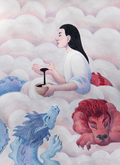
The Place of Shade is an artistic research inquiry into the contemporary wake of the Norwegian presence in South Africa. Norwegians began operating within the British colonial framework around 1840 — the same period as the migration to America. Lutheran missions, whaling, farming, business and family characterise this almost 200-year Afri-Norge diasporic heritage. It has been almost entirely overlooked in visual culture, until now. Their legacy remains an integral component of the city and the province's socio-cultural fabric to this day.
This exposition is just one expression within the broader scope of this ongoing project. Here, we on the one hand reflect on our preliminary research, methodology and fieldwork from a fictional standpoint — a kind of meta-methodological reflection — and, on the other hand, we address our Afri-Norge subject matter head-on. To achieve this, we narrate Ray Franz and Anthony Morton’s part in the initial fieldwork through the fictionalised perspectives of two PhD students at The University of Bergen — Vincent Dibble (RSA) and Bjarne Karlsen (NOR) — who leave their shared office to undertake an expedition which parallels ours, travelling to KwaZulu Natal, South Africa. This journey is set in the penumbra of the seismic socio-political events of 1999: The Truth and Reconciliation Commission, The South African Arms Deal, Case no. 4138/98, and the looming global spectre of Y2K. Dibble, an occidental eschatologist and accidental apocalypse-hunter. Bjarne, a philosophical cosmologist and photography enthusiast.
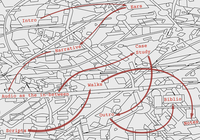
This exposition is imagined as the pair's pin board, suspended upon the expanse of their office wall upon returning to Norway. Behind them it hangs, a silent curation of fever dreams, as they weave theses into existence, their gaze drawn through the window onto the sprawling canvas of Bergen's cityscape.
Taming Amorphalia
(2024)
author(s): Eszter Mag
published in: VIS - Nordic Journal for Artistic Research
Taming Amorphalia is an experimental documentation of the intuitive processes behind/during the development of ProjectMorpheo – a Master’s Project at SKH. The research aims to further discover the fragile connections between dreams and the materials that surround us. Since ProjectMorpheo is a participatory event, Taming Amorphalia attempts to communicate the background of the research in a dialog-like, interactive way by using the form of a text based role play game.
SOUND TO WEAR
(2024)
author(s): Vidmina Stasiulyte
published in: VIS - Nordic Journal for Artistic Research
Can you listen to fashion?
Can you play fashion as music?
Fashion is primarily a visual ontology consisting of definitions, theories, and methods that are based on visual language. This exposition revises fashion by approaching it from a different—sonic—perspective wherein sound is considered not as a negative aspect but as a potential source of a new theory and facilitator of the evolution of new methods. Sound is thus presented not as a secondary quality of designed objects, but as the main idea-generator. The research opens new avenues for design thinking with ears rather than eyes. It explores fashion from the perspective of listening rather than seeing, sounding rather than showing. It is a form of rethinking and redefining fashion by starting with the statement that dress is sound.

Performance as Device for Disorientation
(2024)
author(s): Jennifer Torrence
published in: VIS - Nordic Journal for Artistic Research
By its very nature, performance is precarious—there is always the chance that everything might fall apart. In an attempt to mitigate the discomfort of this unpredictability, many musicians develop strategies in the hope of holding the reins on the proverbial cart. But what if one chose not to maintain control and instead embraced the wild nature inherent to performance? What kinds of knowledge and aesthetic experiences might emerge in the inevitable moments of collapse? Drawing on her recent research in the project Performing Precarity, an extended collaboration with composer Simon Løffler, as well as concepts by Jack Halberstam and Sara Ahmed, percussionist/performer Jennifer Torrence meditates on the notion of performance as a device for disorientation—that is, performance as an embodied practice of rupture, of getting lost, and of undoing the order of things.

Aporia
(2024)
author(s): Maria Jonsson
published in: VIS - Nordic Journal for Artistic Research
In Aporia we find ourselves within a liminal space. A space where the imagined contains traces of the real, and the documentary is reminiscent of fiction. The origin of the word "aporia" is in ancient Greek meaning literally "without passage". This particular passage (or this journey) can be likened to a quest of finding a way out; to navigate in the dark with no sense of direction. At the same time there seems to be a search for something else, like a meaning or the 'core'. Throughout this journey we move between states of wakefulness and of dreaming. The exposition consists of photographs, moving images, notes from dream journalling, drawings, encyclopedic facts, and also a little fiction. Simultaneous to this journey through time and space and changing of states, an index of cross references is created. This index becomes an auto-biographical lexicon of sorts. The artistic research aims to create a new narrative, emerging from a dissolving reality. An attempt to dissolve the physical world and to enter this new space. Is this new reality less authentic than the actual reality, or could it be even closer to the truth?
Listening to / in Public Space
(2024)
author(s): Justin Bennett
published in: KC Research Portal
As an artist working often with audio walks I often have the nagging thought: does using headphones to present sound in public space immerse the listener in a bubble, separating them from their surroundings?
This research looks at the form of the audio walk and the possibilities of using binaural recording, narrative devices and locative media to prioritise engagement with the environment.
In addition it documents the re-activation of an older work of mine in a app using geo-location and it collects documentation of a number of walk-pieces including scripts, audio files, maps and other background information.
Lectorate Music, Education and Society, Koninklijk Conservatorium, Den Haag. 2023-24