Matters of Distance: Walter Benjamin’s dialectical Image, the dynamograms of Aby Warburg’s Atlas Mnemosyne, and William Kentridge’s Drawings and the Arrival of fortuna
(2023)
author(s): derek pigrum
published in: HUB - Journal of Research in Art, Design and Society
What Walter Benjamin calls a ‘dialectical image,’ Aby Warburg a dynamogram and William Kentridge fortuna are a sudden occurence in the distance between the past and a ‘now’ of recognizability of a new constellation. The nature of the vast number of citations that Benjamin compiled from the sources available to him in the Bibliotheque Nationale in Paris for his Arcades Project, the thousands of reproductions of Renaissance works of art and other contemporary material that Warburg collected to pin to the panels of his Atlas Mnemosyne have their parallel in the printed media of out-of-date illustrated dictionaries, encyclopedias, ledgers and atlases that William Kentridge draws upon. Benjamin’s notation, the panels of Warburg’s Atlas and the print media of Kentridge are seen as expendable, reflective spaces, linked to potentiality but free from the pressure of preservation. The new, unforeseen constellations that arise are posited against a cohesive but reductive linear whole or progression. The montage is the medium used by all three where the intervals or distance between images is what generates the assembly, disassembly and reassembly of images or citations that, in the case of Benjamin, generates fragmentary essays, in Warburg in his convoluted theoretical writings based on the dynamograms he perceived in the panels of the Atlas, and in Kentridge the various stages of his process of drawing that he stop-frame films and projects.
Editorial
(2023)
author(s): Orlando Vieira Francisco, Fabrício Fava, Filipa Cruz, Maria Manuela Bronze da Rocha, Pedro Amado
published in: HUB - Journal of Research in Art, Design and Society
For this edition, we shared questions with the authors based on the strategies and ways of visualizing distance in artistic practice. We asked, after all, how we can understand the aesthetics of DISTANCE, including new narrative and visual devices, to reveal something inevitable or ineffable.
Projecting Form, Investigating Distance
(2023)
author(s): Agnese Cebere
published in: HUB - Journal of Research in Art, Design and Society
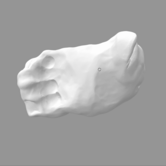
This exposition describes a process of investigating projection of form as a bridge between near and far, physical and virtual, anchored in the production of what I call “handheld devices” and a multimedia performance. It explores sympathetic dwelling in the crevices of the clay forms in relation to the smooth openness of the built environment of scientific and institutional space exemplified by the Phil and Penny Knight Campus for Accelerating Scientific Impact at the University of Oregon which graciously hosted me for a Center for Art Research Project Incubator residency and fellowship in 2023. In this text, I take up concepts of information and noise, distance and intimacy, affordances and the dynamics of action.
Distance, transmission, and journey in the collective construction of an Itaaká
(2023)
author(s): Bruno Moreschi, Irineu Nje'a Terena
published in: HUB - Journal of Research in Art, Design and Society
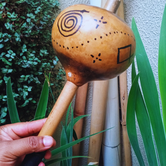
This exhibition discusses the collective construction of an ancestral instrument of the Terena indigenous people in the context of the artistic residency Con/Cri/Tec, held in 2023 at Casa do Povo, in São Paulo. The functions of the itaaká instrument, as well as the process of creating it in the residency, offered decolonial opportunities for understanding the idea of "distance" beyond the non-indigenous scientific view. The first contribution to this expanded understanding of distance comes from the functions of the itaaká, in particular, that of reducing the distance between the terrestrial and the spiritual worlds, based on the idea of "transmission". The second perspective of distance analyzed here came from the experience of building the itaaká, seen in the Terena culture as part of a collective initiation ritual. The making of itaaká performed in the artistic residency showed part of this ritualistic character and how this ancestral instrument relates distance to the idea of collective construction of a "journey".

Dissolving distances: Designing close-to-body experiences for remote settings
(2023)
author(s): Nesli Hazal Oktay
published in: HUB - Journal of Research in Art, Design and Society
I aim to offer embodied intimacy for people who are close by heart but physically apart. Specifically, I explore designing close-to-body experiences at a distance through intimate bio-rings, rings made of natural ingredients. Intimate bio-rings are highly customizable, can be biodegraded, and start dissolving when exposed to humidity e.g.: rain, sweat etc. The idea of creating a non-lasting object to be worn on the body—that required care, that was ambiguous and tangible—was a result of a prior user study of cultural probing and embodied design ideation. I further experimented with intimate bio-rings by making the ring and wearing it in everyday life together with my father, whom I live far away from. In this paper, I showcase a user study with 3 pairs (6 participants) that made intimate bio-rings at their homes while self-reported and self-documented their personal experiences. They then further shared their meaning-makings with me through an interview. Overall, participants found intimate bio-rings to be supporting new understandings about intimacy at a distance. As a result, their experience of "distance" alters slightly or changes completely by i) embarking on a journey, ii) creating time and space to be together, and iii) carrying each other through a tangible object.
Dialogic Liminality: Cartographies of the Inbetween
(2023)
author(s): Rachel Horst, Andy Hoff
published in: Research Catalogue
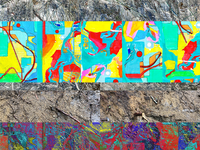
A conversation is a mapping of the spaces in between and within subjectivities, geographies, environments, soundscapes, and silences (of voice and thought); in conversing we abide by certain rules of negotiation while breaking others of propriety, manner, logic. In this exposition we aim to explore and enact the liminalities that occur in an artistic dialogue over the course of a series of weeks and reflections. In our capacity as settler scholar feminist artists and researchers, we are interested in understanding and performing scholarship via artistic practice. For this exposition, we negotiated a series of rules for our weekly inquiry. These rules became the map through/by/against which we navigated and re/defined our scholarship, disciplinarity, and research practice. In this work, we create places of overlap and divergence in a fluid “feeling cartography” (Cram 2016), which is “a mode of encounter and trans-ing, entanglement and movement without destination or conclusive points of arrival” (143). This is also a performance of autotheory, which Fournier (2021) describes, as a term “for works that exceed existing genre categories and disciplinary bounds, that flourish in the liminal spaces between categories, that reveal the entanglement of research and creation, and that fuse seemingly disparate modes to fresh effects” (2). Liminality as a theoretical concept emerges out of a diverse body of entangled life work and struggle. We are thinking with those feminist scholars and artists of colour, Anzaldúa and others, without thinking over the specificities of experience. As Barad notes, “Anzaldúa understood the material multiplicity of self, the way it is diffracted across spaces, times, realities, imaginaries” (2014, 175). We take up this material multiplicity in our artistic practice through a lens of posthumunism, which we see as a theoretical pathway into those spaces between agencies and atoms that may simultaneously define and undo us.