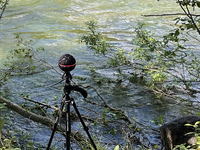
Stedet renner gjennom meg
(2023)
author(s): Trond Lossius
published in: University of Inland Norway
Denne siden er et vedlegg til boka «jeg TENKTE ikke at jeg skulle helle LEIRE på GULVET for å lage en god LYD ...», og dokumenterer Trond Lossius sitt lydarbeid sommeren 2021. Dette var et av flere bidrag til Katrine Køster Holsts prosjekt «Leirens kollaps – derhen og derfra» som i tillegg til ovennevnte bokutgivelse også bestod av utstilling og seminar ved Senter for keramisk kunst, Ringebu Prestegård, gjennomført i perioden 2020-2021.
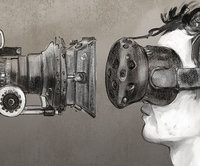
Ways of expression: the impact of VFX technology on modern storytelling in film and interactive media production.
(2023)
author(s): Rafal Hanzl
published in: University of Inland Norway
The rapid development and adoption of digital technology expanded horizons of creativity and opened new artistic frontiers. The broad array of options can potentially have a negative effect, however, as artists can become overwhelmed by the means of expression enabled by new methods they could never have imagined were possible.
Visual communication assists storytelling and should be used precisely to emphasize the desired features of a story. In filmmaking, visual effects (VFX) should serve as a creative instrument to strengthen the story and artistic vision and communicate the desired idea to the audience. Using VFX in planning and developing the implementation of artistic ideas can play a key role in contemporary art as well. This challenge of visual communication is all the more noticeable in an emerging medium of virtual reality. I argue that VFX tools facilitates solving artistic problems in the majority of creative activities.
My project investigates the creative and artistic potential of the tools of digital manipulation. The research focuses on two key artistic creations: a feature documentary “In touch” and a virtual reality installation for the Lodz Philharmonic “The Road to Excellence”. Through artistic experiments performed in these two projects, I develop innovative creative methods for a new creative profession in the film and interactive media industry: a digital visual designer. My aim was to explore how this new artistic collaborator contributes to the visual universe of the artistic creation.

Death to the Welfare State: An Exposition on Political Discourse and Artistic Collaboration
(2023)
author(s): Kent G R Olofsson, Jörgen Dahlqvist
published in: VIS - Nordic Journal for Artistic Research
Död åt välfärdsstaten (Death to the Welfare State) was a theatre performance for actors, dancers, and musicians that dealt with a concern that the welfare system in Sweden was about to be dismantled. To explore this worry political speeches were superimposed with a narrative inspired by George Orwell’s novel Animal Farm to examine how perceptions of welfare in Sweden have changed from the early 1900s to the present. This artistic research exposition elaborates on the process of developing the theatre piece. It unpacks how the relation between discourse and narrative informed the text and music, and how it allowed for a dramaturgical structure that included all the various performative elements and artistic expressions. Furthermore, the exposition discusses how the performance was composed through a collaboration that was characterised by an open-ended dialogue between the artists and how this enabled distributed decision making, as well as artists performing in other ways than they are used to. The exposition explores the open format of Research Catalogue. Through text and video documentation it builds on the dramaturgical structure of the performance itself: an introduction, five parts and an epilogue. The ambition of the exposition has been to make yet another iteration of the performance.

evocations – towards a poetics of documentation
(2023)
author(s): Fernanda Branco
published in: VIS - Nordic Journal for Artistic Research
Every art documentation is an encounter with an artwork in displacement, both in time and space. Yet, the experience of being present in the moment a live art work unfolds is – inevitably – lost in documentation. Evocations – towards a poetics of documentation explores non-conventional documentation to evoke imagination, inspired by the fragmentary, concision and absence found in poetry. This exposition passes through early discussions relating documentation to evidence. It looks into contemporary artists who challenge conventional ways to document, and approaches the act of document as bridging. Insisting on the loss and void inherent in documentation, Fernanda Branco's artistic research: environment embodiment – towards poetic narratives explores the circulatory generative process some non-conventional documentation can have. In the two projects I remember and Traces, the documentation viewer is invited to imagine – rather than to see – what occurred.
Photo Credit:
Performance by Fernanda Branco Traces #3. Drawing documentation and photo by Hilde Grønne Flikke.

Tracing Practices – questioning and circulating archives
(2023)
author(s): Per Roar, Camilla Graff Junior, Luisa Greenfield, Myna Trustram
published in: VIS - Nordic Journal for Artistic Research
Our exposition comes out of a conversation and explorative research process about the performative potential of archives, both publicly and personally, shaped by four different artistic mediums and practices in film, performance art, choreography and essay writing. The shared medium has been through the use of text and online communication.
The research was developed through ongoing monthly meetings and notes that were taken since April 2019. From those meetings, we laid a structure where we each created our parts of what became the score for "Living and Lasting", which we first performed in Oslo and then in Berlin in 2022*. This score is the pivot point of our exposition.
Our working process includes considerable elements of risk and surprise by alternating between collaborative meetings and individual work. The first time we perform a new piece none of us know exactly what or how the others will present. Along with the audience, we experience portions of the text, movements, and media put together for the first time, without knowing whether the whole thing will coalesce, diverge, or fall apart.
(*) In Oslo at the 2022 Nordic Summer University (NSU) and in Berlin at the symposium “Who tells y/our story?” by the artistic research project MEMORYWORK (2021-2024).
TEXTORIUM: Collaborative Writing-Reading with/in Public Space
(2023)
author(s): Emma Cocker, Andrea Coyotzi Borja, Cordula Daus, Lena Séraphin, Vidha Saumya
published in: VIS - Nordic Journal for Artistic Research
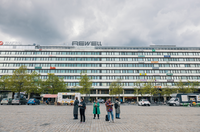
Textorium: Collaborative Writing-Reading with/in Public Space is a language-based artistic research project that explores collaborative score-based approaches to live, situated writing and reading practices, for attending to the experiential aspects of situated embodiment with/in public space. Between 30 May — 4 June 2022, five artist-writers (Emma Cocker, Andrea Coyotzi Borja, Cordula Daus, Vidha Saumya and Lena Séraphin) met in Vaasa, Finland, to engage in a process of observational and collective score-based writing-reading with/in public space. With its conceptual anchor in Georges Perec’s short book An Attempt at Exhausting a Place in Paris (1975/2010), this enquiry evolves a distinctive approach that foregrounds a corporeal, sensorial and bodily approach to language, where writing and reading are conceived as a collaborative undertaking rather than a solitary endeavour. Working with and through different language-based practices — including performative, poetic, and phenomenology-oriented approaches — the research explores the potentiality of emergent spaces (perhaps even of emergent temporalities, subjectivities and collectivities) produced through the interweaving of shared writing and reading practices, as the cyclical rhythms of writing/reading intermingle with the circulating movements, momentums and flows of public space. Through developing and testing various embodied, corporeal, sensorial, and collaborative approaches, this research enquiry advocates the transformative capacity of language-based artistic research for cultivating new “ecologies of attention” (Yves Citton, 2017). This shared enquiry explores the critical potentiality of our “linguistic bodies” (Di Paolo, Cuffari, and De Jaegher, 2018) as sites of both resistance and affirmation.