Intimate to and transcendent of transient time qua the seen and drawn in the present: an email to a painter/academic and his reaction
(2023)
author(s): Mike Croft, derek pigrum
published in: i2ADS - Research Institute in Art, Design and Society
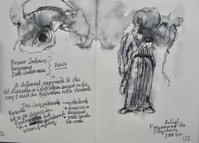
The idea of the exposition was triggered by an email exchange between artists Mike Croft and Derek Pigrum on 30th November 2022. The two artists have for more than a year been maintaining an email correspondence on matters of mutual interest concerning their visual practice and theoretical explorations. On this occasion Croft had read something by the psychoanalyst Jacques Lacan on the automaton, the latter of which he knew to be of great interest to Pigrum, the email to Pigrum of which opens the exposition. The resulting email response from Pigrum has as its point of focus a visit he had made the day before to the KHM (Kunsthistorisches Museum) in his home city, Vienna, where what he terms ‘the automation of contingency that generates repetition’ was as usual in operation. The references Pigrum made in the email to his own artistic work and existing works of art and cultural and historical artefacts suggested his text might be divided and illustrated, the resulting format of which is the present exposition. Several additional responses to the email exchange’s content ensued, termed interventions in the exposition, leading to a closing email exchange dated 11th December 2022. A third email exchange between 13th and 14th December has resulted in a Postscript section. Croft’s contribution pivots, he suggests, around Lacan’s coined term ab-sense, very approximately interpreted to mean absence of meaning between patterns or continuum – in the linguistic context signifiers –that are nonetheless not reducible to mere nonsense. The running through, as it were, of contingency in Pigrum’s practice – which he points out is not his only interest and prompts a need to show the broader picture, as it were, a pivotal influence for him being Aby Warburg’s Atlas Mnemosyne – may be considered informed by sense more so than meaning. The exposition is an example of how an ongoing correspondence can be an important aspect of each artist’s practice.
Sculpting Air In The Sub Habitat
(2023)
author(s): Lotte Anker
published in: Rhythmic Music Conservatory, Copenhagen
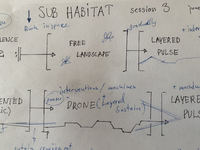
Sculpting Air in The Sub Habitat (subtitle: Texture and Form in Composition for Larger Ensemble of Improvisers) is an exploration and unfolding of creative processes in composing for a larger ensemble (6+ musicians) of improvisers as well as the processes in the ensemble rehearsals and concerts. In Sculpting Air, I am both composer and performer. I work with an ensemble created for this project: Sub Habitat.
Sub Habitat members are: Lotte Anker (DK), Mazen Kerbaj (GER/LBN), Katt Hernandez (S/USA), Nina de Heney (S), Sten Sandell (S), Andrea Neumann (GER), Burkhard Beins (GER)
Sculpting Air grew out of a need to deepen, (re)examine and challenge my compositional practice (including aesthetic preferences and inclinations) within a larger ensemble of improvisers, and I went into the project looking for something: more or less vague, fragmented notions of particular sonic and textural qualities and structural concepts. Notions of a higher degree of connectedness between predetermined and undetermined elements in composition etc.
The project is based on my own compositional work and 4 ensemble Sessions and Session concerts during 2020-22. It includes examples and reflections from these processes, and through them I try to articulate answers to the following research questions:
Based on the concepts of texture, MODE and LIBRARY, how can I develop new compositional tools for a larger ensemble of improvisers in a music that reflects the sonic palette and expression of the individual musician, the expression and identity of the ensemble as an entity, and my artistic intention?
Including:
How can these tools be deployed as sculpting materials in a large form piece, where the predetermined and indeterminate elements mutually reinforce each other and thus help to extend the musical space?
How can I explore the sonic potential of the ensemble in dialogue with the musicians?
How does the ensemble's overall expression inform my compositional work and vice versa?
In score form, how can I develop a specific vocabulary, concepts and notational forms that clarify my artistic intention and convey the balance between the predetermined and indeterminate elements of the composition?
Graduation Seminar (2021) Arts and Visual Communication
(2023)
author(s): Yamil Hasbun Chavarría, Pamela Jiménez Jiménez
published in: Research Catalogue
Graduation Seminar (2021) Arts and Visual Communication
This document constitutes the memory of the Graduation Seminar of the year 2021 of the School of Art and Visual Communication (EACV) of the National University (UNA), Costa Rica.
The theme endorsed by the Academic Unit for 2021 consists of the project directed by Dr. Phil. Yamil Hasbun Chavarría (EACV) and the M.A. Pamela Jiménez Jiménez (School of Performing Arts): Nodos Activos (Investigación + Practica artística (Spanish for Active nodes: Research + artistic practice).
The Seminar is materialized in 5 associated research projects focused on 5 different topics: Artistic research through dialogical and playful processes; Artistic research in the 4th Industrial revolution; The urge to allow research performed by students to be further and easier exposed; the experience interdisciplinary artistic research; and experiences of meta-artistic research.
Authors/students:
Mariana Cañas Lopez, Gloriana Cordero Rojas, Valeria Esquivel Jiménez, Wensi Fuentes Hernández, Andres garita Briseño, Susana Gonzales Gabrilova, María Gabriela Isturiz Rojas, Valeria Leiva Ruiz, Yendry Madrigal Mora, Mariela Martínez Alfaro, Gabriela Mora Araya, Maria Soledad Morales Brenes, Tifany Perla Brenes, Randy Rojas Diaz, Jose Solano Sanchez
Audio-Visual Podcast, Foro No.1
(2023)
author(s): Yamil Hasbun Chavarría, Pamela Jiménez Jiménez
published in: Research Catalogue
This three-part Audio-Visual Podcast (in Spanish) gathers a series of discussions between the leading researchers of the first intermittent forum (or Foro No.1) as a result of the various experiences gathered in that activity. Participants are Dr. Adriana Raggi and Lic. María Sánchez from UNAM (México); and Dr. Yamil Hasbun and M.A. Pamela Jimenez from UNA (Costa Rica) whom also lead the Nodos Activos project team.
The Audio-Visual Podcast is presented in three separate blocks, each one starting with a table of content summarizing what is being discussed in each segment.
Foro No.1 Nodos Activos (2022)
(2023)
author(s): Yamil Hasbun Chavarría, Pamela Jiménez Jiménez
published in: Research Catalogue
As the first intermittent forum (or Foro No.1) of the Nodos Activos project, 4 activities were carried out with the participation of Dr. Adriana Raggi, Lic. María Sánchez, and Mstr. Rubén Cerillo from UNAM, Mexico; and Dr. Alejandra Cano and Mag. Diego Romero from the National Pedagogical University of Colombia. Colleagues from Mexico physically visited Costa Rica for the activities, while the later Colombian academics did so digitally. In addition, the Foro No.1 counted with the participation of students, academics and graduates of the four different Centro de Investigación, Docencia y Extensión artística, CIDEA (Spanish for Research, Teaching and Artistic Extension Center). All activities took place on May 19, 20 and 23, 2022.
All participating academics in this forum belong to the Arts and Design Research Network (INV+ART+DIS) in which the Nodos Activos project team is an active member since 2021.
Think-Tank 0.0
(2023)
author(s): Yamil Hasbun Chavarría, Pamela Jiménez Jiménez
published in: Research Catalogue
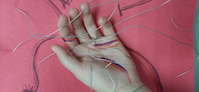
Systematiation of the experiences lived in a space of reflection and dialog among teachers, researchers and students from various artistic and design fields. This particular activity, coined ‘think-tank 0.0’ is the culmination of three similar experiences in which the Nodos team explored how the concept of ‘Artistic Research’ takes shape in practice and as a complex system of intertwined concepts. Hence, the ‘think-tank’ experience initiates with a ‘hands on’ exercise in which participants construct a personal interpretation of a certain ‘phenomenon’ (i.e. Body, light, space and movement) by means of ordering images, drawings, objects, sounds, materials and bodies as symbolic representations of meaningful concepts. Followed these hands-on experiments, participants reflect on the methodological processes followed to construct their interpretations while exposing what sort of learnings, limitations and opportunities where identified. Finally, the various participants engage in a dialogue about their common findings, interests, and sensibilities, allowing them to identify potential theoretical, methodological, epistemological, and empathic partnerships for the future. At the same time, this space for interaction allowed participants to further experience the heterogeneity and similarity of CIDEA’s artistic research constellation and identity.