Overlapping Competencies
(2022)
author(s): Joel Diegert, Jonas Howden Sjøvaag, Adrian Artacho
published in: SAR Conference 2020
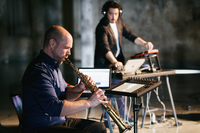
Saxophonist Joel Diegert and composer Adrián Artacho began a collaboration in 2014 with a question about real-time electronics in contemporary music: what kind of works could be produced if the electronics were treated as a ‘part of’ the saxophone? In this presentation they look at the composer-performer relationship with a particular interest in projects that employ real-time electronics. They will describe some of the challenges that can arise in co-creative work and offer strategies for collaboration that center on the idea of ‘overlapping competencies’. The work aubiome for soprano saxophone and live electronics, which was developed during Joel’s doctoral research, will be referenced as a case study.
NEUROPOSTHUMAIN : expérimentation transcyberféministe des techniques de l'hybridité en tant que critique des biopouvoirs dans une pratique de l'art performance technologique
(2022)
author(s): Archie S. Reid
published in: Research Catalogue
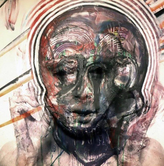
Archie Reid (i(e)l) explore une pratique expérimentale du rapport à ses perceptions. Par une approche de l’hybride et des multiples (mad, trans, non-binaire, gender hacker), ses expérimentations du posthumain déconstruisent et reforment, par la méta-cognition, une exploration transformative de soi, des sens et des synesthésies.
OPTIMAL Practising: An Autonomous Journey of Exploring Enhanced Expectancies and External Focus
(2022)
author(s): Xavier Tan
published in: KC Research Portal
While exploring ways to improve practice methods and reduce stage anxiety, the researcher came across the OPTIMAL (Optimising Performance through Intrinsic Motivation and Attention for Learning) theory of motor learning while reading William’s 2019 research on “Finding Focus”. The theory was proposed by Wulf and Lewthwaite (2016) to utilise motivation and attentional focus in improving performance.
Through a thorough theoretical review of the theory, other relevant studies, and attending workshops and courses, the researcher discovered better approaches and methods to practising for himself, enhancing his quality of practice and promoting personal growth.
By developing and applying an informed method to a group of 13 musicians from the Royal Conservatory of the Hague, this research also investigated the impact of the OPTIMAL theory on the practice of other musicians through a three-week intervention. The goal-coupling action from enhanced expectancies, autonomy, and external focus was found to bring about greater practice quality. The data obtained from the intervention and a retention test also revealed enhanced levels of organisation, objectiveness, mindfulness, and confidence during practice. However, some found themselves more anxious in the process. The intervention highlighted a need for more resources, as well as safe spaces to discuss practice and performance in Conservatoires.
This research hopes that the findings bring about more awareness, acts as a source of information, and encourage more open discussions on the way musicians practice and perform, as more attention could be given to this in the way we shape music education.
“Sonic Spaces for the Stray”: (Dif)Fusing Dis-location in Sound Installation and Performance
(2022)
author(s): Andrea Parkins
published in: Norwegian Academy of Music
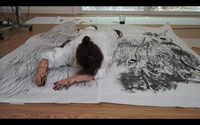
This project examines subjectivity and its embodiment through the application of interactive electronics within sound installation and performance. It employs a merging of theory, method and practice that has not been fully researched to date and which represents a valuable addition to sound performance and electroacoustic composition.
My artistic research focuses on an ongoing series of improvisational/compositional experiments, moving between a dedicated workspace and sound production studios where I will work with acousticians, engineers, and programmers. The aim is to develop gestural/embodied approaches for applying interactive electronics within sound performance and fixed-media composition—mining tensions between failure and fluency; and diffusion strategies that highlight correspondences between embodiment, sound and space—emphasizing tensions between absence and presence.
Foundational research includes studying methods and applications for investigating spatialization and psychoacoustics, employed by artists including Maryanne Amacher. I will also study concepts/methods developed by artists such as George E. Lewis, focusing on interaction between algorithmically-based technology tools and physical gesture in musical improvisation. This research also engages with Julia Kristeva’s psychoanalytically-based writing on abjection and the sublime, grounding my studio-based research in theoretical inquiry that engages with subjectivity and embodiment. Supplementary research will address psychoacoustics, aural architecture, and spatialization theory and technologies.
The outcome of the project will be twofold: a body of sound installations and performances demonstrating an interactive approach to addressing relationships between the body, materiality, sound, space and situation; and a set of reflective writings that articulates the poetics and affective aspects of this multi-layered inquiry. The completed project will offer new knowledge production in the field of artistic research, and transmission of interdisciplinary knowledge to creative practitioners.
Out of the "Engine Rooms"
(2022)
author(s): Michelle Pritchard
published in: KC Research Portal
The late Nineteenth Century saw the emergence of the viola from the ‘engine room’ of the orchestra to a solo instrument in its own right, due to champions such as English violist Lionel Tertis. The viola’s rising status paved the way for collaborations between violists and composers, resulting in an expansion of a relatively limited repertoire and placing higher demands on the performer. Through theoretical and practical based research, I identify the roles and responsibilities of the classical violist when collaborating with living composers. At the centre of my practical investigations were collaborations with four composers in the realisation of new works and exploration of pre-existing works by three composers, as part of a cross-departmental/cross-cultural collaboration. These collaborations highlight the importance of a high level of musicianship and an ability to communicate with and without the instrument. Artistic and intellectual exchange through open communication results in mutually beneficial outcomes and a deeper connection with the music. Additionally, these collaborations reveal that the viola is still emerging as a solo instrument, needing further experimentation and exploration.
The final aspect of my research is the curation of a lecture-recital series showcasing these new compositions, anchored with works from the standard and lesser-known repertoire. The future aim is to perform and record these new works in order to reach a wider audience. Successful collaborations contribute to the generation, promotion, and contribution to the classical viola repertoire and the status of the instrument itself now and into the future.
Bio
Michelle Pritchard is an Australian violist, violinist and pedagogue, studying her Master in Classical Music (Viola) with Ásdís Valdímarsdottír at The Royal Conservatoire, The Hague. In Australia, Michelle studied with Alex Todicescu, Sydney Conservatorium. Later with Jeremy Williams, obtaining an Associate of Music Diploma with Distinction, and a Graduate Diploma of Professional Music Performance Practice through the University of Tasmania. Specialising in chamber music, Michelle established a concert series in Sydney. She has toured Europe as recitalist and as a member of the Hourglass Ensemble. Additionally, she founded ‘Eisteddfod on the Mountain’ in the regional area north of Sydney