Is This Me?-Humanity's Wake-Up Call
(2021)
author(s): Julia Fromm
published in: Research Catalogue
The artist chronicles a beetle. Metamorphosing, transcending physical limitations into transcendental non-human existence, the artist moves over being kinematically shackled and bound by the imagined limits of the human mind. Within the perceptual cell, onomatopoeic expressions metamorphose into an unfettered call for change, albeit within the constrains of its actual existence.
A series of videos chronicles the metal framework, simultaneously concealing and revealing the process of alienation. Oblique perspectives on the adjacency in perception and spatial alienation come into the chronicler's gaze.
The artist confronts her actual intentions-contrasting zones of the 'alienation of the self' and 'self-transformation' by an illustrative enhancement, impelled as humanity's wake-up call, overcoming barriers and impediments, making decisions to transform and recount the tales of the ever-changing.
A∴418: Um Contributo para a Pesquisa Artística em Música
(2021)
author(s): Vasco Alves
published in: Journal for Artistic Research
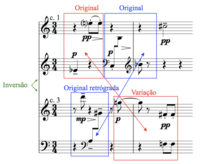
The A∴418 is a method for the systematization of the interpretative musical conception, oriented to the study of musical interpretation. Through the application of two analysis techniques, the researcher demonstrates the expressive idealization and the respective technical configurations of the sound narrative that he builds, as an interpreter, from the original musical text of the composer. At the end, a final score is produced in which both the composer and interpreter’s details appear. This methodological proposal aims to fill a gap regarding the lack of specific strategies that allow the production of knowledge about this interpretive musical practices, in an objective and verifiable way. The results of applying this method suggest a contributory potential with artistic, scientific, pedagogical and technological implications.
Multilayeredness in Solo Performance
(2021)
author(s): Søren Kjærgaard
published in: Rhythmic Music Conservatory, Copenhagen
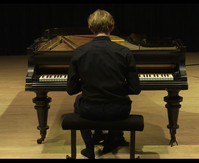
This project investigates the multilayered potentials of solo performance with the intention of opening up the single player limitations often experienced during the creative process of play and practice.
In performance contexts ranging from acoustic solo piano to a digital code-based video keyboard, concepts of multilayeredness are explored through compositional and improvisational strategies, that include instrument topography, extended piano techniques, audio-visual sampling and digital keyboard mapping.
The purpose is also to create results that will contribute to how solo artists across formats can express themselves more dynamically and with greater flexibility in the interaction between their various materials and artistic ideas. A contribution also in terms of expanding methodological approaches to how solo performers and research practitioners can work iteratively and interactively in their reflective processes, inviting both a more verbalised and dialogic form, and to explore ways of documenting and communicating these processes in hybrids between text, sound and image.

The Atemporal Event
(2021)
author(s): Helga Schmid, Kevin Walker
published in: Journal for Artistic Research
The COVID pandemic has prompted many people to reconsider their previous living and working rhythms and to consider alternatives. We believe that the global enslavement to the standardised time of clocks and calendars has had a negative impact on us individually, socially, and environmentally. We aim, therefore, to change perceptions of time by helping people step outside societal time, treating time instead as a malleable material that can be stretched and moulded.
This exposition describes our process, outcomes, and analysis in staging an event using an alternative approach based on natural and material time processes specifically related to the body and the external day/night cycle driven by light colour and intensity. In a twenty-four-hour event in London designed around chronobiological phases, we investigated our research question of how to change perceptions of time by treating it as a malleable material.
We discovered that treating time as a malleable material necessitates first stepping outside of the clock-time system: in our case, using daylight and bodily chronobiological phases as alternative time-givers. Dialogues using linguistic and non-linguistic means between ourselves, our collaborators and participants, as well as with our tools and materials, resulted in treating time as place, and places and things in temporal terms. We discovered that time is not only stretchable but can take different shapes and qualities, with multiple times existing alongside each other, by 'programming' actions and activities through performance, rhythm, and materiality.
Our research focuses on the broader issue of the ‘time crisis’ as identified by sociologists, chronobiologists, and philosophers, as a result of acceleration processes driven by digital technologies and contemporary 24/7 societal norms. We address this by bringing together Helga's research on ‘uchronia’ (temporal utopia or non-time) and Kevin's anthropological perspective on designing embodied experiences.
Composition of graphic and sonic works through the improvisers' co-creation
(2021)
author(s): Laura Toxvaerd
published in: Rhythmic Music Conservatory, Copenhagen
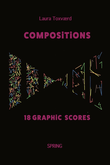
Taking my compositions as a point of departure, the project investigates the improvisers’ co-creation in the compositional process. The composer (in this case, me) explores how improvisers’ ideas can be integrated into the development of the compositions, and explores what impact the integration has on the works of art. In the project, graphic scores are being designed, through the means of which I am seeking to bring forth new aesthetic forms of expressions. Along the way in this project, I have created new compositions that came to be drawn out as scores, which were continually adapted and re-arranged on the basis of the improvising musicians’ concert performances of the existing compositions. The working method could be characterized as an iterative artistic developmental process, which shuttled back and forth between my own compositional work, together with the design and elaboration of the graphic scores, and videotaped rehearsals and performances of my compositions with the collaborating musicians.
Vox Spatium
(2021)
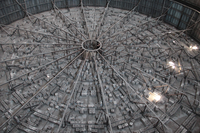
author(s): Sofía Balbontín
published in: Journal for Artistic Research
This exposition recognizes the "Vox Spatium" through the comparative study of acoustic spaces and their reaction to an impulse response (IR). The artistic research arises from two creative instances: a residency at the Experimental Base for Sound Art TSONAMI Valparaíso, Chile (2019) and the field studies of the project Resonant Spaces (Balbontín-Klenner, 2019-2020) in Belgium, Scotland and Spain. Both experiences unfolded as expeditions towards the sound exploration of the acoustics of urban and architectural space. In the exploratory process, the project begins to change its course and redirects the north towards new spatial horizons; the spaces visited are increasingly uninhabitable generating a direct relationship with the intensity of their acoustic interest. In the tracking process towards the "Vox Spatium" a narrative begins to be forged that transcends from human spaces to non-human spaces, raising issues around urban entropy and the current geological era of the Anthropocene. The sound exploration becomes an agency and sound becomes the evidence that reveals the rhythm of the anthropic impact on the planet.