Overhearing the Unheimlich Home: Power and Proximity in “Shut Up Little Man!”
(2021)
author(s): Hannah Spaulding
published in: Journal of Sonic Studies
This article explores the relationship between home and the auditory through an examination of the “Shut Up Little Man!” recordings – secret tapes made by two men of their next-door neighbors’ fights. These recordings documented the vocal performances of an unheimlich domesticity, marked by poverty, violence, and what would become iconic phrases. Embraced as comedy, the tapes were traded and shared, gaining subcultural fan followings and broader popular cultural impacts. The “Shut Up Little Man!” recordings thus offer crucial case study of the permeability of the domestic soundscape, the struggle of ownership over sounds at home, the ethics and politics of eavesdropping, and the intervention of media technologies in these dynamics. Ultimately, this article argues that the tapes’ creation, power, and popularity stem from a desire to listen to the unheimlich home of the urban poor – a desire that underscores social distance, invites identification, and reminds us that proximity does not mean intimacy.
Sonic Relations as Bulging Spheres
(2021)
author(s): Sandra Lori Petersen
published in: Journal of Sonic Studies
In multistory housing, sounds occasionally penetrate the walls and floors separating apartments. It may seem like this is a one-way flow of acoustic waves moving through built material from one inhabitant to another. In this article, I show that acoustic waves passing among apartments often move in more ways than just through built material. I propose a conceptualization of the auditory connection between neighbors as sonic relations that consist not only of concrete sounds but also of a range of abstract emotional layers, elements of personal histories, and interpersonal conflicts. Through an exploration of the accounts of two neighbors living in an early 20th-century building in Copenhagen, I show how the sonic relation between them can be understood as interfering in the domestic-personal spheres that shape both of them.
Studies on Fantasmical Anatomies
(2021)
author(s): Anne Juren
published in: Stockholm University of the Arts (SKH)
Studies on Fantasmical Anatomies is an ongoing transdisciplinary artistic research, which encompasses the spectrum of experiences and practices that I have developed as a choreographer, dancer and Feldenkrais practitioner. By drawing on various fields of knowledge – anatomy, psychoanalysis, feminist and queer theories, poetry and somatic practices – the research expands choreography towards disparate discourses, practices and treatments of the body. Based on Feldenkrais’ speculative use of language, imagination and touch, I have developed several body-orientated practices situated at the intersection of the therapeutic and the choreographic, the somatic and the poetic.
The research is articulated through three transversal movements. The first movement is the expansion and distortion of the Feldenkrais Method® from its initial somato-therapeutic goals into a poetic and speculative way of addressing the body. Secondly, I propose experiences of diffraction, "blind gaze" and dissociation as a strategy for troubling the dominant regime of vision. The third movement consists of the co-regulation of bodies and dynamic relationships between the individual and the collective.
Combining fantasy, the fantasme and phantasmagoria, I invented the word “fantasmical” to emphasize how the ability to imagine may create phantom limbs that are as concrete as pieces of bone. Studies of Fantasmical Anatomies are simultaneously a set of practices, methods and places where the corps fantasmé is tangible.
What is the word
(2021)
author(s): Renee Jonker
published in: KC Research Portal
What than is music? – Music is language.’ Composer Anton Webern was quite outspoken in 1932 : 'A human being wants to express thoughts in this language, but not a thought that can be transferred into an idea, but only into another musical thought.’ Almost sixty years later composer Wolfgang Rihm isn’t sure whether music is a language but states in his speech 'Was ‘sagt’ Musik/ What does music ‘say’?:’ if music is saying something, than the first what is addressed to us is: speak! Music wants to make us speak. That’s what music says!’
That raises the question whether music can be referential or carry meaning just as language can. A question that has made many speak and filled libraries of studies. Cognitive psychologist Aniruddh D. Patel writes in 2008: ‘A natural place to turn for help in defining musical meaning is the work of music theorists and philosophers of aesthetics’. After summing up a dozen publications on the topic since Webern made his statement, Patel reports: ‘No consensus has emerged from these writings for a definition of musical meaning.’
There is a lot of evidence in linguistics that qualities attributed to musicality contribute to language being the carrier of meaning. So what about the other way around? Can language help to understand what is experienced as meaningful in music?
Language itself is an indicator that qualities inherent to language are often given to music. In German the word Interpret is used for instrumentalists performing music. The Dutch language has the word zeggingskracht that attributes power to music. 'Zegging-’ stems from the verb zeggen (to say), ‘kracht’ means power. Zeggingskracht was one of the three criteria to assess the work of composers by the Fund for the Creation of Music (Fonds voor de Scheppende Toonkunst ) in The Netherlands. When the power to speak is inhibited and people stammer or lose their speech suffering from aphasia, it has been said that “only music, can do the calling.” And it’s almost a cliché to say that music can express what can’t be given words.
Music is not a language but often sounds like one. What do musicians that are ‘speaking’ that music have to say about meaning in music, singing, performing or creating what composer Louis Andriessen describes as ‘talkative’ music? Or the stammering that composer György Kurtág calls his mother language? How do musicians give words to those moments when their music does the talking?
What is the word is the last text that Samuel Beckett completed at the end of his life when through a stroke he periodically suffered from the disability to finds words, commonly diagnosed as aphasia. The Irish author inspired many to explore the zeggingskracht of music. Precise as he was, Beckett left out a question mark in the title, both in the original French version of Comment dire and in his English translation. That the title of Samuel Beckett’s last text is not posing a question but may provide us with an answer, is the hypothesis of this research.
Movement first : Directing for Movement-Based Performative Arts
(2021)
author(s): Lena Stefenson
published in: Stockholm University of the Arts (SKH)
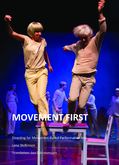
Making performances that have movement as a base means in many ways to venture out into an unexplored landscape. What is to be played on stage usually has its origin in a movement-based idea and not in an already written text to be analyzed. How can this work go? Where are the challenges and what methods can be used?
Lena Stefenson has written this book on the basis of her own experiences as a choreographing director with examples from various works as well as her own and others' teaching. The text is about how to create the elevated movements in a performance. How to work with theme? With story? What is the relation between text and movement? What does it mean to be a choreographer / director for a movement-based work? How are the last rehearsal weeks going?
The book is aimed at anyone who is, or wants to become, a choreographing director or actor in the movement-based performing arts with forms such as dance, mime and circus. It is also aimed at those who generally want to make their scenic work more physical.
Smitte som skapelsesmaskin
(2021)
author(s): Liv Kristin Holmberg
published in: VIS - Nordic Journal for Artistic Research
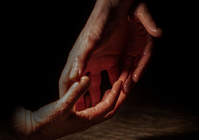
The exposition ”Smitte som skapelsemaskin” (Contagion as a creation machine) is based on the artistic project ”Kroppsliturgiske eksperimenter” that explores the boundaries emerging when performing arts and human bodies enter the sacred space of a church. To what extent does the church as a social and architectural environment, shape human conceptions of bodies? What might the history of theology and of the Christian church tell humans about our relationship to our own bodies? The pandemic has put the above questions in a new light: It made the skin a potential carrier of life-threatening infections. At the same time, we suffered the lack of mutual human touch and of physical presence. Caught between the fear of being infected by touch and a hunger for being touched, the project ”Kroppsliturgiske eksperimenter” appears both challenging and attractive. Crisis has produced a desire for new forms of touch, in art and in human life. This contribution to VIS was created in collaboration and dialogue with performer Hanna Barfod, priest, professional singer and research fellow Mathias Gillebo, film photographer and editor Mats Christian Rude Halvorsen and priest Arne Jor.