Corona Influentia och den mörkare materian
(2021)
author(s): Timo Menke
published in: VIS - Nordic Journal for Artistic Research
In my practice as an artist, I constantly return to the dark agency of cosmic and (micro)biological matter. I explore how it may transform, “infect” or enter into symbiotic relationships, that are linguistic, visual, and trans-material in the spirit of Karen Barad. The aim of my work is to offer an outline of what I refer to as a dark enlightenment, by using the ontological and epistemological discourses that humans are entangled in. This text is a manuscript for a performance lecture about bats, viruses, and dark matter, illuminated by a Corona inside Plato’s cave. Similar to and in contrast with the microscopic size of the virus, the pandemic is not here understood as the ultimate disaster, but rather as a footnote in a much vaster narrative that involves a manifold of associated phenomena, related to Timothy Morton’s hyperobject. From the view point of speculative realism, object-oriented ontology, and hauntology, the virus may be capable of hiding future consequences that dwell in our darkened contemporary world. In short, the manuscript may be understood as a contribution to the dark microhistory of an infection. The current version of my work was adapted for online publication, with visual elements of composition.
Viral Drawings: Transmission BC / QT / AV
(2021)
author(s): Karen Schiff
published in: VIS - Nordic Journal for Artistic Research
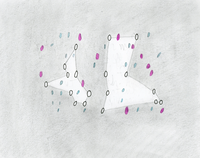
This exposition reflects on the drawings I was making at different stages during the COVID-19 pandemic. Initially they are compared to my long-term practice of making abstract drawings patterned on language, and then they are used to theorize a "poetics of transmission." This framework is discussed in relation both to how the virus is transmitted and to how ideas are created and circulated. Various analytical interpretations of the drawings are considered. At some moments, I treat dots in the drawings like ideas or virus particles; at other moments, the strategies I use for connecting the dots represent the process of generating ideas. The drawings become tools for the "research" of thinking through physical and intellectual contagion.
The Plot, The Compositor, Mourning/Mistakes
(2021)
author(s): Alexandra Crouwers
published in: VIS - Nordic Journal for Artistic Research
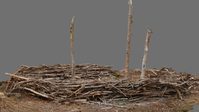
In the Summer of 2019, a small family forest fell victim to a spruce bark beetle plague. Unusually mild winters caused larvae numbers to explode, and extreme drought weakened the otherwise more resilient trees. Expanding patches of dead forest can be found from the North Sea coast to the Baltics. The cleared forest became The Plot: a witness to climate change, and a gateway to dealing with ecological grief. My own eco-anxiety is utilized as a case study: how to deal with this new kind of loss? What is The Plot telling us? How do we move forward without losing hope? The exposition presents The Plot as fertile ground for artistic and collaborative research, including a contribution by Lisa Jeannin, a custom made font, moving image, and an audio work.
Soft to the Touch: Performance, Vulnerability, and Entanglement in the Time of Covid
(2021)
author(s): Jennifer Torrence
published in: VIS - Nordic Journal for Artistic Research
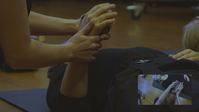
What is the nature of human touch and human contact in contemporary music performance, both in general and in the context of the COVID-19 pandemic? In a time when bodies must be kept at several meters distance, what comes of works which explicitly call for closeness, physical contact, and sharing? How might these works be interpreted differently in light of the COVID-19 pandemic? Percussionist and performer Jennifer Torrence reflects on the impact of the pandemic on her artistic practice and on her research as part of the project entitled Performing Precarity, which seeks to explore the inherent risks in performance when musicians and audiences are entangled in codependent structures. In light of COVID-19, this exposition attempts to unfold and trace modes of vulnerability in contemporary music performance—from human contact via eye contact and physical touch, to the precarious negotiation of shared space—and to reflect on how such encounters might breed new understandings and knowledge.
REPUBLIC OF THE OTHER
(2021)
author(s): Xenia Mura Fink, Jinny Yu
published in: Research Catalogue
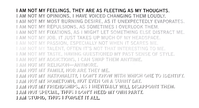
REPUBLIC OF THE OTHER is an art collective consisting of and founded by Jinny Yu and Xenia Fink.
A contradiction in itself, REPUBLIC OF THE OTHER reflects our questioning of geographic and national identities defined by borders and boundaries and is the basis of our research on the attraction to form an entity.
Our collaboration started with the urgency to express our resistance against the generalized right-wing tendency, with nation-states and borders strengthening with great force worldwide and with the conviction that we have something to contribute to the discussion.
Manifestos as a subject matter are our way to describe a utopia where we all accept each other as an “other”.
Our practice is executed through exchanging and developing ideas from our respective locations. Remotely sharing thoughts naturally lend to working with text as a medium; when we occasionally do convene, concepts may also take the shape of installations and video work.
The other's sonic experience; Bus22
(2021)
author(s): Kim Minji
connected to: Royal Academy of Art, The Hague
published in: Research Catalogue
The research includes one and a half years of artistic practice and research about the sonic experience while highlighting the exploration of the ‘Sonic experience of the others’.
It starts from a first-person – myself; what I am listening to now? It quested by sound notation in an explicit form and listening performance to understand the structure of hearing in a philosophical way.
Then, the research shows how the writer’s interest moved to ‘the other’ with the question: What is this I’m listening to and how is it different what you’re hearing? and attempts to bring the method of fiction to reveal the third person’s sonic experience.
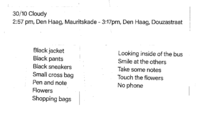
Bus 22 is an audio-playback fiction with visual instructions. It helped by two keywords, Anamnesis: mnemo-perceptive effects, and Voice in thoughts: storytelling.
At the last, the author talks about difficulties in the process, nevertheless, the perceived artistic value of the topic as non-objected oriented sound art.