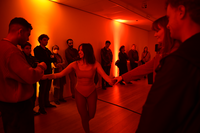
Sculpting Music Performances: About Choreomania and the Process of Shaping a Performance
(2025)
author(s): Silvia De Teresa Navarro
published in: KC Research Portal
This research explores how choreomania - the historical phenomenon of uncontrollable, communal dance “plagues” that emerged in the Middle Ages - can inform and shape my artistic practice. Central to this inquiry is the question: how does choreomania influence my creative process and the way I shape my performance practice as a classically trained pianist? The study unfolds three main blocks. First, an essay examines the conceptual formation of choreomania, its contemporary relevance, and its impact on my artistic work. Simultaneously, I observe and document the creative processes of artists-in-residence during my internship at the residency programme "Choreomania - Bodily Excess, Collective Unrest". The thrid block involves an experimental playground consisting of several performance try-outs, each rigorously documented, analysed, and reflected upon. Adopting a rhizomatic approach, I explore performance-making as a fluid, irregular process. The resulting performances weave together classical piano, improvisation, movement, voice, collaboration, live-electronics, audience engagement, and the submerged elements of choreomania. The research culminates in a synthesis and reflection of the entire process, offering new insights into performance-making.
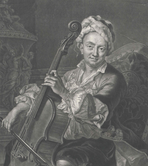
The Birth of Cello Virtuosity
(2025)
author(s): Antonio Pellegrino
published in: KC Research Portal
At the turn of the nineteenth century, cellists were trained to provide chordal continuo realisation for recitativi in various parts of Europe. In other words, when they accompanied an upper voice, players would create a harmonically rich texture to better support the line above them, filling in chords rather than playing single bass notes. My research aims to trace the origins of this practice, examining pedagogical materials from the Neapolitan conservatories at the end of the 1600s. First, we investigate sections of the Montecassino Manuscript MS 2-D-13 (1699), analysing cases when Neapolitan-trained cellists needed to conjure up music beyond the written bass line. Selected works by prominent cello virtuosi and pedagogues of the time (Rocco Greco, Gaetano Francone, and Francesco Supriani) help us grasp how the violoncello gained the possibility of playing sophisticated improvised lines upon a bass and even (dare we say) partimenti. The second part of my research takes us forward in time to the second half of the eighteenth century. We discover how Salvatore Lanzetti and Antonio Guida continued the pedagogical traditions established by the preceding generations of Maestri, crafting methods that trained cellists to employ the rule of the octave in order to get comfortable with chordal improvisation. Ultimately, these explorations aim to suggest how the ground may have been fertilized for the growth of the aforementioned recitativo practices in the late 1700s, treating chordal continuo realisation as a result of a dynamic process across generations rather than an isolated phenomenon.
o fazedor de imagens
(2025)
author(s): ska Batista
published in: Research Catalogue
Este ensaio visual parte da figura do fazedor de imagens, onde articula experiências
pessoais, memórias, imagens apropriadas e práticas performativas para evidenciar
que toda memória é, em essência, partilhada e continuamente reencenada. A
pergunta-afeto que orienta o percurso é: e se eu fosse imagem? Um convite à
reinvenção coletiva dos modos de existir, fazer e imaginar. tal como os vaga-lumes de Didi-Huberman que persistem e
brilham mesmo em meio à noite iluminada pelos holofotes… Dessa forma, convida-se a
imaginar… imaginar apesar de tudo.
Maisterin opinnäyte / taiteellinen osio
(2025)
author(s): Pia Korhonen
published in: University of the Arts Helsinki
Taideyliopiston Teatterikorkeakoulu / Kirjoittamisen maisteriohjelma / opinnäytteen taiteellinen osio.
Esittelen kenttälaboratoriossa kenttäkirjoittamisen menetelmiäni tekstien, kuvien, videoklippien ja ääninäytteiden avulla. Näytteenotto, näytteiden esikäsittely ja esikäsiteltyjen näytteiden jatkokäsittely ovat keskeisiä poeettisen kenttälaboratorioni toimenpiteitä ja asettuvat vuoropuheluun luonnontieteellisen kenttätyöskentelyn proseduurien kanssa.
A/r/tographic design of an a/r/tographic course for staff in higher education
(2025)
author(s): Tone Pernille Østern
published in: Research Catalogue
This exposition is part of the peer-reviewed article:
Østern, T. P., Reppen, C., O’Connell, S., & Daneberg, M. (2025). Choreographer/researcher/teacher: Developing a/r/tography as an approach to dance pedagogy at Stockholm University of the Arts in a professional learning community of teachers. Nordic Journal of Art & Research, 14(2). https://doi.org/10.7577/ar.5460
This exposition explores my a/r/tographic design dive as course coordinator of the course "A/r/tography in theory and practice in higher education" (7.5 ects) at Stockholm University of the Arts.
The decision to create and offer this course arose from a large collaborative change project at the former Department for Dance Pedagogy. The project led to a revision of the BA in Dance Pedagogy into an a/r/tographic study program, emphasizing the entangled roles of choreographer, researcher, and teacher.
The course was developed to support professional development in a/r/tography for staff teaching across arts disciplines in higher education.
As course coordinator, I dove into the course design a/r/tographically.
5 år etter- en musikksosiologisk undersøkelse av unge og nyetablerte musikeres levekår
(2025)
author(s): Marianne Baudouin Lie
published in: Research Catalogue
Som ferdigutdannede frilansere har profesjonelle musikkutøvere hverken fast ansettelse eller forutsigbare arbeidstider, så hverdagen for mange vil aldri bli helt forutsigbar uavhengig av hvor mange spillejobber man får eller hvor mye man underviser. Musikere er også en yrkesgruppe som kontinuerlig ser seg nødt til å kjempe for sin egen status i samfunnet, og i så måte «rettferdiggjøre» sin egen eksistens som profesjonell utøver. Dette kan gjelde ovenfor både «outsidere», som nedvurderer verdien av deres håndverk og kunnskap – i et tilfelle fikk en informant en kommentar fra egen svigermor om «å finne seg en ordentlig jobb» i tillegg til musikken – og andre «insidere», ved at man hele tiden vurderes på ens evne til å spille bra og prestere i møte med publikum – en informant kommenterte at «man er kun så god som den siste spillejobben man gjorde». Til tross for enkelte goder og oppsider med musikeryrket, er det mange utfordringer for de som dedikerer seg til musikken på fulltid.