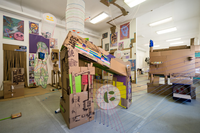
This exposition examines the intersection of drawing, installation, and handmade objects informed by popular culture, spectacle, and visual symbolism. Central to the practice is the duality between physical materiality and virtual environments, a framework through which fictional realities are constructed and analyzed—often reflecting states of exhaustion, overload, and alienation characteristic of hyperactive contemporary culture. The use of low-budget materials and do-it-yourself methods introduces a deliberate tension between meticulous craftsmanship and intentional “amateurism,” while simultaneously subverting the capitalist logics of mass culture through the reuse and recontextualization of its visual language. Connecting introspective and social dimensions, the exposition offers not only an aesthetic experience but also a critical lens on everyday consumer routines, media-shaped reality, and processes of personal self-reflection.
The exhibition is deeply rooted in local history—the artist group explores the story of the white pigment titanium dioxide's industrial origin in Sandbekk, and how this world sensation from 1910 has influenced our world today. Titanium dioxide white pigment is a global color phenomenon. Ilmenite is transported from Titania to its sister company Kronos Titan in Fredrikstad, where it is refined into titanium dioxide. From there, the pigment circulates seemingly invisibly in a global network of systems. It is used in paint, plastics, paper, ink, cosmetics, medicine, sunscreen, and millions of products we use daily. This history is the starting point for the development project TiO2: The Materiality of White.
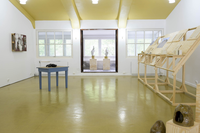
Over the past two years, the artist group has visited Titania's mines and deposits, gathering materials from the local history. Just as geologists examined the areas in Sokndal over 150 years ago in search of valuable minerals, the group has wandered through the landscape, picking stones and collecting sand, clay, and rust-colored earth. These findings have been brought back to the ceramic laboratory at KhiO, where they have been processed through ceramic methods.
This exposition comprises textual fragments (both written and voiced) produced through the act of returning to (in turn re-activating, re-configuring, even re-imagining) conversational transcripts generated within the artistic research project Dorsal Practices, a collaboration between choreographer Katrina Brown and writer-artist Emma Cocker. Initiated in January 2021, Dorsal Practices is an artistic collaboration for exploring how the cultivation of a back-oriented awareness and attitude might shape and inform our embodied, affective and relational experience of being-in-the-world. Conceived at the threshold between choreographic-movement practices and language-based artistic research, Dorsal Practices explores how the experiences of listening, languaging, even thinking, might be shaped differently through this embodied tilt of awareness and attention towards the back, moreover, through a practice of coming back, the act of (re)turning. The original transcript material that forms the basis of this exposition was produced through a practice of conversation undertaken within six interrelated blocks of exploration, taking place over 18 months between October 2022 and February 2024. Within this period of enquiry, we — Brown and Cocker — focused our attention on the act of returning within our shared practice, re-imagined as a "dorsal turn". Through the intermingling of two registers of language-based practice, that is, through the performativity of both the written and spoken texts themselves, within this exposition we attempt to make tangible how the dorsal gesture of the turn and the circling principle of re- become operative as a spinal thread within our shared enquiry. Deviating from the straightforwardness of a strictly linear text, we invite a form of dorsal listening-reading that might engage through loops and returns. We conceive the research artefacts generated through the practice itself as the central focus within this exposition, alongside a supporting text where we introduce the wider enquiry of Dorsal Practices, reflecting on how we conceive the act of turning and of re-turning therein.
The term ‘Occupational Folklore’ refers to the social expressions of people, linked to the work that they do. This exposition explores the possibility of there being a common language of clay, a vernacular that can be used to story-tell, and how stories arise from the studio, from the intersection of making, thinking/talking and clay.
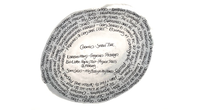
Comprising three discrete projects, we move from a study of the materiality of voice to establishing a vocabulary of clay to a narrative collection of embodied experiences. Their combined knowledge leads to a fourth project, in the form of conversations held whilst making around a studio table. Passages from the exchange are filmed and analysed from the perspective of ‘small stories’, an oral history methodology that gives focus to the speculative, iterative and nuanced decisions often overlooked in a conventional account of a conversation. When applied to the making process, it begins to uncover a deeper understanding of the processual and implicit decisions that take place through the interaction of making, thinking and material properties. The passages allow us to witness the very emergence of storytelling taking place, the moment at which life experiences intersect with formations in clay.
The aim of collecting all four projects together is not simply to document examples but, as with all modes of folklore, to use story to identify and share more resilient and connected ways of being in the world. Within these intersections lie the porous and mutable properties of clay practice, that are rapidly redefining the wider field of ceramics in terms of its social contribution. Contained within these social expressions of clay lies its ability to connect with and contribute to wider community and environmental issues. The term occupational folklore is used in recognition of the historic continuity of behaviours, actions and beliefs that arise from these interactions, if only we shift our focus from individual attainments to the collective knowledge and transferable learning these small stories contain.
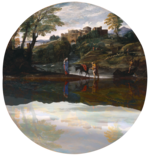
Troubling the Ideal Landscape – A Visual Narrative critically examines possible intersections between imagination and physical landscape. Through a practice-based approach, this exposition explores the composition and decomposition of ideal landscapes, with a focus on Cannero Riviera, a small Italian village. Grounded in my doctoral research at PhDArts, a collaboration between ACPA, Leiden University, and the Royal Academy of Art in The Hague, the project employs spatial montage as both a methodological tool and an artistic outcome.
By fragmenting the landscape into moving images, I seek to disrupt conventional visual regimes and reflect on the ideological forces shaping the village and its environment. This approach is informed by Aby Warburg's Mnemosyne Atlas, where fragmented images form unstable constellations that navigate multiple meanings, temporalities, and spaces. Engaging with Warburg’s method, I question crystallised, linear visualisations of the ideal, focusing on dynamic processes of spatial composition.
The exposition aims to reframe landscape imagery not as a passive backdrop, but as an active force. It proposes a model of the ideal landscape that resists linearity, embracing a complex, shifting narrative that questions the visual regimes through which contemporary imaginaries of place are constructed.
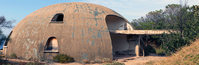
In this paper I propose to re-visit the outcome of a research trip I made a few years ago to the island of Sardinia in order to capture stills and video of a dilapidated villa, La Cupola, once belonging to the Italian filmmaker Michelangelo Antonioni. The research output took the form of an essay video using a film studies methodology to critically re-assess Antonioni’s classic 1960 film L’Avventura. The research took the form of what I would term an occularcentric-cognitive approach whereby my analysis was based primarily on my visual interpretation of the villa. My mental image of La Cupola on first hearing about it was replaced by the online image in my research process, which in turn was replaced by the real image when I arrived at the site, and ultimately by the mediated images of my audio-visual essay. But what wasn’t included in this original research was an unexpected opportunity to enter inside La Cupola, which I retrospectively realised offered an entirely new understanding of the space. With reference to both film and architectural theory, this paper will seek to understand my encounter with the villa according to a primarily sensory and embodied interpretation rather than a sighted one.