The Right to Polished Sound: Age and Class in the Viennese Balkan Music Scene
(2022)
author(s): Ondřej Daniel
published in: Journal of Sonic Studies
This study explores the musical sounds that link contemporary Vienna to the countries of the former Yugoslavia. For this purpose, I uncover a layer of South Slavic sounds in the Austrian capital and analyze two musical contributions to the city by migrants from this former socialist federation. I consider Vienna’s residents from the former Yugoslavia to be a distinct acoustic community; the two sound objects are in particular analyzed regarding age and class of both their producers and consumers.
Contextualities of Listening to Soundscapes: The Past and The Present Converging in Sarajevo
(2022)
author(s): Maja Zećo
published in: Journal of Sonic Studies
This article discusses the relationship between autobiographical memories and personal and group identities in the post-conflict soundscape of Sarajevo in Bosnia and Herzegovina. The discussion will focus on the perspectives of residents and their intersecting narratives, collected in interviews, on the city's soundscape. I will relay intimate experiences of the city's soundscapes, contextualized from the position of a listener who is native to the city. The ways in which memories of the recent war (1992-1996) inform conversations reveal links between traumatic memories and experiences of environmental sounds. From the religious calls of mosques and churches to inhabitants pleading for help on the streets of Sarajevo, the complexity of contexts that play a role in knowledge production about the city will be explored through listening and writing. The article, in the form of praxis, aims to accentuate the importance of local knowledge of soundscape as a means of decolonizing the sonic arts discourse. An interest in the ways that the city’s inhabitants engage with contemporary soundscapes and how the past informs our present knowledge about places guides this inquiry.
Сарајево concrète
(2022)
author(s): Lasse-Marc Riek
published in: Journal of Sonic Studies
The recordings presented here are made in 2004 in Bosnia and Herzegovina, with the main focus on Sarajevo. I had come to Bosnia to find out what was still audible from the war, which at that time was ten years ago. The central core of the recordings is the documentation of everyday life: churches and mosques, streetcars, people on sidewalks and in cafes. Ten years after persecuting and murdering each other, they are living together again.
Remuer les cendres
(2022)
author(s): Benoit
published in: Research Catalogue
Le projet s’intitule Remuer les cendres et je propose une réflexion sur les corps non réclamés des personnes décédées à Montréal. Dans mes recherches, je m’intéresse aux histoires individuelles et collectives que j'aborde à travers la photographie et le témoignage. Plus précisément, je suis préoccupé par le thème de la mort. C'est-à-dire que je la trouve mystérieuse, silencieuse et elle vient bousculer nos vies sans avertir dans nos familles. Elle vient chambarder nos émotions et nos angoisses. Elle se déplace pour nous renseigner que l'éternité n'existe pas, et elle nous invite à vivre le néant, qui nous attend, une fois que la mort se présente.
Concert for Double Bass ‘In Absentia’
(2022)
author(s): Ivar Roban Krizic
published in: Research Catalogue
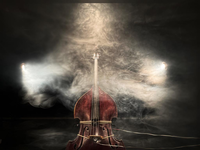
The project “Concert for Double Bass ‘In Absentia’” explores the effects of spatial displacement between performer and audience on the production and reception of free improvised practices. An instrument fitted with contact speakers and placed in a space becomes a conduit for sound, creating a reversal of roles–the audience is present in the performance space while the performer streams an improvisation from another location. This setting breaks established conventions and expectations of a performance situation, and therefore allows for a thorough analysis of the various ways in which improvisatory practices are perceived and conceptualized. The framework of the performance provides stimulation resulting in a series of qualitative interviews with members of the audience on the topics of absence, classification, perception of musical form, distraction, and interaction. Through these interviews, clear irritations in relation to the absence of a performer have been observed. These initial irritations in turn stimulated heightened levels of imaginative thinking and listening during the performance. This project shows how an experimental performative setting can provide a starting point for subsequent theoretical research.
Do we create enough space for mistakes within the film system?
(2022)
author(s): Carina Randloev
published in: International Center for Knowledge in the Arts (Denmark)
Do we need to make more mistakes to keep the film language alive as cinema window no 1, in a time of high performance streaming platforms? Can we use the open process approach from visual art to do so?
In this exposition I will unfold thematic aspects related to: the audience, the film funding system, open processes, the production value, the space in between (art and film, documentary and fiction), something about language, the mistake, experiments, the ugly, and expectations on format.
The exposition is the result of six months of preliminary Artistic Research conducted at The National Film School of Denmark.