auto-ethno r/c
(2021)
author(s): christian scott
published in: Research Catalogue
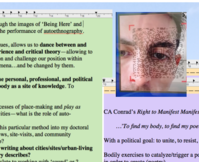
performing autoethnography requires writing that is dangerous, messy, risky.
Gut Feeling
(2021)
author(s): Robertas Narkus
published in: Research Catalogue
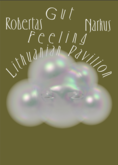
The research on the project
Coded Perception: 'Out of the Corner of One's Eye'
(2021)
author(s): Mike Croft
published in: i2ADS - Research Institute in Art, Design and Society
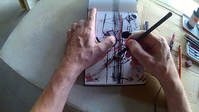
The exposition concerns how aspects of perception, mainly visual but not excluding other senses, are encoded within the artist’s drawing-based practice. Such coding is increased due to the artist's use of speech and its recording to eventually produce textual transcripts, and video evidence of the process of drawing while drawing. More inclusively stated, the artist’s practice oscillates between visual and linguistic means, and analogue and digital methods. As research, the exposition questions where and how coding is implicit in the artist’s perception during his approach to his work. Such questioning is enabled by a split between the artist in his reflexive involvement presented as speech transcripts and supporting screenshots from the video recording, and his reflective observation on the content of the transcript as if made by another-person interlocutor. The exposition is presented as a textual introduction and conclusion, between which is access to the full audio-visual recording of the drawing process and a flip-book presentation of the transcript and interlocutor interventions. The exposition's main image is the artist's finished drawing.
Angela Ramette
(2021)
author(s): Angela Ramette
published in: Research Catalogue
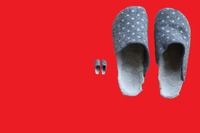
Die künstlerische Forschungsarbeit ‚Eine Anatomie der Macht‘, erforscht ein klassisches sozialarbeiterisches Paradigma, das ‚Machtgefälle‘ zwischen, Klient_in und Sozialarbeiter_in, sowie die implizite Machtstruktur sozialarbeiterischer Interventionen, als exemplarische Fragestellung und Anwendungsbeispiel, durch künstlerisch- ästhetische Mittel. Über die künstlerische Forschungsarbeit wird das Thema visualisiert und körperlich- sinnlich erfahr- und erforschbar. Die zu Grunde liegende Forschungsfrage lautet: Wie beforsche ich ein Thema oder eine Fragestellung der Sozialen Arbeit über ästhetisch-künstlerische Mittel, und welche Methode lässt sich aus den Ergebnissen des exemplarischen Forschungsvorgangs ableiten?
Entstanden im Rahmen eines Reflexionsseminars zur professionellen Rolle des/der Sozialarbeiter_in, des Bachelorstudienganges Soziale Arbeit, beinhaltet das originäre Forschungsprojekt der Künstlerin, Ansätze, welche auch im Kontext Lehre und dem ‚forschenden Lernen‘, partizipative Zugangsmöglichkeiten ermöglichen. In dieser Verbindung liegt die Kernhypothese der Künstlerin: künstlerische Forschungsdesigns für sozialarbeiterische Fragestellungen nutzbar und partizipativ anwendbar zu machen.
Die in der Performance verwendeten Materialien und Objekte können als ‚Sprachzeichen‘, ähnlich wie eine ‚Übersetzung‘ in die sinnlich- erfahrbare Welt, verstanden und analysiert werden. Über die künstlerischen Handlungen im Forschungsprozess, welche sich methodisch als ‚‘Denken/Reflektieren in der Kunst‘, ‚Improvisieren und Sammeln‘, und ‚Inszenieren‘ beschreiben lassen, führen eine Analyse und Reflexion zu einer Logik und Eindeutigkeit innerhalb der performativen Erzählung. Die daraus abgeleitete Methode, beschreibt eine ‚Probenforschung des Sozialen‘ und wird im folgenden Forschungsbericht detailliert vorgestellt. Die ‚Storyline‘ der inszenierten performativen Elemente, bietet während des Datenerhebungsprozesses, die Möglichkeit kollektivistisches Wissen, sichtbar und befragbar zu machen, und im angeschlossenen Publikumsgespräch in eine diskursive Form zu überführen.
Constructing a framework for interdisciplinary performances featuring classically trained musicians and dancers or actors
(2021)
author(s): Joel Gester Suarez
published in: KC Research Portal
The research aims to construct a framework for interdisciplinary performances. This framework is organised in the different components that shape creative processes. The research follows a process that begins with my experience in the dance-music collaboration “The Devil on the Dance Floor”, which included my ensemble Quinteto del Diablo, dancer Rosanna Ter Steege, and stage director Laura Suárez. The insights gained from this project, as well as the interview with director and actress Laura Suárez, led to the theorisation of the framework.
The mentioned components are organised in a map. Each one of them serves as a possible starting point for a creative process. The propositions drawn from the framework support the notion of non-hierarchical creative processes. However, it also concludes that all the mentioned components have to be observed and worked with according to their qualities. After the layout of the framework, the interview with dancer and choreographer Mar López provides a critical comparison to support the theory through the experience of someone outside my environment. The last section analyses my master project, a piano-dance duo with Rosanna ter Steege, as a practical application of this theoretical framework. The research aims to set a framework that can help me and others, especially classically trained musicians, when working on an interdisciplinary performance. The format of the presentation is a research exposition.
(Un-) settling Sites and Styles
(2021)
author(s): Einar Røttingen, Bente Elisabeth Finseraas
published in: Faculty of Fine Art, Music and Design, University of Bergen
(Un-)settling sites and styles: In search of new expressive means.
Eight performers (voice, piano, violin, cello), one musicologist and one composer aspired to unsettle their habitual ways of working with musical interpretation of 20th century and contemporary Norwegian composers. By collaborating to develop new perspectives and methods, they investigated questions of style and how different sites influenced their rehearsals and performances.
How do performers find new expressive means? How can intersubjective exchange within a research group contribute to articulating tacit knowledge? How can mutual unsettling approaches influence conventional or subjective attitudes of fidelity to a score or a performance tradition? How can novel sounds, musical material and musical meaning emerge beyond prejudiced conceptions or through improvisation?
The three-year project was facilitated by the Norwegian Artistic Research Programme and the Faculty of Fine Art, Music and Design (Grieg Academy), University of Bergen, and resulted in texts, sound recordings, videos, and new commented score editions.