ARTISTS AND MACHINE INTELLIGENCE
(2024)
author(s): Linda Janson, Mirko Lempert
published in: Stockholm University of the Arts (SKH)
In the dynamic interplay between art and technology, the integration of artificialintelligence (AI) has opened new frontiers of exploration and expression. Our researchproject, initiated in 2021, ventured into this evolving landscape with a mission to examinethe relationship between AI and contemporary artistic practices. Focusing primarily ontext and image synthesis using AI technologies, our project embarked on an in-depthexploration of the creative potentials and limitations of Large Language Models (LLM).This journey was far more than a technical exercise; it represented a deep dive into thefusion of creativity and technology, examine traditional workflows, especially related topre-production in filmmaking. The project revealed AI's capacity to both emulate andstimulate human creativity, offering insights into the capabilities and boundaries of LLM inartistic creation. These reflections are not just a recount of past achievements but a lensthrough which one can view the potential and future intersections of art and machineintelligence.Leading the research project are Linda Janson, a production designer with over 30 yearsof experience in the art departments of films, TV series, and commercials, currentlyserving as a senior lecturer in production design at Stockholm University of the Arts, andMirko Lempert, founder of the company Monocular. Monocular specializes in integratingAI with traditional 2D/3D techniques for practical applications in visual content creation.This project is driven by their collective goal to investigate the practical applications of AIin visual arts, combining Linda’s extensive industry experience and academic backgroundwith Mirko’s expertise in applying AI technologies. Their joint effort focuses on enhancingthe methodologies of visual arts and design education to align with the ongoingadvancements in digital technology.We would also like to recognize and express our gratitude to PhD candidate Marc Johnson, whose significant contributions were instrumental in initiating this researchendeavor and who has continuously supported the process with valuable advice andexpertise.Lastly, we wish to emphasize that Chat-GPT served as an editorial assistant in thecomposition of this report. This involvement was twofold: as an integral part of ourresearch methodology and as a proficient contributor, aiding in the summarization,formalization, and articulation of arguments to deepen the discourse on the topic ofArtificial Intelligence in the visual arts.
O naufrágio e as miragens da ilha.
(2024)
author(s): FELIPE Argiles
published in: Research Catalogue
Desenvolvendo um ensaio visual a partir de reflexões sobre a metáfora do naufrágio e a experiência de imigrar.
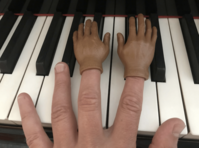
Puppets at the piano (11.08.2023) by Ellen Ugelvik
(2024)
author(s): Ellen Kristine Ugelvik, Io Sivertsen
published in: Norwegian Academy of Music
In Performing Precarity we have been working with several composers staging projects that enhance unstable situations on stage. For Berg & Høeg’s Photostudio I composed the music myself. In this exposition I reflect upon experiences from the process of creating and performing the music in improvisational dialogue with my collaborators in Theater Corpus.
What ideas and work methods are available to me in the encounter between puppets, actors, myself and my instrument? How can themes and experiences from the research project Performing Precarity inform the work?
My reflections deal specifically with the music, despite the fact that the music clearly cannot to be separated from the whole setting. Many thanks for permission use our material in this exposition; Tormod, Aina, Tuva, Ragni and Daniel.
Como naufragar em segurança
(2024)
author(s): Diego Xavier
published in: Research Catalogue
Este é um ensaio sobre a metáfora da navegação baseado no texto “A Engenharia do Naufrágio” de Hans Blumenberg . E aborda como a deriva lúdica, a cartografia e a psicogeografia, atuam enquanto metodologias de pesquisa em minha investigação em artes.
Editorial: Inaugural issue of an emergent journal on arts, design, and performing arts
(2024)
author(s): Filipa Cruz, Fabrício Fava, Maria Manuela Bronze da Rocha, Orlando Vieira Francisco, Pedro Amado
published in: HUB - Journal of Research in Art, Design and Society
Welcome to the inaugural issue of the HUB, the Journal of Research in Art, Design, and Society. HUB has been created to bridge a gap within the current cross-disciplinary space of the arts and design research by providing a platform for the exchange of ideas to foster new forms of inquiry and documentation of artistic research. As a result, HUB intends to provide an opportunity for discussion concerning the eclecticism of creative processes and methodologies and the educational impact of artistic research. At the same time, it seeks to stimulate the debate surrounding the social, cultural, and technological frames of art and design practices.

Authoring Noise, Noising Authority: Loudness and Oratory in an East Javanese Family Gathering
(2024)
author(s): Heikki Wilenius
published in: Journal of Sonic Studies
In this article, Heikki Wilenius reexamines an initially disregarded field recording from a family meeting in East Java, Indonesia, to understand the interplay between loudness and authority. The focal point of the analysis is the presence of a massive sound system in the gathering and its impact on social interactions. Wilenius explores the oratorical practices within the context of the event and examines the different ways speakers attempt to speak in an authoritative manner. Additionally, he investigates the semiotics of noise, considering it not as a mere lack of structure but as a moment of interruption that can produce insights upon closer analysis.
Wilenius argues that the loudness of oratory events in Java implies power but can also risk being perceived as empty rhetoric. He suggests that authority in Java has a semiotic ideology where refined, ignorable sounds can coexist with harsh, compelling ones. The article concludes that the materiality of the recording itself serves as an ethnographic object that resists assimilation into a cultural context, offering insights into the dynamics of authority at play. By embracing the "deficiencies" of the recording, Wilenius uncovers new dimensions of the ethnographic experience, proposing a methodology of repeated listening to reveal structures within seemingly arbitrary sounds.