Acts of Transfer: Documentation as Creative Reimagining.
(2025)
author(s): Katy Beinart, Lizzie Lloyd
published in: RUUKKU - Studies in Artistic Research
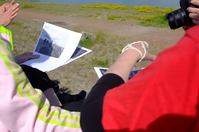
This exposition presents parts of a practice-based artistic research project, Acts of Transfer, a collaboration between artist Katy Beinart and writer Lizzie Lloyd (2020–2021). The project consists of a series of ‘chapters’ which revisit artworks from the recent past that involved social engagement or public participation, documenting both the process and outcomes of our returns. Acts of Transfer was interested in what the afterlife of such artworks might be and how they might be meaningfully represented in the future.
Each return or ‘chapter’ generates new artwork, while retaining some sense of the original. They include a range of outcomes: excerpts (screenshots, photographs, readings, instructions etc.) from the original artworks made by our participants, as well as our own documentation through photography, drawings, and notes taken during our returns, alongside passages of experimental writing and films.
In presenting parts of this project in Acts of Transfer: Documentation as Creative Reimagining, we further explore how documentation might serve as a means to reenact and reimagine the artworks to which we returned. In each case, we consider how aesthetic, emotional, physical, psychological or conceptual transfer might signify to those involved and to future audiences. We expose the complicated relationships that underlie practices that rely on participation, and highlight how meaning develops beyond the immediate duration of such projects. What follows renders these complications tangible, leading to new artworks that are intentionally emergent and fragmented. We look to evoke the effervescent experience of participating, remembering and communicating experiences of social, relational and durational artwork, to hold fast to what is lost and what might be reimagined.
11 UNDERGROUND: Reenactment, Social Practice and Political Intervention
(2025)
author(s): Arturo Delgado Pereira
published in: RUUKKU - Studies in Artistic Research
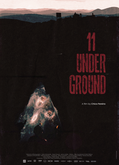
This exposition centres around the fieldwork and shooting process of my documentary feature film, 11 Underground (Chico Pereira, 2024). 11 Underground is a reenactment film project based on a mining strike that happened in Almadén in the summer of 1984, in which 11 miners locked themselves in at 650 meters underground to protest their precarious working and social conditions. After 11 days of enduring the dark and toxic underground galleries, the Almadén Mining Company finally accepted the miners’ claims and the miners came out of the dark hole, received as heroes by their neighbours. As a local filmmaker belonging to the first non-mining generation in over 2000 years, I thought of the premise of making a reenactment film in town: what if 11 people locked-in in the underground mine for 11 days now to pay homage to the 1984 strike? Out of this rather strange proposition there was a desire to create an event -partly social, partly artistic-, that could help to collectively reflect -or re-imagine- our present by reenacting a collective action from the past.
On the one hand, 11 Underground can be presented as a loose reenactment that reproduces the form and duration of a past strike: 11 people confined inside a mine for 11 whole days. On the other hand, the speculative character of this what if scenario (what would happen if..), opens these 11 days to the unexpected, to new actions and directions that might emerge from the implementation of that speculative scenario into the town’s present reality. The intrinsic relation of reenactment with the past, together with the future-oriented nature of what if scenarios -as ways of engaging creatively with possibilities- are, in fact, representative and metaphorical of the current situation of Almadén, which tries to construct a future from the remains of the mining past, while deeply struggling with the negative consequences of the lack of structural plans after the end of mining. Overall, the way this artistic research approaches reenactment is by using the historical referent (i.e. the past mining strike) as a documentary scenario and performing it in the current socio-political conditions, opening the possibility to intervene in the present and collectively imagine possibilities for a better future.
TiO2: The Materiality of White Research Project
(2025)
author(s): Marte Johnslien
published in: Research Catalogue
The artistic research project TiO₂: The Materiality of White (MoW) is led by Associate Professor Marte Johnslien, Department of Art and Craft, Oslo National Academy of the Arts. The project builds on her PhD project White to Earth, completed at the same department in 2020. MoW is funded by the Norwegian Directorate for Higher Education and Skills (HK-dir) through the Programme for Artistic Research for the period 2022–2026.
Foot Baths for All
(2025)
author(s): Julia Weber, Mayumi Arai
published in: Research Catalogue
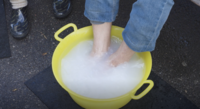
The artistic intervention "Foot Baths for All" (2024) emerged from an ethnographic exploration of collective forms of life on wastelands in Switzerland. Ethnographic insights regarding self-organized care, occupation, informal infrastructure, gift economies, and the shared use of water and electricity were fictionalized and recontextualized in the inner city of Zurich, in order to explore new forms of appropriation and participation in urban life.
This exposition aims to share the results and experiences of this research through multiple formats: a video documentation, a how-to guide, and a text that offers insights into the ethnographic research and its translation into an artistic intervention, conceptualizing "Foot Bath Urbanism" as an artistic method for city-making from below.
This project is situated in the field of artistic urban research. It is based on an expanded notion of art that moves beyond institutional contexts to intervene directly in public urban spaces through installations and performative practices, following approaches such as “New Genre Public Art”. The how-to guide is connected to instruction-based art, challenging conventional notions of authorship while emphasizing accessibility, participation, and interactivity, rooted in the conceptual art of the 1960s and 1970s, including the Fluxus movement.
TEXT FORMAT The Hijacked Dream in Arts-Based Research: A Work of Surrealist Criticism
(2025)
author(s): Fey (Faith) Harkey, Cassie Fielding
published in: Research Catalogue
Mention of a surrealist form of criticism comes to us through Breton and Polizzotti, but we have little in the way of criteria or techniques for developing and identifying such critiques. This article, then, begins with the inquiry, what is surrealist criticism—or what might it be? The authors then introduce the focus of their own surrealist critique, the research methodology known as arts-based research (ABR). Over the course of their examination, Fielding and Harkey suggest that an egoic, or will-driven, approach to arts-based research must ultimately fail, in that it both denies the spirit of artmaking and disregards autonomy of figures in psyche. Blending academic and surrealist prose, fiction and poetry, the authors explore ways the ABR methodology can fail to serve either art or research. Still, Jungian thought, as well as the surrealist approach, may offer tools to inform an ABR that supports art, psyche, and research. In exploring the personal complex and the collective unconscious, particularly, Harkey and Fielding offer a window on all that can be lost—or gained—when the life of psyche is considered in an arts-based methodology.

between the minutes
(2025)
author(s): Ina Thomann
published in: HUB - Journal of Research in Art, Design and Society
This essay examines the subjective perception of time during the performance of long musical forms from the perspective of the performer. The starting point is the composition "Haltezeit", which works specifically with the stretching of time. Two improvisational performances without an audience will be used to explore how the perception of time changes in the course of performances lasting several hours and how this influences improvisational behavior. Practical experience is combined with concepts from the fields of philosophy, performance studies and musical improvisation research. The artistic experiments show that physical states such as tiredness or tension as well as external disturbances significantly influence the subjective perception of duration. While inner restlessness led to an extended experience of time and more frequent improvisational interventions, calmness and concentration favored a condensed, meditative experience of time with less frequent changes.
Artistic practice thus becomes an experiential space for a qualitative perception of time beyond measurable structures. The essay sees itself as an open research gesture that invites us to perceive time more consciously as a flowing continuum in a performative context.