Terrania
(2023)
author(s): Nat Grant, Nicky Stott
published in: RUUKKU - Studies in Artistic Research
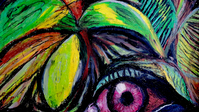
Terrania is a gothic eco-drama podcast project exploring gender-queer and disability themes in the face of climate catastrophe. This project draws on contemporary environmental realities to explore how (dis)abled, genderqueer bodies might be reimagined in dystopian and utopian futurity narratives.
Stitching for Material Sensitivity: From Traditional to Activist Embroidery
(2023)
author(s): Fabiola Hernandez Cervantes, Maria Huhmarniemi
published in: RUUKKU - Studies in Artistic Research
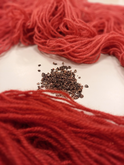
Cochineal is an insect that has been used for textile dyeing since pre-Hispanic cultures in Mexico. This exposition discusses the use of the cochineal insect as a natural dye for wool and the bridge between ancient indigenous knowledge and contemporary artistic research. A transatlantic connection is created between the Mexican plateau and the Arctic region, merging traditional knowledge, contemporary art, crafting and conceptualisation through an artistic embroidery initiative involving researchers, craft artists and human rights activists living in the province of Lapland in Finland. Documentary photos of artistic practice and research diaries enhance discussion on sustainability, tradition, craftivism, decolonisation and indigenous knowledge. This exposition embraces collaborative craftivism through a group initiative called Embroidered Stances, discussions about material interconnectedness in a web-of-life conceptual structure that includes sheep wool, cactus, cochineal and ancestral knowledge. The endorsement of material sensitivity is narrated into embroideries by the first author Cervantes and discussed, acknowledging complexities within issues of cultural and ecological sustainability.
Life Between Art and Blood
(2023)
author(s): Heidi Pietarinen, Amna Qureshi
published in: RUUKKU - Studies in Artistic Research
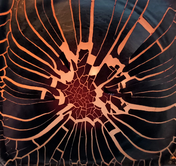
Artist-researchers Heidi Pietarinen and Amna Qureshi from the University of Lapland have conducted in-depth work on the innovative BioARTech laboratory environment and utilisation of available resources for a bioart project called Life Between Art and (Reindeer) Blood. The aim and focus of the project were to utilise reindeer blood as a reindeer herding by-material instead of treating it as waste material. Both artist-researchers were curious to see how nature as a living design medium becomes perceptible to humans. In this study, a living design medium refers to material production that incorporates simple living organisms such as reindeer blood, material-driven design and co-designing, with an entity having its own agency. Bioart can be used to develop innovative design and art practice to work with nature (biology) and the non-human, such as live tissues (i.e. materials engineered by nature itself), microbes or living organisms (birds, insects, trees and blood), to bring about new design solutions and life processes. Through the arts-based research (ABR) approach, this ground-breaking research aims to develop activities that integrate environmental biotechnology, bioart, surface pattern design, and science.
Challenging animal-based food systems: Citizen Surgery on vegan body simulators
(2023)
author(s): Kaisu Koski
published in: RUUKKU - Studies in Artistic Research
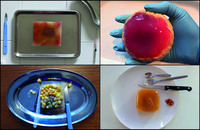
This article discusses the voices of resistance emerging in the work of the Citizen Surgery Collective, an interdisciplinary practice-based research group I initiated in 2020. The collective consists of artists, critical posthumanists, anthropologists, and activists in the UK and the Netherlands. The collaborative work included in this exposition concerns the relationship between (non)human animal bodies and food, specifically through surgical simulation and sensory skills acquisition. These practices are geared toward multispecies justice, and they form a serial inquiry into ways of challenging animal-based food systems and meat-related cognitive dissonance. Reversely, they investigate ways to train surgical skills with food and by eating instead of using live or dead animal models. Our collective practices re-enact surgical choreographies and dialogue to analyze both the materiality and connotations of the food/body intersection and the process of dissolving interspecies boundaries by eating.
Light from aside: A screenwriter’s perspective in virtual reality
(2023)
author(s): Cecilie Levy
published in: University of Inland Norway
This PhD project in artistic research by Cecilie Levy investigates the language of spatial storytelling in virtual reality through artistic research. Drawing on screenwriting practice and theory, as well as creative documentary approaches such as room-scale virtual reality design, the conceptualisation and partial production of the experience Finding Frida is central to this investigation. In its final form, this single-user, room-scale virtual reality experience will be approximately 20 minutes long; it is intended for general audiences, including those who are unfamiliar with virtual reality.
Beyond the reconstruction of a personal narrative – that of forgotten artist Frida Hansen’s life and art – the experience seeks to combine linear storytelling devices with spatial ‘dreamscapes’, giving the spectator access to the protagonist’s private memory world, through representational spaces.
A vertical slice from the VR experience was presented publicly at The Norwegian Film School and at Qvisten XTND in Oslo, June 2023. The vertical slice is a test-scene in VR that will serve as an illustration for the virtual reality concept, giving an impression of transitions, interactivity, and spatial storytelling. The test can be viewed individually in the VR Lab at the NFS (Norwegian Film School) in Oslo and lasts approximately seven minutes per viewer.
An essay, available at this page, presents the conceptual and creative groundwork for the work-in-progress storytelling in Finding Frida. The essay also seeks to convey insights from a writer’s point of view of the hurdles and challenges of transitioning from temporal to spatial storytelling in virtual reality – and the aligning of narrational and stylistic choices in an experiential, technically complex and innovative form. An appendix provides samples from the script at different stages of development.
Electrifying Opera, Amplifying Agency. Artistic results. reflection and public presentations (PhD)
(2023)
author(s): Kristin Norderval
published in: Research Catalogue
Exposition of PhD research for PhD fellow at the Oslo National Academy of the Arts, Academy of Opera, Kristin Norderval.
This artistic research project examines the artistic, technical, and pedagogical challenges of developing a performer-controlled interactive technology for real-time vocal processing of the operatic voice. As a classically trained singer-composer, I have explored ways to merge the compositional aspects of transforming electronic sound with the performative aspects of embodied singing.
I set out to design, develop, and test a prototype for an interactive vocal processing system using sampling and audio processing methods. The aim was to foreground and accommodate an unamplified operatic voice interacting with the room's acoustics and the extended disembodied voices of the same performer. The iterative prototyping explored the
performer's relationship to the acoustic space, the relationship between the embodied acoustic voice and disembodied processed voice(s), and the relationship to memory and time.
One of the core challenges was to design a system that would accommodate mobility and allow interaction based on auditory and haptic cues rather than visual. In other words, a system allowing the singer to control their sonic output without standing behind a laptop. I wished to highlight and amplify the performer's agency with a system that would enable nuanced and variable vocal processing, be robust, teachable, and suitable for use in various settings: solo performances, various types and sizes of ensembles, and opera. This entailed mediating different needs, training, and working methods of both electronic music and opera practitioners.
One key finding was that even simple audio processing could achieve complex musical results. The audio processes used were primarily combinations of feedback and delay lines. However, performers could get complex musical results quickly through continuous gestural control and the ability to route signals to four channels. This complexity sometimes led to surprising results, eliciting improvisatory responses also from singers without musical improvisation experience.
The project has resulted in numerous vocal solo, chamber, and operatic performances in Norway, the Netherlands, Belgium, and the United States. The research contributes to developing emerging technologies for live electronic vocal processing in opera, developing the improvisational performance skills needed to engage with those technologies, and exploring alternatives for sound diffusion conducive to working with unamplified operatic voices.