Choreokratic Ecologies - An Archive of the Murmurations Project
(2026)
author(s): Carlos Eduardo de Carvalho Mello
published in: Research Catalogue
This exposition is an archival gesture emerging from the Dramaturgical Ecologies research-creation collective. Rooted in the entwined inquiries of Blacknesses and Dramaturgy, it gathers the dialogues, encounters and an artistic residency that unfolded through the SSHRC-funded Murmurations project. Between the viscous resonance of okra and the shifting flight of murmuring birds, this exposition shares choreokratic ecologies - a garden of study where movement, thought, and relation co-compose. Here, Blackness becomes a method, a lens, a refrain, challenging the neutrality of the performer-dancer body and inviting modes of collective creation that are relational, porous, and opaque. Murmurations attends to what forms in the formless - like a swarm of birds: a living archive of bodies, voices, and ecologies composing a landscape.
Costume Dramaturgies
(2026)
author(s): Christina Fossaas Lindgren, Charlotte Østergaard
published in: Stockholm University of the Arts (SKH)
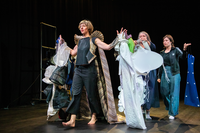
With the artistic research project Costume Dramaturgies we explore the dramaturgy that emerges when performance takes an unconventional starting point: a costume – a thing. By approaching dramaturgy as an assembly of things, we shift perspective from the human to the non-human, giving agency to costume, props, and light in performance. We argue that the dramaturgy of things remains an under-researched area in the performing arts.
The one-year project is funded by Stockholm University of the Arts and brings together 12 researchers from costume design, dramaturgy, mime acting, LARP, film direction, theatre studies, scenography, and performance art. This multi-perspective, poly-vocal approach aims to generate a nuanced understanding of dramaturgy of things, and includes workshops based on devising methods—most notably the Costume Jam Session, where participants interact with costumes through chains of action, followed by reflection on the dramaturgy that emerges. The project is a continuation of the artistic research project Costume Agency.

The Opener - sharing the performer’s process
(2026)
author(s): Einar Røttingen
published in: Faculty of Fine Art, Music and Design, University of Bergen
The Opener - sharing the performer’s process was a one-year artistic research pilot project (March 2024 - March 2025) funded by strategic funds at the Faculty of Fine Arts, Music and Design, University of Bergen. It was part of the Grieg Academy Research Group for Performance and Interpretation (GAFFI) together with external members from The Academy of Performing Arts in Bratislava. The project consisted of 8 sub-projects and educational activities, involving different instruments: piano solo, violin, duos with voice and piano, clarinet, accordion and guitar.
The term opener can in this project proposal symbolize a three-fold meaning connected to the music performance field. This project seeks to
- see the performer as an opener of musical meaning in a performance (interpretation of musical intentions in scores and improvisation)
- challenge ourselves as performers as openers that share his/her artistic work (getting insight into the creative process and methods)
- finding openers as tools to reveal and show the creative process of performers (ways of showing the artistic process)
THIS IS IT
(2026)
author(s): Federico Federici
published in: Research Catalogue
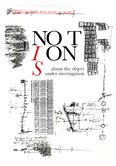
“Objects under investigation” is a collection of separately conceived works addressing the problem of the text as medium and, more broadly, mediality in art from an experimental perspective. The term object[s] functions as a neuter reference to the text both as a phenomenon and as a product in itself. It evokes the idea of something that can be physically handled, without implying a necessarily physical object.
Home page JSS
(2026)
author(s): Journal of Sonic Studies
published in: Journal of Sonic Studies
Home page of the Journal of Sonic Studies

Safe Ocean: Artistic and Autoethnographic Explorations of Music and Sound as Vessels for Finnish Kosovar Second-Generation Identity
(2026)
author(s): Merve Abdurrahmani
published in: Research Catalogue
Abstract
This study investigates the role of music and sound in shaping a sense of identity among second-generation immigrants in Finland, with a particular focus on Finnish Kosovar experiences. As Finland moves from a historically homogeneous society toward a more multicultural landscape, understanding how musical engagement influences identity formation becomes increasingly significant. Through autoethnographic reflection and artistic practice, this research explores how listening, performing, and creating music mediate the negotiation of cultural heritage, integration, and hybrid identities among individuals navigating multiple cultural worlds.
Central to this exploration is the master concert Safe Ocean, which serves as both a personal and academic articulation of the study’s core themes. The concert integrates multilingual expression, traditional Albanian and Turkish musical materials, and hybrid compositional methods that also incorporate Nordic musical elements such as modal melodies, open-voiced harmonies, and timbral aesthetics characteristic of the region’s contemporary folk and art music practices. By combining solo, small-group, and full-ensemble arrangements, the project presents both intimate and collective expressions, engaging instruments and musical influences from Kosovar Albanian, Turkish, Nordic, and Middle Eastern traditions.
Through the interweaving of autoethnographic insight, artistic creation, and scholarly inquiry, this study demonstrates how music evokes memory, supports emotional processing, and supports dialogue between multiple cultural worlds. Findings indicate that engagement with sound and musical practice contributes not only to personal identity formation but also to the creation of social belonging and spaces for intercultural dialogue. This research contributes to broader discussions on music, diaspora, and identity, offering insight into how artistic practices can mediate complex cultural experiences and support the integration of second-generation immigrants within multicultural societies.