Why journalists need a carrier bag, not a spear
(2026)
author(s): Tanja K. Hess
published in: Research Catalogue
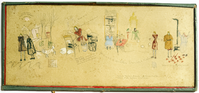
Journalistic storytelling should move away from the hero narrative. Instead, drawing on Ursula K. Le Guin’s Carrier Bag Theory, it should adopt a “carrier-bag” perspective: to gather, carry, and connect—collecting attentively, bringing home what matters, and linking insights through pencil-based drawing. Drawing becomes a journalistic method for deepened research. Through the nouvelle histoire (Annales School, longue durée) and the sculptural contrast between Rodin (monumental condensation) and Medardo Rosso (fragile appearance), the text shows how attention to everyday life, materiality, and in-between spaces generated new forms of relevance and helped initiate social shifts. Drawing is proposed as a research practice that makes complexity visible, marks uncertainty, and enables more peaceful, context-rich modes of storytelling in newsrooms and teaching.
From Interpretation to Collaborative Creation - Reframing the Performer’s Autonomy in Mixed Music for Cello and Live-Electronics
(2026)
author(s): Pedro do Carmo
published in: Codarts
This research investigates the performer’s role and autonomy in the interpretation and creation of mixed music with live electronics. The project begins with a multi-layered study of the interpretive process of Près (1992) by Kaija Saariaho — from the technical and expressive demands of the cello part, to the development of sensitivity toward the electronic transformations, and the testing of different performative configurations — and evolves toward the co-creation of a new work, Wolves and Wires (2025), in collaboration with composer Marta Domingues. In this later phase, the performer actively experiments with the relationship between gesture, sound, and the expressive and technical requirements of the electronic system.
This artistic trajectory, developed across three research cycles, moves from interpretative inquiry to creative authorship. The first two cycles focus on the cellist’s practice strategies and technical awareness of real-time electronics, while the third introduces a collaborative process in which the performer contributes to the design of the electronic material, spatial configurations, and control systems.
A defining outcome of this process is the physical repositioning of the performer within the quadraphonic field. In contrast to Près, where the performer remains outside the spatial projection, this immersive setup enables full auditory feedback and real-time interaction with the electronics. Spatial integration becomes a condition for performative autonomy, dissolving the separation between acoustic gesture and electronic transformation and allowing the performer to act as a unified sonic agent.
The research reveals that autonomy in mixed music does not arise solely from technological control, but from a situated, embodied relationship with space, instrument, and system. These outcomes contribute to broader reflections on performer agency and offer concrete insights for practice, suggesting new models for collaborative and transdisciplinary creation in mixed music contexts.
Being Free, Together: Instant Composition in a Contemporary Multi-Instrumentalist Context
(2026)
author(s): Koen Joseph Gijsman
published in: Codarts
This research investigates strategies for free improvisation, or “instant composition,” from the 1960s onwards. Instant composition is defined in this research as “working with concepts, structures, and limitations that stimulate interplay, coherence, and creativity in free improvisational contexts.” The research aim is to reemploy these strategies and find how they need to be adjusted to fit the contemporary jazz practice I share with Epoxy Quartet. Based on interviews, literature review, and practice-based experimentation, this research aims to develop exercises, instructions, or methods to co-create and co-evaluate expressive improvised performances. Although the strategies our quartet employs are rooted in an existing tradition of free improvisation – often atonal and cerebral music – we hold the artistic ambition to develop a musical idiom that is more lyrical and accessible. Therefore, the intended outcome of this research is a unique performance practice situated in the interstices between improvisation and composition, supported by well-developed methods to co-create and co-evaluate expressive improvised performances.
Non è il gelato ad essere consumato ma chi lo vende.
(2026)
author(s): Alessandra Debernardi
published in: Research Catalogue
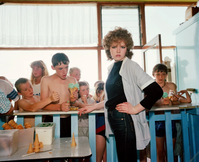
Questa esposizione fa parte di un progetto di ricerca artistica più ampio, articolato in diverse declinazioni.
Il focus presentato si concentra su un’indagine specifica della violenza attraverso il dispositivo dell’auto-conferenza, intesa come pratica performativa e riflessiva.
La ricerca prende avvio dalle conferenze autofinzionali di Sergio Blanco, in particolare dalla sua elaborazione della violenza come costruzione narrativa, e si sviluppa attraverso la rielaborazione di un’esperienza personale di violenza subita. In questo contesto, l’autofinzione diventa uno strumento metodologico capace di mettere in relazione l’esperienza vissuta, il discorso teorico e la rappresentazione.
L’auto-conferenza viene quindi intesa come una vera e propria metodologia di ricerca artistica: uno spazio in cui l’esperienza personale si intreccia con riferimenti teorici e visivi, generando una riflessione critica sulla rappresentazione della violenza e sulle possibilità del racconto di sé come pratica di conoscenza. L’elemento autobiografico, sempre in bilico tra attendibilità e finzione, diventa così il punto di partenza per una riflessione che supera l’io dell’autore e si apre a una dimensione collettiva, coinvolgendo lettori e spettatori.

Paths of Artistic Research
(2026)
author(s): Silvia Diveky, Monika Šimková
connected to: Janáček Academy of Performing Arts (JAMU)
published in: Research Catalogue
Interviews about where artistic research is heading
The work Paths of artistic research is a collection of interviews with artistic researchers - Andrea Buršová, assistant professor at the Nika Brettschneiderová Dramatic Acting Department, Faculty of Drama, JAMU, Jiří Honzírek, director, manager of the Feste Theatre and PhD student at the Theatre Faculty, JAMU, Barbora Klímová, head of the Studio of Environmental Design at the FFA BUT, Lenka Klodová, head of the Studio of Body Design at the FFA BUT, Lucia Repašská, researcher at the Cabinet for Theatre and Drama Research, Theatre Faculty, JAMU, Hana Slavíková, head of the Studio of Radio and Television Dramaturgy and Scriptwriting, Theatre Faculty, JAMU, Pavel Sterec, artist and former head of the Intermedia Studio at the FFA, BUT, and Lenka Veselová, researcher at the Department of Theory and History of Art at the FFA, BUT and PhD student at the FFA, BUT. These are artists who have been associated with art colleges in Brno, specifically with the Faculty of Fine Arts of the BUT and the Theatre Faculty of the JAMU. Through interviews with the artists, the reader will learn under what circumstances they began to engage in artistic research, how they perceive it, what meanings they attribute to it and the purpose it serves for them. The selected group of artists is very diverse and their creative and research strategies are different, as are the purposes for which they use artistic research. The work does not aim to provide an exhaustive overview of the methods used in artistic research, but it does aim to show that there are many approaches to artistic research and to present the paths that have brought particular artists to artistic research.
Berlin, lava fields, rebellion, street life
(2026)
author(s): Ilpo Jauhiainen
published in: Research Catalogue
This essay examines the challenges of generative AI in composing ‘new’ music. The focus is on the commercial generative AI applications (i.e. AI music generators) due to their prominence in the mainstream cultural and technological discourse. The essay adopts a philosophical rather than a technological approach, situating the use of generative AI in music within a broader societal, cultural, and environmental context. If AI and music (understood as normative practices) are majoritarian, molar, and arborescent entities, then the approach taken here is Deleuzian: minoritarian, molecular, and rhizomatic. By engaging with their fault lines, disassembling and reassembling their structures, and connecting them to the wider world, the essay presents an alternative way of thinking about AI and music – and AI in music – and proposes one such possible application.