RUUKKU - Studies in Artistic Research
Re-Imagining
This issue addresses the various gestures of going back, returning to take another look, or starting anew. It suggests that research in the context of artistic and creative practice could have a special relation to time; simultaneously attaching itself to a prior moment in time and, from there, propelling imagination to unforeseen futures. The theme "Re-imagining" proposes reassessments where the evaluation of past events, integral to research, is in unison with the anticipation potential, integral to the arts. It wonders about new conceptions of an idea, place, space, object, and ways of doing and making that emerge from a reverse glance — the challenges, updates, and improvements.
Acts of Transfer: Documentation as Creative Reimagining.
(2025)
Katy Beinart, Lizzie Lloyd
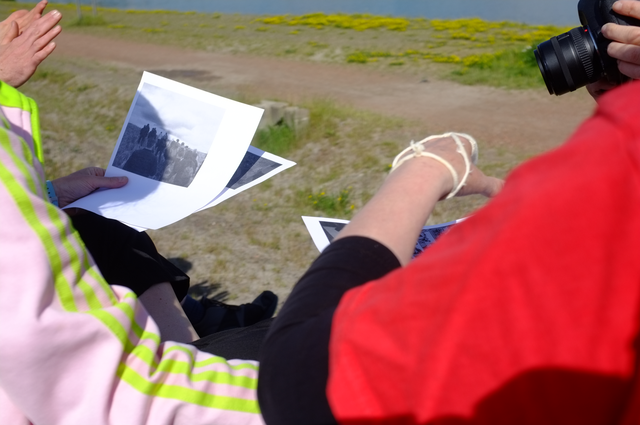
This exposition presents parts of a practice-based artistic research project, Acts of Transfer, a collaboration between artist Katy Beinart and writer Lizzie Lloyd (2020–2021). The project consists of a series of ‘chapters’ which revisit artworks from the recent past that involved social engagement or public participation, documenting both the process and outcomes of our returns. Acts of Transfer was interested in what the afterlife of such artworks might be and how they might be meaningfully represented in the future.
Each return or ‘chapter’ generates new artwork, while retaining some sense of the original. They include a range of outcomes: excerpts (screenshots, photographs, readings, instructions etc.) from the original artworks made by our participants, as well as our own documentation through photography, drawings, and notes taken during our returns, alongside passages of experimental writing and films.
In presenting parts of this project in Acts of Transfer: Documentation as Creative Reimagining, we further explore how documentation might serve as a means to reenact and reimagine the artworks to which we returned. In each case, we consider how aesthetic, emotional, physical, psychological or conceptual transfer might signify to those involved and to future audiences. We expose the complicated relationships that underlie practices that rely on participation, and highlight how meaning develops beyond the immediate duration of such projects. What follows renders these complications tangible, leading to new artworks that are intentionally emergent and fragmented. We look to evoke the effervescent experience of participating, remembering and communicating experiences of social, relational and durational artwork, to hold fast to what is lost and what might be reimagined.
Troubling the Ideal Landscape A Visual Narrative
(2025)
Ilaria Biotti
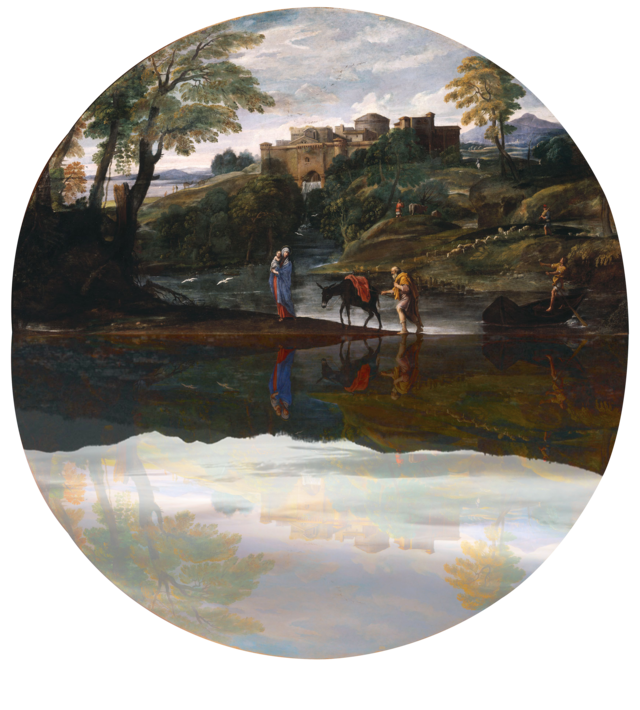
Troubling the Ideal Landscape – A Visual Narrative critically examines possible intersections between imagination and physical landscape. Through a practice-based approach, this exposition explores the composition and decomposition of ideal landscapes, with a focus on Cannero Riviera, a small Italian village. Grounded in my doctoral research at PhDArts, a collaboration between ACPA, Leiden University, and the Royal Academy of Art in The Hague, the project employs spatial montage as both a methodological tool and an artistic outcome.
By fragmenting the landscape into moving images, I seek to disrupt conventional visual regimes and reflect on the ideological forces shaping the village and its environment. This approach is informed by Aby Warburg's Mnemosyne Atlas, where fragmented images form unstable constellations that navigate multiple meanings, temporalities, and spaces. Engaging with Warburg’s method, I question crystallised, linear visualisations of the ideal, focusing on dynamic processes of spatial composition.
The exposition aims to reframe landscape imagery not as a passive backdrop, but as an active force. It proposes a model of the ideal landscape that resists linearity, embracing a complex, shifting narrative that questions the visual regimes through which contemporary imaginaries of place are constructed.
CHARMS — re-imagining the body in motion: the embodied armoured flesh and the biomechanics research lab
(2025)
MARIANA Barrote
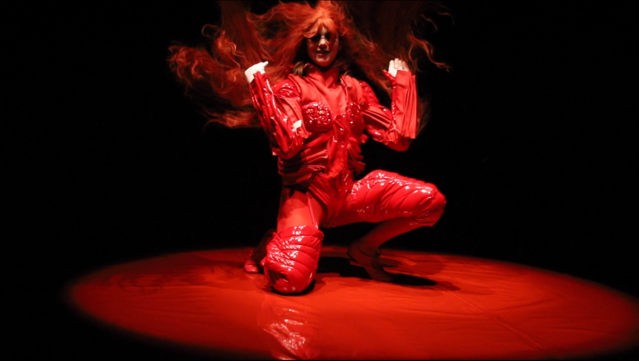
In this study I elaborate on how Charms unfolds as a plastic experimentation rooted in an initial vision of the body. It is grounded in a reimagined body image, constructed from other imagined bodies, such as the anatomical flayed figure and protective devices. This study explores the notion of the body turned upside down —both literally and conceptually — reconfigured through an armor-like structure in which flesh paradoxically assumes the role of an external layer. The resulting image is of a body that is both armored and exposed, charged with contradictions that disrupt binary oppositions such as inside/outside, alive/dead, human/animal, and powerful/fragile. This hyperbolic Charms, constructed from two distinct costumes, is offered for visual contemplation, recurring within contemporary visual culture as a manifestation of the scientific body still subjected by imagination and visceral sensation. The work, a multichannel video installation, also investigates the body’s capacity to generate imaginaries through movement, employing measurement tools from the biomechanics research laboratory to visualize this dynamic relationship.
Re-imagining Berio’s Sequenza I for flute solo: Challenging musical interpretation through storytelling and rhetoric models
(2025)
Ann Elkjär
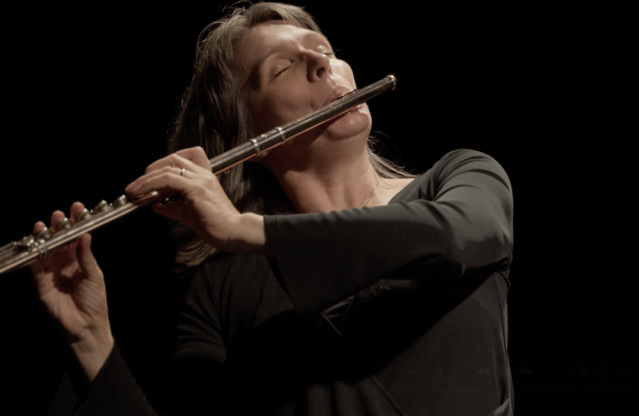
Among classical musicians, there is a tendency to define our profession more by craftsmanship than artistry. In our artworld, we often focus on reproducing: A musical performer becomes a transparent medium for the composer’s supposed intentions (Leech-Wilkinson, 2020, chapter 6). How can we reclaim agency and liberty in the process of shaping music? In this exposition, a storytelling approach is applied to the performance interpretation of Luciano Berio's classic flute solo Sequenza I from 1958, with the aim of becoming a more daring interpreter. The storytelling in focus was recorded in the 1950s, echoing even older times. However, in my explorations, the archival storytelling serves as a tool for reimagining a musical score and creating something new.
Betwixt and Between
(2025)
Max Spielmann, Daniel Hug, Catherine Walthard, Andrea Iten
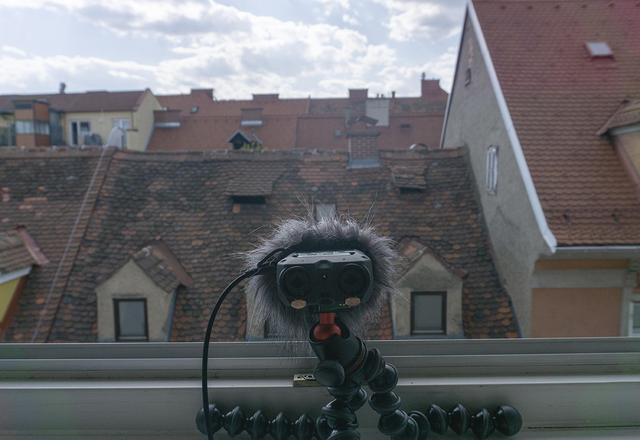
At the beginning of the COVID-19 pandemic in 2020, we, in our role as lecturers, conducted hybrid workshops with design and art students from ten partner institutions on five continents. Our goal was to explore soundscapes from different viewpoints, and we were deeply impressed by the outcome. The recordings and their accompanying images and conversations dissolved geographical borders along with social, cultural, and structural differences. Following Hartmut Rosa, we understand this atmosphere of connection produced between the participants and the soundscapes themselves to be a resonance space, which only became explicit to us after some time had passed. In this article, we re-interpret this space through personal recollections and theoretical positions, and claim that such a collaboration holds pedagogical and artistic implications for future teaching and creative practice. These include not only the impact upon technology in the classroom, temporal perception, inter-relationality, and care practices, but also the artistic benefits of opening up spaces of resonance as a means of engaging with the challenge of intercultural communication and witnessing in our global world.
dorsal practices [re-turning]
(2025)
Emma Cocker, Katrina Brown
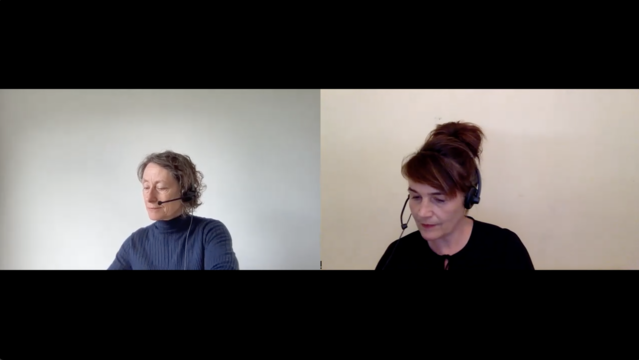
This exposition comprises textual fragments (both written and voiced) produced through the act of returning to (in turn re-activating, re-configuring, even re-imagining) conversational transcripts generated within the artistic research project Dorsal Practices, a collaboration between choreographer Katrina Brown and writer-artist Emma Cocker. Initiated in January 2021, Dorsal Practices is an artistic collaboration for exploring how the cultivation of a back-oriented awareness and attitude might shape and inform our embodied, affective and relational experience of being-in-the-world. Conceived at the threshold between choreographic-movement practices and language-based artistic research, Dorsal Practices explores how the experiences of listening, languaging, even thinking, might be shaped differently through this embodied tilt of awareness and attention towards the back, moreover, through a practice of coming back, the act of (re)turning. The original transcript material that forms the basis of this exposition was produced through a practice of conversation undertaken within six interrelated blocks of exploration, taking place over 18 months between October 2022 and February 2024. Within this period of enquiry, we — Brown and Cocker — focused our attention on the act of returning within our shared practice, re-imagined as a "dorsal turn". Through the intermingling of two registers of language-based practice, that is, through the performativity of both the written and spoken texts themselves, within this exposition we attempt to make tangible how the dorsal gesture of the turn and the circling principle of re- become operative as a spinal thread within our shared enquiry. Deviating from the straightforwardness of a strictly linear text, we invite a form of dorsal listening-reading that might engage through loops and returns. We conceive the research artefacts generated through the practice itself as the central focus within this exposition, alongside a supporting text where we introduce the wider enquiry of Dorsal Practices, reflecting on how we conceive the act of turning and of re-turning therein.
Approcreations - Weight of an Absent Ancestry
(2025)
Maarika Autio
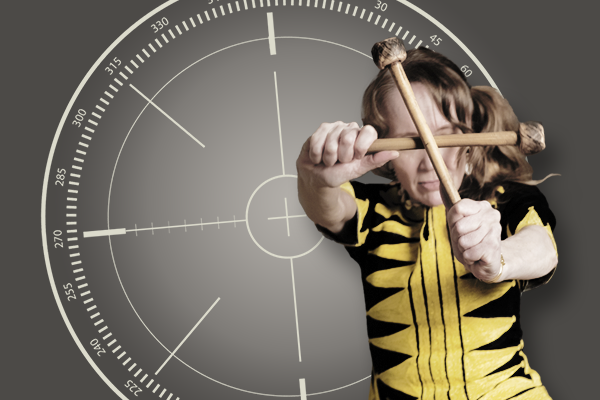
In the globalising world, our cultural influences have become more diversified than ever. At the same time, the code of good conduct on honouring intercultural sources of inspiration is still being written in the collective consciences of artists and audiences alike. The current mindset is being explored in an artistic research project, of which the concert this article focuses on was a component.
“Approcreations”, an experimental solo concert, was atypical in terms of the conventions of the instruments played. The recital trialled the public’s receptiveness by developing pioneering uses for a tradition-oozing instrument while casting thoughts into the perception of artistic identity in the crossfire of preconceptions, aftermaths of colonialism and cultural appropriation disputes. Would the public’s sentiments differ from the performer’s expectations?
The author, having developed a time-tested perspective after decades of international touring as a non-African player of the Mande diatonic balafon, now zeroes in on the factors influencing how we interpret and feel about culturally complex art practices. Sociocultural and symbolic connotations of musical instruments are analysed in light of the affordance theory, and the instruments’ evolution from cultural assets into universal vehicles for human creativity is pondered upon. Video samples from the concert stage concretise words into sounds and colours. The outcome of this artistic component is then inquired based on both self-reflection and audience feedback.
Finally, as the controversy around cultural appropriation vs. inspiration extends beyond music to encompass a broader range of performing arts, the conclusion seeks to identify tendencies in the findings that might benefit art practitioners in other genres as well.
Re-imagining @ourdaysofgold_film: Follower Experience, Polyvocality, and Autofiction
(2025)
Assunta Ruocco, Thisbe Nissen, Genevieve Maynard, Frank Abbott, Phil Nunnally
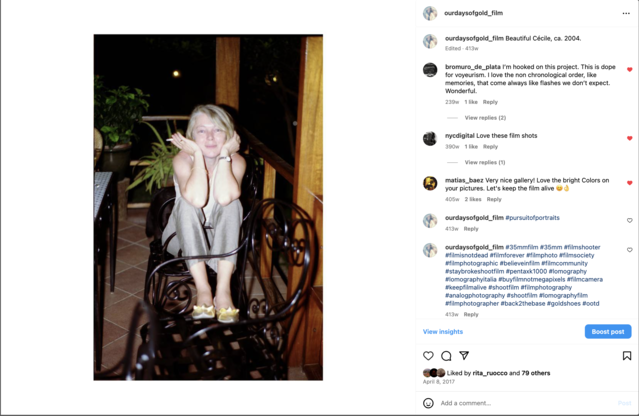
Our Days of Gold (ODOG) is an ongoing, durational artwork staged on Instagram at @ourdaysofgold_film since April 2017. Over its eight-year duration, the work has accumulated new layers of memory and interpretation shaped by followers’ responses, shifting platform aesthetics, and changes to Instagram’s visual logic, including the disappearance of the square grid in January 2025. Alongside creative contributions, the project draws on a survey conducted with long-term followers, tracing how experiences of viewing, remembering, and interpreting the work unfold over time. This co-authored exposition includes videos, screen-recorded navigations, and writing produced by followers whose contributions reveal a form of polyvocality: multiple interpretive threads and associations that remediate the archive while shaping its evolving narrative. Within this distributed process, ODOG engages autofiction not as a singular self-narration but as a collective mode of authorship, emerging through dispersed readings, layered memories, and networked resonances. At the same time, the project foregrounds the precarity of social media archives, where redesigns, algorithmic shifts, and potential platform loss constantly reshape how the work circulates and persists. Drawing on debates around remediation and digital preservation, ODOG tests how meaning, memory, and narrative can be sustained within unstable infrastructures while acknowledging their continual transformation.
Uncovering an Occupational Folklore of Ceramics: Small Stories Found in the Spaces Between Word, Gesture and Clay
(2025)
Natasha Mayo, Kim Norton, Sam Lucas
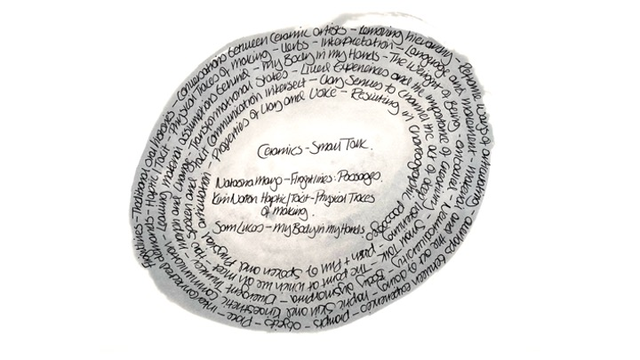
The term ‘Occupational Folklore’ refers to the social expressions of people, linked to the work that they do. This exposition explores the possibility of there being a common language of clay, a vernacular that can be used to story-tell, and how stories arise from the studio, from the intersection of making, thinking/talking and clay.
Comprising three discrete projects, we move from a study of the materiality of voice to establishing a vocabulary of clay to a narrative collection of embodied experiences. Their combined knowledge leads to a fourth project, in the form of conversations held whilst making around a studio table. Passages from the exchange are filmed and analysed from the perspective of ‘small stories’, an oral history methodology that gives focus to the speculative, iterative and nuanced decisions often overlooked in a conventional account of a conversation. When applied to the making process, it begins to uncover a deeper understanding of the processual and implicit decisions that take place through the interaction of making, thinking and material properties. The passages allow us to witness the very emergence of storytelling taking place, the moment at which life experiences intersect with formations in clay.
The aim of collecting all four projects together is not simply to document examples but, as with all modes of folklore, to use story to identify and share more resilient and connected ways of being in the world. Within these intersections lie the porous and mutable properties of clay practice, that are rapidly redefining the wider field of ceramics in terms of its social contribution. Contained within these social expressions of clay lies its ability to connect with and contribute to wider community and environmental issues. The term occupational folklore is used in recognition of the historic continuity of behaviours, actions and beliefs that arise from these interactions, if only we shift our focus from individual attainments to the collective knowledge and transferable learning these small stories contain.
11 UNDERGROUND: Reenactment, Social Practice and Political Intervention
(2025)
Arturo Delgado Pereira
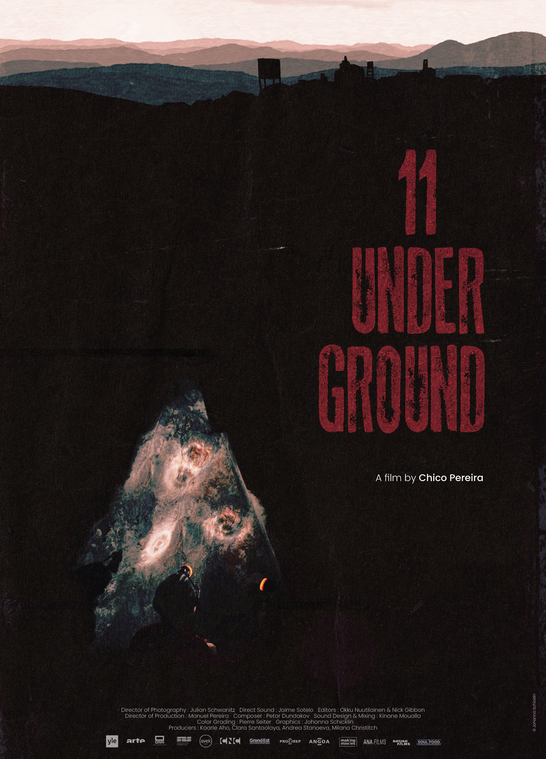
This exposition centres around the fieldwork and shooting process of my documentary feature film, 11 Underground (Chico Pereira, 2024). 11 Underground is a reenactment film project based on a mining strike that happened in Almadén in the summer of 1984, in which 11 miners locked themselves in at 650 meters underground to protest their precarious working and social conditions. After 11 days of enduring the dark and toxic underground galleries, the Almadén Mining Company finally accepted the miners’ claims and the miners came out of the dark hole, received as heroes by their neighbours. As a local filmmaker belonging to the first non-mining generation in over 2000 years, I thought of the premise of making a reenactment film in town: what if 11 people locked-in in the underground mine for 11 days now to pay homage to the 1984 strike? Out of this rather strange proposition there was a desire to create an event -partly social, partly artistic-, that could help to collectively reflect -or re-imagine- our present by reenacting a collective action from the past.
On the one hand, 11 Underground can be presented as a loose reenactment that reproduces the form and duration of a past strike: 11 people confined inside a mine for 11 whole days. On the other hand, the speculative character of this what if scenario (what would happen if..), opens these 11 days to the unexpected, to new actions and directions that might emerge from the implementation of that speculative scenario into the town’s present reality. The intrinsic relation of reenactment with the past, together with the future-oriented nature of what if scenarios -as ways of engaging creatively with possibilities- are, in fact, representative and metaphorical of the current situation of Almadén, which tries to construct a future from the remains of the mining past, while deeply struggling with the negative consequences of the lack of structural plans after the end of mining. Overall, the way this artistic research approaches reenactment is by using the historical referent (i.e. the past mining strike) as a documentary scenario and performing it in the current socio-political conditions, opening the possibility to intervene in the present and collectively imagine possibilities for a better future.
Re-enactment as Research, A monologue
(2025)
Clare Bottomley
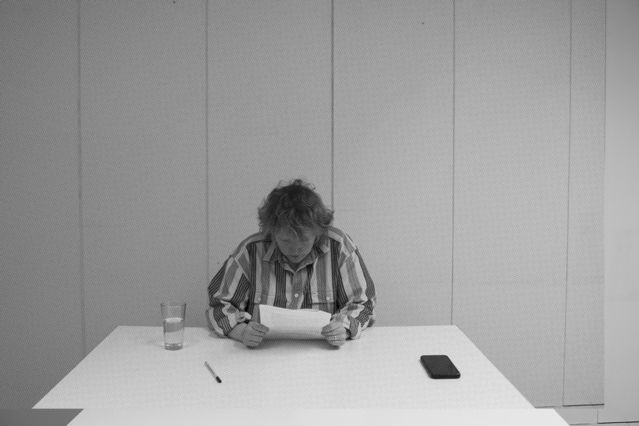
In this half paper, half soliloquy, I aim to propose re-enactment as a research method. Through textual analysis and situated reflections, I will explore the potential of re-enactments in performative returning to destabilize and reconfigure canonical understandings of the past, and consider any implications this understanding of re-enactment can have within research approaches
The Antonioni House: Sensory-Temporal Architecture
(2025)
Peter Spence
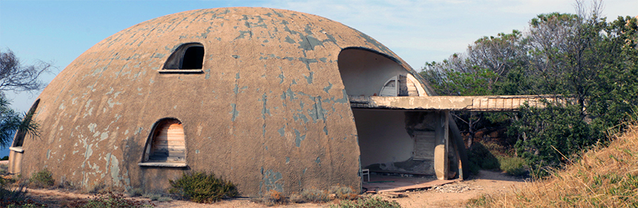
In this paper I propose to re-visit the outcome of a research trip I made a few years ago to the island of Sardinia in order to capture stills and video of a dilapidated villa, La Cupola, once belonging to the Italian filmmaker Michelangelo Antonioni. The research output took the form of an essay video using a film studies methodology to critically re-assess Antonioni’s classic 1960 film L’Avventura. The research took the form of what I would term an occularcentric-cognitive approach whereby my analysis was based primarily on my visual interpretation of the villa. My mental image of La Cupola on first hearing about it was replaced by the online image in my research process, which in turn was replaced by the real image when I arrived at the site, and ultimately by the mediated images of my audio-visual essay. But what wasn’t included in this original research was an unexpected opportunity to enter inside La Cupola, which I retrospectively realised offered an entirely new understanding of the space. With reference to both film and architectural theory, this paper will seek to understand my encounter with the villa according to a primarily sensory and embodied interpretation rather than a sighted one.